Have you ever wondered whether something should be described as spatter or splatter? The two words look and sound similar, and in many everyday situations, people use them almost interchangeably. However, there is a subtle difference in meaning, especially when describing liquids, paint, blood, mud, or other substances scattered into small drops.
Understanding spatter vs splatter becomes particularly useful when you are writing, editing, painting, discussing crime scenes, or simply trying to choose the most precise word. While both terms describe a substance being scattered, they can suggest different amounts, patterns, or degrees of force.
Let’s break down the distinction in simple terms.
Spatter vs Splatter: The Basic Difference
The easiest way to remember the difference is this:
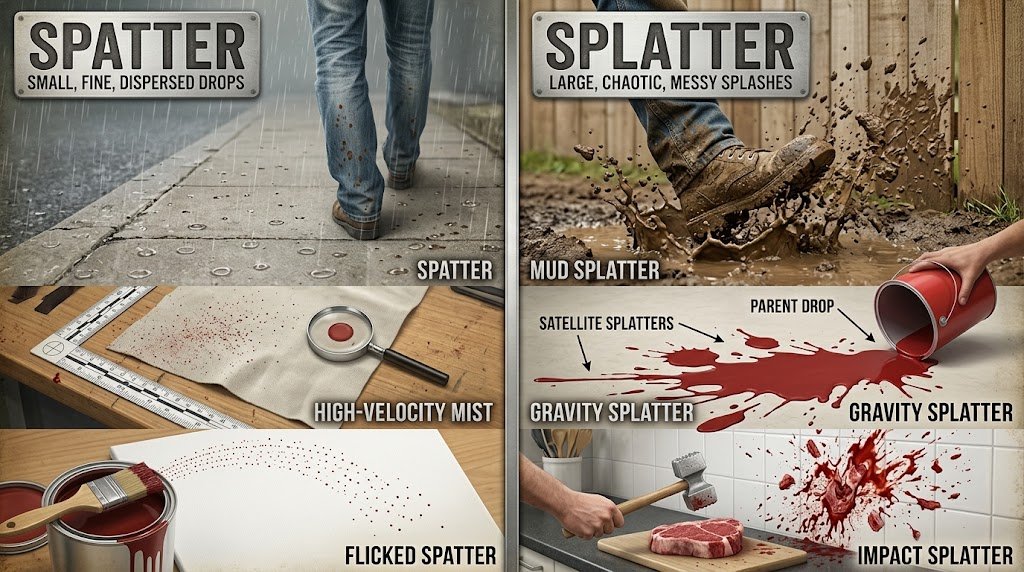
- Spatter usually refers to small drops or particles scattered over a surface.
- Splatter often suggests a larger, messier, or more forceful scattering of a liquid or substance.
For example, if a little water gets scattered onto your clothes, you might say your shirt was spattered with water. If someone throws a bucket of muddy water and it lands everywhere, splattered may sound more natural.
The distinction is not always strict, though. English speakers commonly use the words interchangeably, and dictionaries often give overlapping definitions.
What Does Spatter Mean?
Spatter means to scatter small drops or particles of a substance onto something or across an area.
It can be used as both a verb and a noun.
As a verb:
The artist spattered paint across the canvas.
As a noun:
There were paint spatters on the floor.
The word often brings to mind relatively small droplets distributed across a surface.
Common Examples of Spatter
You might use spatter when talking about:
- Paint droplets
- Water droplets
- Mud
- Grease
- Blood
- Cooking liquids
- Rain
- Small particles
For example:
“The frying oil spattered onto the stove.”
Here, the emphasis is on individual drops being scattered.
What Does Splatter Mean?
Splatter also means to scatter liquid or another substance in drops. However, it often carries a stronger sense of messiness, force, or quantity.
For example:
The car drove through a puddle and splattered mud everywhere.
The image created by splattered is more dramatic than simply saying the car was spattered with mud.
Like spatter, splatter can function as both a noun and a verb.
Common Examples of Splatter
The word splatter frequently appears in descriptions involving:
- Mud
- Paint
- Food
- Water
- Blood
- Grease
- Wet substances
For example:
“The child splattered paint all over the wall.”
This suggests a messy result rather than a few isolated drops.
Spatter vs Splatter in Everyday English
In casual conversation, there is considerable overlap between the two words.
Consider these sentences:
“The wall was spattered with paint.”
This sounds like the wall has small drops or spots of paint on it.
“The wall was splattered with paint.”
This sounds messier and perhaps more extensive.
Both sentences are grammatically correct. The choice depends largely on the image you want to create.
A Simple Memory Trick
Think of spatter as small scattered drops and splatter as a messier spread.
This is not an absolute rule, but it is a useful way to understand the usual difference in tone.
Spatter vs Splatter in Art
Artists use both words when describing painting techniques.
Spatter painting generally involves scattering small drops of paint onto a surface. An artist might load a brush with paint and flick it toward a canvas.
Splatter painting can describe a similar technique but often gives the impression of a more energetic or uncontrolled application.
Jackson Pollock’s action-painting techniques, for instance, are often described using words such as splatter, drip, and splash.
In an art tutorial, you might see instructions such as:
- Dip a stiff brush into diluted paint.
- Hold the brush above the canvas.
- Flick the bristles to create small droplets.
- Repeat with different colours.
The resulting marks can reasonably be called spatters or splatter, depending on the writer’s preferred terminology.
Spatter vs Splatter in Cooking
Both terms are also common in the kitchen.
When hot oil jumps out of a frying pan in tiny drops, spatter is particularly natural:
“The hot oil spattered my hand.”
You could also say:
“The sauce splattered all over the stove.”
The second sentence suggests a larger or messier spread.
This is one reason people often choose splatter when describing a noticeable mess.
Spatter vs Splatter in Crime and Forensic Writing
The distinction can become more important in technical contexts.
Spatter is commonly used in forensic terminology to describe small droplets of blood or another substance distributed onto surfaces. Terms such as bloodstain pattern analysis and blood spatter have historically been widely used.
However, forensic terminology is more precise than simply choosing between two everyday words. The size, shape, distribution, direction, and characteristics of stains can all matter when professionals analyse a scene.
For general writing, therefore, blood spatter is a familiar and established expression.
Splatter can also describe blood scattered across a surface, particularly in fiction, movies, and horror writing. It often has a more graphic or dramatic feel.
Is Spatter More Formal Than Splatter?
Not necessarily.
Both are standard English words. The difference is mainly about meaning, emphasis, and context, rather than one being formally correct and the other being informal.
That said, spatter may sound more neutral or technical in some contexts, while splatter can sound more vivid or dramatic.
Compare:
Neutral:
“The surface was spattered with droplets.”
More vivid:
“Mud splattered across the windshield.”
The second sentence creates a stronger visual impression.
Spatter vs Splatter vs Splash
Another word that sometimes causes confusion is splash.
These words describe related but different actions.
Spatter
Usually involves small drops scattered around.
Example:
“Rain spattered the window.”
Splatter
Often suggests a messy or forceful scattering of drops.
Example:
“Water splattered across the floor.”
Splash
Usually involves a larger amount of liquid moving or scattering, often after impact.
Example:
“The stone fell into the pond and caused a splash.”
The exact boundaries can overlap, but these descriptions give you a useful sense of how native speakers often use the words.
How to Choose the Right Word
When deciding between spatter and splatter, ask yourself what kind of image you want the reader to picture.
Use “spatter” when:
- You are describing small drops.
- The substance is scattered in individual spots.
- You want a neutral description.
- You are writing in a technical or descriptive context.
Use “splatter” when:
- The scattering looks messy.
- The substance is spread with noticeable force.
- You want a more vivid description.
- You are describing a larger or more dramatic mess.
There is no need to overthink the choice in casual writing. In many sentences, either word will communicate the basic idea successfully.
Common Spatter and Splatter Examples
Here are some quick examples to make the distinction clearer:
| Sentence | What it suggests |
| Paint spattered the canvas. | Small drops scattered across it |
| Paint splattered the canvas. | A messier or more energetic spread |
| Mud spattered the trousers. | Small spots of mud appeared |
| Mud splattered across the car. | Mud spread messily over the car |
| Oil spattered from the pan. | Small hot droplets escaped |
| Sauce splattered across the counter. | A messy spread of sauce |
These are tendencies rather than rigid grammar rules.
Why Do Spatter and Splatter Sound So Similar?
There is a good reason these words are easy to confuse: they are closely related in meaning and sound.
Both contain the ending “-atter”, and both describe substances being scattered into drops. The added “l” in splatter contributes to a slightly different sound and, over time, the word has developed a stronger association with mess and force.
English has many pairs of words where a small sound difference produces a slightly different shade of meaning. Spatter and splatter are a good example.
Frequently Asked Questions
Is “spatter” and “splatter” the same thing?
They have very similar meanings, and they can often be used interchangeably. However, spatter tends to suggest smaller scattered drops, while splatter can suggest a messier or more forceful spread.
Is blood spatter or blood splatter correct?
Blood spatter is a widely established term, particularly in forensic and technical contexts. Blood splatter is also used, especially in general and fictional descriptions.
Is paint spatter or paint splatter?
Both are correct. Paint spatter often suggests small droplets, while paint splatter can suggest a more energetic or messy application.
What is the difference between spatter and splash?
Spatter generally involves small drops scattered across an area. A splash usually involves a larger amount of liquid being displaced or thrown, often after an object hits or enters it.
Is splatter a real word?
Yes. Splatter is a standard English word that can function as both a noun and a verb. It describes the scattering of liquid or another substance in drops.
Which word should I use in formal writing?
Choose the word that best matches the situation. Spatter can work well when you want a neutral or precise description, while splatter is useful when the scene is messier, more forceful, or more vivid.
Final Thoughts on Spatter vs Splatter
The easiest way to understand spatter vs splatter is to think about the size, force, and messiness of the scattered substance. Spatter often describes small drops scattered across a surface, while splatter tends to create a stronger image of something spreading messily or with force.
Still, the distinction isn’t absolute. Context matters, and English speakers frequently use both words for similar situations.
When in doubt, focus on the picture you want your sentence to create. If you are describing a few tiny drops, spatter may be the better choice. If you want to emphasise a messy or dramatic spread, splatter may fit more naturally.