Have you ever typed invision or envision and stopped to wonder which one is actually correct? You are not alone. These words look and sound similar, which makes the confusion surprisingly common.
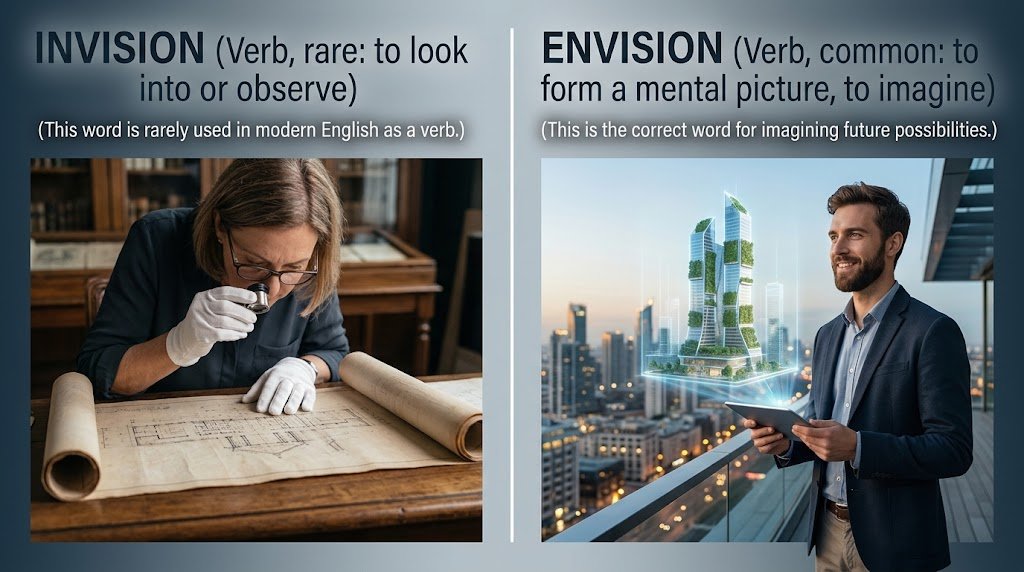
In most situations, envision is the correct English word. It means to imagine or picture something in your mind, especially something that may happen in the future. “Invision,” on the other hand, is generally considered a misspelling when someone intends to use the verb envision.
Understanding the difference is useful if you are writing an email, preparing a report, creating website content, or simply trying to improve your English vocabulary.
Invision or Envision: What Is the Correct Word?
The correct word in standard modern English is envision.
Envision is a verb that means to imagine, picture, or think about something as a possible future reality.
For example:
- I envision a future where people work more flexibly.
- She envisioned a beautiful garden behind the house.
- How do you envision your career developing over the next five years?
In these examples, the word describes the act of forming a mental picture or imagining a situation.
Is “Invision” a Word?
“Invision” is not normally used as the standard spelling of the verb meaning “to imagine.” If you write “invision” when you mean envision, most dictionaries and standard English usage guides will treat it as an error.
There can be exceptions when InVision appears as a proper name or brand name. A proper name can have its own spelling, so it should not be confused with the ordinary English verb envision.
What Does Envision Mean?
Envision means to imagine something clearly in your mind.
It often refers to something that does not exist yet. You might envision a new business, a different career, a future home, or a long-term goal.
The word is especially common when talking about plans and ambitions.
For example:
The company envisions expanding into international markets.
This means the company imagines or plans for a future in which it operates in international markets.
Another example would be:
He envisions himself working abroad within the next few years.
Here, the speaker is imagining a possible future situation.
Envision Meaning in Simple English
If you want a very simple definition, envision means “to imagine or picture something in your mind.”
Some close alternatives include:
- Imagine
- Picture
- Visualise
- Conceive
- Foresee
- Anticipate
However, these words are not always interchangeable. Envision often has a sense of imagining a future situation, idea, plan, or possibility.
How to Use Envision in a Sentence
Using envision is fairly straightforward. It is usually followed by a noun, pronoun, or phrase describing the thing being imagined.
noun
We envision a stronger economy in the coming years.
Envision + -ing verb
She envisions starting her own company.
object + as
They envision the building as a modern community centre.
Envision + yourself
Can you envision yourself living in another country?
These sentence structures are common in professional, academic, and everyday English.
Envision vs Imagine
One reason people may be unsure about envision is that it is closely related to imagine.
Both words can describe creating a picture or idea in your mind. However, envision often sounds more purposeful or future-focused.
Compare these examples:
I imagine a quiet beach.
This could simply describe a mental image.
I envision myself owning a house near the beach.
This suggests a possible future goal or situation.
The distinction is not absolute, but envision is particularly useful when discussing plans, goals, possibilities, and future outcomes.
Envision vs Visualise
Visualise is another close synonym.
To visualise something means to form a mental image of it. In British English, visualise is the usual spelling, while American English commonly uses visualize.
Envision has a slightly broader meaning. You can envision not only a physical scene but also an idea, plan, outcome, or future situation.
For example:
She visualised the finished painting.
But:
She envisioned building a successful art business.
The first sentence focuses more on a mental picture. The second focuses on a future possibility.
Why Do People Write “Invision”?
The confusion probably comes from pronunciation and word structure.
When spoken quickly, envision can sound as though it begins with an “in” sound. People may therefore spell it as invision.
English has many words where pronunciation does not make spelling obvious. This is one reason relying only on sound can lead to spelling mistakes.
The best way to remember it is simple:
Imagine = envision
When you mean “imagine” or “picture a future possibility,” use envision, not invision.
Common Mistakes With Envision
Here are a few mistakes worth avoiding.
1. Writing “invision” instead of “envision”
Incorrect:
I invision a better future.
Correct:
I envision a better future.
2. Using the wrong verb form
Because envision is a regular verb, its forms are:
- Envision
- Envisions
- Envisioned
- Envisioning
For example:
She envisions a different approach.
They envisioned a larger project.
We are envisioning several possible solutions.
3. Confusing envision with predict
Envision does not necessarily mean that something will happen.
If you envision something, you imagine or picture it as a possibility. You are not necessarily claiming that it is certain.
For example:
I envision the business becoming more successful.
This expresses a vision or expectation, not a guaranteed outcome.
When Should You Use Envision?
The word works particularly well when discussing:
- Future goals
- Career plans
- Business strategies
- New ideas
- Personal ambitions
- Long-term projects
- Possible outcomes
- Creative concepts
- Social or technological changes
It is common in professional writing because it can communicate a future-oriented idea without saying that the outcome is guaranteed.
For example:
The organisation envisions creating more opportunities for young professionals.
This sounds natural in a business or organisational context.
Envision in Professional Writing
You will often see envision in company statements, strategic plans, mission statements, and leadership discussions.
For example:
The company envisions becoming a leading provider of sustainable technology.
The sentence describes the company’s desired future position.
However, writers should avoid using the word simply to make ordinary sentences sound more sophisticated. In some cases, imagine, plan, or expect may be clearer.
Instead of:
We envision meeting tomorrow at 10 a.m.
A more natural sentence would be:
We plan to meet tomorrow at 10 a.m.
Envision works best when you are describing a broader idea or future possibility.
Easy Ways to Remember the Correct Spelling
If you frequently confuse these words, try one of these memory tricks.
Think: “Envision = imagine.”
Both words are commonly used when describing something you picture in your mind.
You can also remember the phrase:
Envision the future.
This is a common and natural combination, so it can help reinforce the spelling.
Another useful approach is to connect the word with related forms:
- Envision
- Envisioned
- Envisioning
- Envisions
Once you become familiar with the family of words, invision will look less natural.
Quick Comparison: Invision vs Envision
| Word | Standard English usage | Meaning |
| Envision | Correct | To imagine, picture, or consider a future possibility |
| Invision | Usually incorrect | Common misspelling of envision |
| InVision | Proper name in some contexts | May refer to a brand or other specific name |
The important point is that invision and envision are not normally interchangeable. If you are writing about the act of imagining something, envision is the word you want.
Examples of Envision in Everyday Sentences
Here are some natural examples:
- I can envision a better way to solve this problem.
- She envisions a career in international business.
- They envision the project becoming a major success.
- Can you envision yourself living in a different city?
- We envision creating a more comfortable workplace.
- He never envisioned becoming a teacher.
- The designers envisioned a bright and welcoming space.
- The team is envisioning several possible solutions.
Notice that many of these examples relate to ideas, plans, possibilities, or the future.
Frequently Asked Questions
Is “invision” or “envision” correct?
Envision is the correct spelling when you mean to imagine, picture, or think about something as a possibility. Invision is generally a misspelling in this context.
What does envision mean?
Envision means to imagine or picture something in your mind. It is often used when discussing a possible future situation, goal, plan, or outcome.
Is invision a real word?
“Invision” is not normally the standard spelling of the English verb meaning “to imagine.” It may appear as part of a proper name, but that is different from the ordinary verb envision.
What is another word for envision?
Depending on the sentence, alternatives include imagine, picture, visualise, conceive, foresee, and anticipate. The best choice depends on the intended meaning.
Is envision the same as imagine?
They are closely related, but not always identical. Imagine is broader, while envision often suggests forming an idea or mental picture of a possible future situation.
How do you pronounce envision?
Envision is commonly pronounced roughly like “en-VIZH-un.” The middle sound is similar to the “zh” sound in words such as vision.
Final Thoughts
When you are choosing between invision or envision, the answer is usually straightforward: use envision when you mean “imagine,” “picture,” or “think of something as a possible future reality.”
“Invision” is generally a spelling mistake in ordinary English, although InVision can appear as a proper name or brand. Learning this small distinction can help you avoid an easy error in emails, articles, assignments, business documents, and everyday writing.
A good rule to remember is simple: envision the future, imagine the possibilities.