
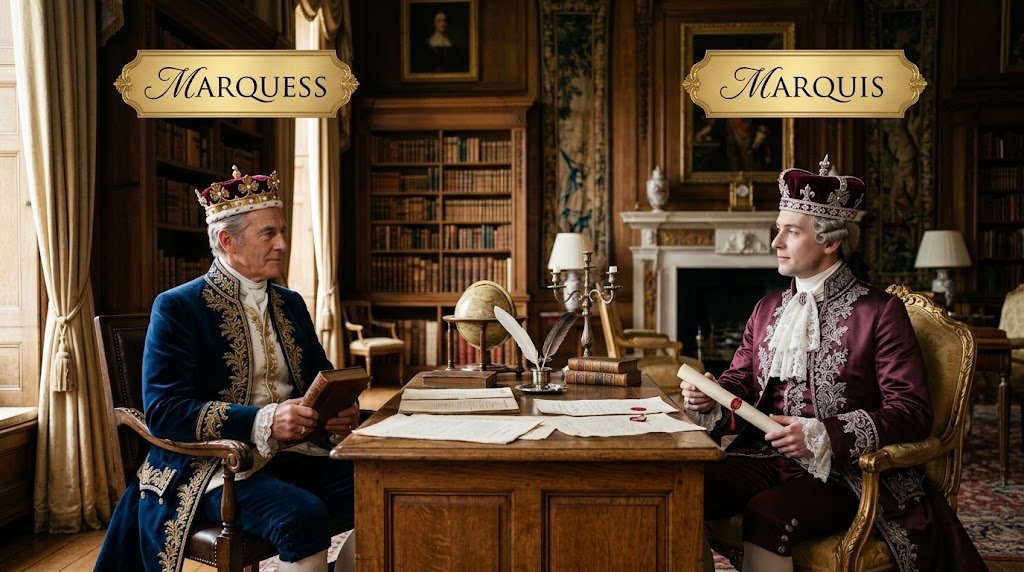
Have you ever seen the words marquess and marquis and wondered whether they mean different things? You are not alone. The two titles are closely related, and in many contexts they refer to essentially the same rank of nobility. The main difference comes down to language, spelling, and national tradition.
When comparing marquess vs marquis, the simplest rule is this: marquess is the traditional English form, while marquis is the form commonly used in French and several other European traditions. However, there is a little more to the story.
Understanding these titles can make historical books, royal biographies, and discussions about European aristocracy much easier to follow.
Marquess vs Marquis at a Glance
Before getting into the history, here is the basic distinction:
| Term | Common Usage | Meaning |
| Marquess | British English | A nobleman ranking below a duke and above an earl |
| Marquis | French and many European contexts | A noble title roughly corresponding to marquess |
| Marchioness | British English | Female equivalent or wife of a marquess |
| Marquise | French | Female form of marquis |
So, while the spellings are different, the titles generally describe a similar level of aristocratic rank.
What Is a Marquess?
A marquess is a member of the British peerage. In the traditional ranking of British nobility, a marquess ranks:
- Duke
- Marquess
- Earl
- Viscount
- Baron
That makes the marquess one of the highest ranks in the British aristocratic system.
The word is particularly associated with Britain. For example, British titles such as the Marquess of Westminster and Marquess of Salisbury use the spelling “marquess.”
A marquess historically had an important connection to border territories. The title developed from the idea of a nobleman responsible for a march, meaning a border region.
What Did a Marquess Historically Do?
In medieval Europe, borderlands could be politically and militarily sensitive areas. A nobleman governing such a territory might be given special authority to defend it.
Over time, the title became more closely associated with rank and hereditary aristocracy rather than simply responsibility for a border.
In Britain, the title eventually became part of the formal peerage system.
What Is a Marquis?
A marquis is essentially the continental European counterpart of a British marquess.
The word is especially associated with France, where marquis has long been used as a noble title. It is also found in other countries influenced by French or Latin European traditions.
In French, the title is written marquis for a man and marquise for a woman.
Historically, a marquis could govern a frontier territory or “march.” Like the British marquess, the title developed from the relationship between aristocratic authority and border regions.
However, European systems of nobility were not identical. The precise privileges, responsibilities, and ranking of a marquis could vary from one country to another and from one historical period to another.
Why Are Marquess and Marquis Spelled Differently?
The difference largely comes from language.
The English marquess developed alongside related European forms such as the French marquis. English aristocratic terminology often adopted words from French after the Norman Conquest, but spelling and usage changed over the centuries.
The distinction became particularly important because Britain developed its own formal peerage conventions.
Today, British titles generally use marquess, while French titles use marquis.
This is why you might encounter both words in historical writing without either one being “wrong.”
Marquess vs Marquis: Are They the Same Rank?
In broad terms, yes.
Both titles traditionally represent a noble rank between a duke and an earl or count.
But there is an important qualification: noble ranks were organized differently in different countries.
For example, Britain traditionally uses the sequence:
Duke → Marquess → Earl → Viscount → Baron
Many continental European systems use terms such as:
Duke → Marquis → Count → Viscount → Baron
The exact hierarchy depended on the country and historical period.
So it is better to think of “marquess” and “marquis” as linguistic and cultural equivalents, rather than assuming that every country used the titles in exactly the same way.
The Connection With Borderlands
One of the most interesting things about the two titles is their connection to borders.
The word is related to the concept of a march, an old term for a frontier or border territory. In medieval Europe, border areas often required stronger military leadership because they could be vulnerable to invasion.
A nobleman responsible for such an area might therefore receive a special title and additional authority.
This explains why the title became associated with frontier territories before developing into a hereditary aristocratic rank.
The historical connection is useful because it explains why two seemingly unusual words—marquess and marquis—are so closely related.
Marquess vs Marquis Pronunciation
The spelling difference can also create confusion about pronunciation.
In standard English, marquess is generally pronounced approximately like:
MAR-kwis
The French word marquis has a similar pronunciation when it is used in English.
In French, however, pronunciation follows French rules, and the word is commonly pronounced approximately like:
mar-KEE
The final sound differs because French pronunciation is different from English pronunciation.
So if you are reading a historical English text, “marquess” is usually the form you will encounter. In a French context, “marquis” is more appropriate.
What Is the Female Equivalent?
This is another area where English and French terminology differ.
In British English, the feminine title is marchioness.
A marchioness may be:
- A woman who holds the title in her own right
- The wife of a marquess
In French, the feminine form is marquise.
This gives us a useful comparison:
English: Marquess → Marchioness
French: Marquis → Marquise
The spelling changes, but the underlying aristocratic relationship remains similar.
Marquess vs Marquis in Modern Usage
Today, these titles are mainly encountered in historical, genealogical, literary, and aristocratic contexts.
Britain still has marquesses as part of its peerage system, although modern hereditary titles no longer carry the same political power they once did.
The title may still appear in formal names, historical records, biographies, newspapers, and discussions of the British aristocracy.
“Marquis,” meanwhile, remains especially relevant when discussing French nobility or aristocratic titles in continental Europe.
This means choosing between the two words is usually a matter of context.
If you are writing about a British nobleman, marquess is normally the appropriate spelling.
If you are writing about a French nobleman, marquis is generally the correct term.
Common Confusion About the Title
People sometimes assume that “marquess” and “marquis” represent two completely different ranks. That is usually not the case.
The confusion is understandable because English has borrowed many aristocratic terms from other European languages.
It is also important not to assume that a title automatically tells you how powerful someone was. Aristocratic rank, political influence, land ownership, wealth, and royal favour were separate matters.
A wealthy earl, for instance, could have more practical influence than a financially struggling marquess.
Titles indicate social and hereditary rank, but they do not tell the entire story.
How to Use Marquess and Marquis Correctly
If you are unsure which word to use, consider the country and historical context first.
Use “Marquess” When:
- Referring to a British peer
- Writing in a British aristocratic context
- Discussing the British peerage
- Referring to a specific British title such as Marquess of Salisbury
Use “Marquis” When:
- Referring to a French nobleman
- Discussing French aristocracy
- Using the traditional terminology of a continental European country
- Referring to a historical person whose title is conventionally spelled “marquis”
The safest approach is to follow the established spelling of the individual title.
Why This Distinction Matters in Historical Writing
Using the right title can make historical writing much clearer.
Imagine reading a sentence about a French aristocrat and suddenly seeing “marquess.” The meaning may still be understandable, but the wording could sound historically or culturally out of place.
Likewise, describing a British peer as a “marquis” may introduce terminology that is not normally used in the British peerage.
For researchers, writers, students, and anyone interested in genealogy, these small differences can help provide a more accurate picture of the period being discussed.
Frequently Asked Questions
Is a marquess higher than a marquis?
Not necessarily. In most contexts, marquess and marquis represent equivalent or closely corresponding aristocratic ranks. The difference is primarily connected to language and national tradition.
Is a marquess the same as a duke?
No. A marquess traditionally ranks below a duke in the British peerage. A duke is the highest-ranking British peer below the monarch.
Is marquis a French title?
Yes. Marquis is strongly associated with the French aristocratic tradition, although similar forms of the title have been used in several other European countries.
What is the British version of marquis?
The British form is marquess. It is a formal rank in the British peerage and traditionally sits below duke and above earl.
What is the wife of a marquess called?
In British English, the wife of a marquess is traditionally called a marchioness. The same term can also describe a woman who holds the rank in her own right.
How do you pronounce marquess?
In English, “marquess” is generally pronounced MAR-kwis. The French “marquis” has a different pronunciation, roughly mar-KEE.
Which spelling should I use: marquess or marquis?
Use marquess when referring to the British title. Use marquis when referring to French or other traditions that use that spelling.
Final Thoughts on Marquess vs Marquis
The marquess vs marquis question becomes much easier once you know that the two terms are closely related. Both developed from the old idea of a nobleman associated with a frontier or border territory, and both came to represent a high rank within European aristocracy.
The key difference is usage. “Marquess” is the standard British form, while “marquis” is especially associated with French and continental European traditions.
If you are writing about a particular historical figure, the best approach is to check the established title used in that person’s country and period. That small detail can make historical writing much more precise—and save you from mixing two different aristocratic naming traditions.