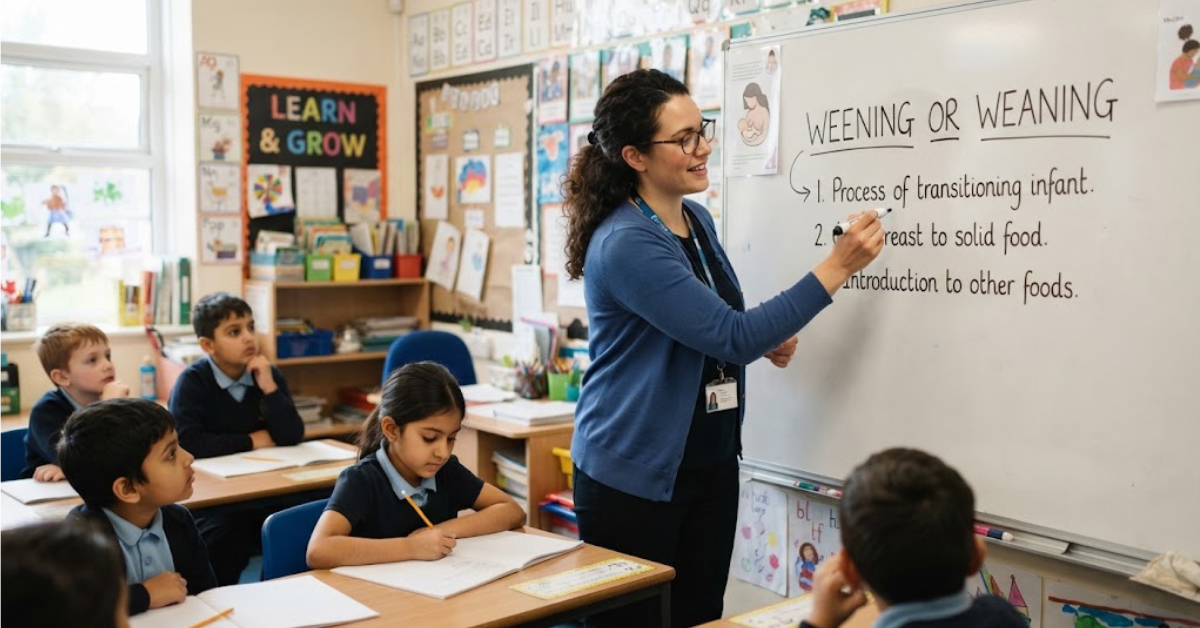
If you have ever typed weening or weaning and wondered which one is correct, you’re not alone. The two words look almost identical, but they are not interchangeable. In standard English, weaning is the correct spelling when you mean gradually stopping breastfeeding or becoming accustomed to something less.
The confusion usually comes from pronunciation. When people hear “weaning,” the spelling weening can seem perfectly reasonable. However, ween is generally not the verb you want when talking about stopping breastfeeding, reducing dependence, or transitioning away from something.
Let’s break down the difference so you can use weaning, weaned, and related forms with confidence.
Weening or Weaning: The Quick Answer
The correct spelling for the process of gradually stopping breastfeeding or reducing dependence on something is weaning.
- Weaning — the standard spelling and the form you normally want.
- Weaned — the correct past tense and past participle of wean.
- Ween — not the standard spelling of the verb wean.
- Weening — generally considered a misspelling when the intended word is weaning.
For example:
The baby is weaning from breastfeeding.
And:
The child was successfully weaned from the bottle.
The important word to remember is wean, which becomes weaning and weaned.
What Does Weaning Mean?
Weaning means gradually becoming accustomed to food, nourishment, or a situation other than something a person has previously depended on.
The word is especially common when discussing babies transitioning from breast milk or formula to other foods. However, its meaning has expanded and can be used in many other contexts.
For example:
- A baby is weaning from breastfeeding.
- A child is being weaned off a bottle.
- Someone may be weaned off a medication under appropriate medical guidance.
- A person can be weaned away from an old habit.
- An organization can be weaned from financial support.
The central idea is gradual transition or reduction of dependence.
Why Is It Weaning Instead of Weening?
The spelling comes from the base verb wean.
When the suffix -ing is added, the final n is retained:
wean + ing = weaning
There is no extra e inserted between the base word and the suffix.
This is similar to other common English words where the spelling can be less obvious from pronunciation.
A useful way to remember it is:
WEAN → WEANING → WEANED
If you’re talking about gradually stopping or reducing dependence, start with wean, not ween.
Weening vs Weaning: Is Weening a Word?
Weening is not the standard spelling for the common English verb wean.
If you are writing about breastfeeding, transitioning a baby to solid foods, or gradually stopping dependence on something, use weaning.
For example:
Correct:
We are starting the baby’s weaning process.
Incorrect in standard usage:
We are starting the baby’s weening process.
The extra e is the source of the spelling mistake.
Weaned or Weened: Which Is Correct?
The correct past-tense form is weaned, not weened.
For example:
The baby was weaned from breastfeeding.
She was gradually weaned off the medication under medical supervision.
The farmer weaned the young animals from their mothers.
In each case, weaned comes from the verb wean.
Weaned vs Weened at a Glance
| Form | Correct standard spelling? | Example |
| Wean | Yes | The parents plan to wean the child. |
| Weaning | Yes | The child is weaning from breastfeeding. |
| Weaned | Yes | The child was successfully weaned. |
| Ween | Generally no for this meaning | — |
| Weening | Generally no for this meaning | — |
| Weened | Generally no for this meaning | — |
So if you’re searching for weened or weaned, the answer is straightforward: weaned is the standard spelling.
How to Use Weaning in a Sentence
The word weaning can appear in several different contexts.
Weaning a baby
The parents began weaning their baby onto solid foods.
Weaning from breastfeeding
She is gradually weaning her child from breastfeeding.
The weaning off something
He is being weaned off his dependence on the old system.
Weaning animals
The farmer began weaning the calves from their mothers.
These examples show an important feature of the word: weaning often describes a gradual process rather than an abrupt change.
What Does “Wean Off” Mean?
The phrase wean off means to gradually reduce someone’s dependence on something.
It can be used literally or figuratively.
For example:
The child was gradually weaned off the bottle.
Or:
The company is trying to wean itself off outdated technology.
The phrase is particularly useful when describing a transition that happens step by step.
Wean Off vs Wean From
Both constructions can be used, although the wording can depend on context.
You might say:
The baby was weaned from breastfeeding.
Or:
The baby was weaned off breastfeeding.
The broader idea is the same: moving away from a previous source of nourishment, support, or dependence.
Is Weaning Only Used for Babies?
No. Although weaning is strongly associated with infants and breastfeeding, the word has a much broader meaning.
It can describe:
- Babies transitioning to other foods
- Animals becoming independent from their mothers
- People gradually stopping reliance on something
- Organizations reducing dependence on a resource
- People becoming less dependent on a habit or system
For example:
The company is being weaned off its dependence on a single supplier.
Here, the word has nothing to do with breastfeeding. It is being used metaphorically to describe a gradual reduction in dependence.
Common Mistakes With Weaning
Because weaning and weaned are pronounced in ways that can make the spelling less obvious, several mistakes are common.
Mistake 1: Writing “weening”
The baby is weening from breastfeeding.
Correct:
The baby is weaning from breastfeeding.
Mistake 2: Writing “weened”
The child was weened from the bottle.
Correct:
The child was weaned from the bottle.
Mistake 3: Confusing weaning with another word
The word weaning specifically relates to gradually reducing or ending dependence on something. It should not be confused with unrelated words that happen to sound similar.
How to Remember the Correct Spelling
A simple memory trick can help:
Think of the base word first: WEAN.
Then build the forms from it:
- Wean — present/base form
- Weaning — -ing form
- Weaned — past tense
So:
WEAN → WEANING → WEANED
If you remember the four-letter base word wean, the spelling becomes much easier.
Frequently Asked Questions
Is it weening or weaning?
The correct spelling is weaning when referring to the process of gradually stopping breastfeeding or reducing dependence on something.
Is it weened or weaned?
The standard spelling is weaned. For example: “The baby was weaned from breastfeeding.”
Is “weening” a word?
Weening is generally not the standard spelling of the word used for gradually reducing dependence or transitioning away from breastfeeding. In that context, use weaning.
How do you spell weaning?
It is spelled W-E-A-N-I-N-G: weaning.
How do you spell weaned?
It is spelled W-E-A-N-E-D: weaned.
What does weaning mean?
Weaning means gradually transitioning away from a source of nourishment or reducing dependence on something.
What does “wean off” mean?
Wean off means to gradually reduce someone’s dependence on something. For example, a person may be gradually weaned off a particular routine or substance.
Can you use weaning for animals?
Yes. Weaning is commonly used when young animals become less dependent on their mothers for milk or nourishment.
Is weaning the same as stopping?
Not exactly. Weaning usually suggests a gradual process, whereas stopping can happen suddenly. The idea of gradual transition is central to the word weaning.
Conclusion: Weening or Weaning?
When you’re deciding between weening or weaning, remember that weaning is the standard spelling for the gradual process of moving away from breastfeeding, nourishment, or dependence on something.
Likewise, the correct past form is weaned, not weened.
The easiest way to remember both is to start with the base verb:
wean → weaning → weaned
Keep that pattern in mind, and you’ll have no trouble choosing the right spelling the next time you encounter weening vs weaning or weened vs weaned.