
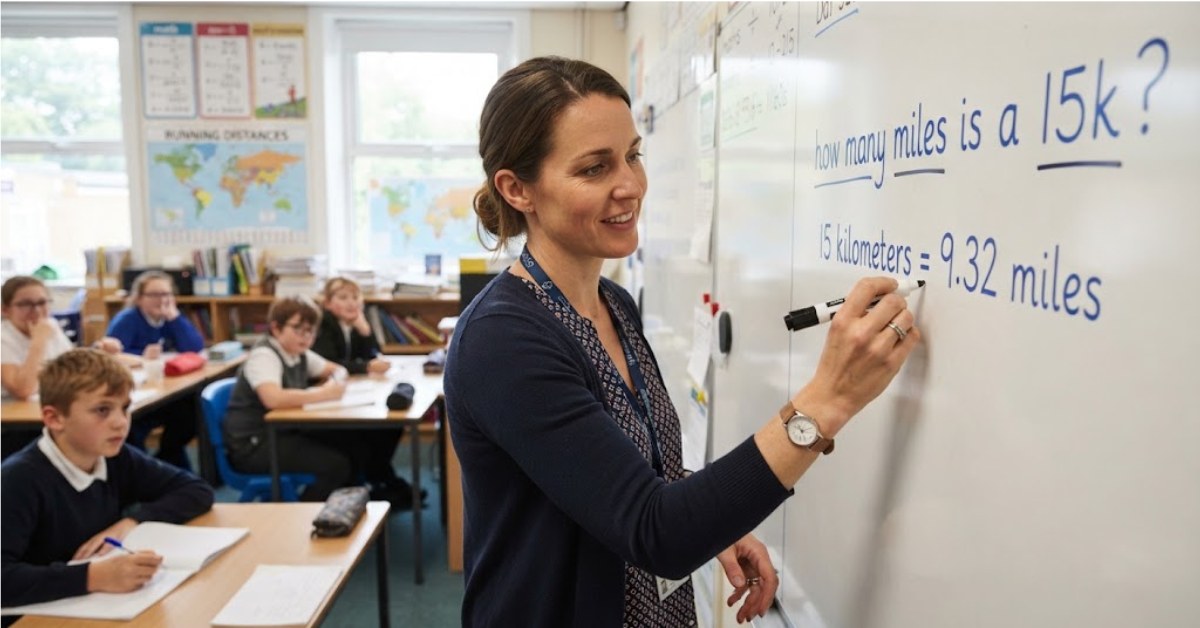
A 15K sounds straightforward, but if you’re more familiar with miles than kilometers, you may find yourself asking, “How many miles is a 15K?” The answer is surprisingly simple: a 15K is 9.32 miles.
More precisely, a 15-kilometer race covers 9.3206 miles, so runners usually refer to it as approximately 9.3 miles. That makes a 15K longer than a 10K but shorter than a half marathon.
If you’re considering signing up for a 15K race, the distance is long enough to require some preparation, but you don’t necessarily need to train for the full 13.1 miles of a half marathon. Let’s look at exactly how far a 15K is, how long it might take to complete, and how it compares with other popular running distances.
How Many Miles Is a 15K?
A 15K is 15 kilometers, and one kilometer equals approximately 0.621371 miles.
Therefore:
15 × 0.621371 = 9.320565 miles
Rounded to two decimal places:
15K = 9.32 miles
For everyday conversation, you can simply say:
A 15K is about 9.3 miles.
Here’s the basic conversion:
| Distance | Miles | Kilometers |
| 5K | 3.11 miles | 5 km |
| 10K | 6.21 miles | 10 km |
| 15K | 9.32 miles | 15 km |
| Half marathon | 13.11 miles | 21.1 km |
| Marathon | 26.22 miles | 42.195 km |
So, if you’ve already completed a 10K, a 15K means adding another 5 kilometers, or about 3.11 miles, to your distance.
What Does 15K Mean?
The K in 15K stands for kilometer, not thousand.
A kilometer is a metric unit of distance equal to 1,000 meters. Therefore, a 15K race is simply a race covering 15 kilometers.
You may see race distances written in several ways:
- 5K = 5 kilometers
- 10K = 10 kilometers
- 15K = 15 kilometers
- 20K = 20 kilometers
- 21.1K = half marathon distance
- 42.195K = marathon distance
The letter K is commonly used in running because road races are traditionally described using metric distances in many parts of the world.
How Many Miles Is a 15K Run?
A 15K run is 9.32 miles.
The distance doesn’t change based on whether you’re running, jogging, or walking. What changes is the amount of time it takes you to complete the course.
For example, if you run a 15K at a 10-minute-per-mile pace, the race would take roughly 93 minutes. Someone running at an 8-minute-per-mile pace would finish considerably sooner.
The distance remains exactly the same:
15 kilometers = 9.32 miles.
How Many Miles Is a 15K Walk?
A 15K walk is also 9.32 miles.
The word “walk” doesn’t change the distance. It only changes the speed and therefore the finishing time.
Walking 9.32 miles is a substantial distance for many people, so someone preparing for a 15K walking event may want to gradually build endurance rather than attempting the entire distance immediately.
How Many Miles Is 15K in Feet?
If you’re curious about the distance in feet, 15 kilometers equals approximately:
49,213 feet
Here’s the calculation:
15 km = 15,000 meters
Since one meter equals approximately 3.28084 feet:
15,000 × 3.28084 ≈ 49,213 feet
That’s a lot of individual feet when you think about it. It also illustrates just how much ground a 15K race covers.
How Many Miles Is 15K in Meters?
This conversion is much easier.
One kilometer equals 1,000 meters.
Therefore:
15K = 15,000 meters
So a 15K race covers exactly 15,000 meters.
That’s the official distance before converting it into miles.
15K vs. 10K: How Much Longer Is It?
If you’ve run a 10K before, a 15K isn’t an entirely different kind of race. It’s simply 50% longer.
A 10K is:
10 kilometers = 6.21 miles
A 15K is:
15 kilometers = 9.32 miles
The difference is:
5 kilometers = 3.11 miles
So moving from a 10K to a 15K means adding approximately 3.1 miles to your race distance.
| Race | Distance in Miles |
| 5K | 3.11 miles |
| 10K | 6.21 miles |
| 15K | 9.32 miles |
| Half marathon | 13.11 miles |
| Marathon | 26.22 miles |
For someone who has already built a comfortable 10K base, a 15K can be a natural next-distance goal.
15K vs. Half Marathon
A half marathon covers 21.0975 kilometers, or approximately 13.11 miles.
That means a 15K is shorter than a half marathon by:
21.0975 − 15 = 6.0975 kilometers
In miles, that’s approximately:
13.11 − 9.32 = 3.79 miles
So a 15K sits fairly close to a half marathon, but there is still a meaningful difference.
| Race | Kilometers | Miles |
|---|---|---|
| 10K | 10 km | 6.21 miles |
| 15K | 15 km | 9.32 miles |
| Half marathon | 21.0975 km | 13.11 miles |
If you’re progressing through longer races, a 15K can serve as an intermediate distance between the 10K and half marathon.
How Long Does a 15K Take?
There’s no single finishing time for a 15K.
Your time depends on your pace, fitness, terrain, weather, elevation, and whether you’re running continuously or using a run-walk strategy.
Here are some approximate finish times based on running pace:
| Pace per Mile | Approx. 15K Finish Time |
| 6:00 min/mile | 55:56 |
| 7:00 min/mile | 1:05:14 |
| 8:00 min/mile | 1:14:33 |
| 9:00 min/mile | 1:23:53 |
| 10:00 min/mile | 1:33:12 |
| 11:00 min/mile | 1:42:32 |
| 12:00 min/mile | 1:51:51 |
| 13:00 min/mile | 2:01:10 |
| 14:00 min/mile | 2:10:29 |
| 15:00 min/mile | 2:19:49 |
These calculations use the exact distance of approximately 9.3206 miles and assume a constant pace.
Your actual race time can be different because outdoor courses aren’t perfectly uniform. Hills, turns, crowds, weather, aid stations, and brief stops can all affect your pace.
15K Pace Chart
If you’re training for a 15K, knowing your target pace can make the distance easier to understand.
Here’s what different mile paces look like over the full 15K:
| Pace | Approx. 15K Time |
| 7:30/mile | 1:09:54 |
| 8:00/mile | 1:14:33 |
| 8:30/mile | 1:19:13 |
| 9:00/mile | 1:23:53 |
| 9:30/mile | 1:28:32 |
| 10:00/mile | 1:33:12 |
| 10:30/mile | 1:37:52 |
| 11:00/mile | 1:42:32 |
| 11:30/mile | 1:47:11 |
| 12:00/mile | 1:51:51 |
A pace calculator can be particularly useful because it lets you work backward from a desired finish time.
For example, if you wanted to finish a 15K in 90 minutes, your average pace would need to be approximately 9 minutes 39 seconds per mile.
15K Pace in Minutes per Kilometer
If your running watch displays pace in kilometers rather than miles, you can convert your target pace.
For example, a 15K completed in 90 minutes requires:
90 ÷ 15 = 6 minutes per kilometer
So a 90-minute 15K corresponds to:
6:00 per kilometer
That’s approximately:
9:39 per mile
Here are some common examples:
| Pace per Kilometer | Approx. 15K Time |
| 4:00/km | 1:00:00 |
| 4:30/km | 1:07:30 |
| 5:00/km | 1:15:00 |
| 5:30/km | 1:22:30 |
| 6:00/km | 1:30:00 |
| 6:30/km | 1:37:30 |
| 7:00/km | 1:45:00 |
| 7:30/km | 1:52:30 |
| 8:00/km | 2:00:00 |
This is one reason knowing both kilometer and mile pace can be helpful when you’re using different training plans or running apps.
How Many Steps Is a 15K?
If you’re wondering about steps rather than miles, there’s no exact answer.
Your step count depends on your stride length and whether you’re running or walking.
A person with a longer stride may take fewer steps to cover 15 kilometers, while someone with a shorter stride may take more.
As a rough illustration, someone averaging about 2,000 steps per mile would take approximately:
9.32 × 2,000 = 18,640 steps
But this is only a rough estimate.
Running cadence and stride length vary considerably, so you shouldn’t assume that every 15K equals exactly the same number of steps.
Is a 15K a Long Run?
For a recreational runner, 9.32 miles is a substantial running distance.
It’s considerably longer than a 5K or 10K and can require specific endurance training. However, it is shorter than a half marathon, so the preparation demands may be more manageable for someone who has already developed a solid running base.
Whether a 15K feels “long” depends on your experience.
For someone accustomed to running 3 miles, 9.3 miles is a major jump. For someone regularly running 10–12 miles, a 15K may simply feel like another moderate-long training run.
How to Train for a 15K
If you’re preparing for your first 15K, consistency matters more than trying to run the full distance during every training session.
A basic training approach might include:
- Build your weekly mileage gradually.
- Keep most runs comfortable.
- Include a weekly longer run.
- Add rest or easy-recovery days.
- Practice your planned race pace.
- Test your hydration and fueling strategy during longer training.
- Give yourself adequate recovery between harder sessions.
If you’re new to running or increasing your mileage substantially, a structured training plan can help you manage the progression more sensibly.
You don’t need every training run to be fast. In fact, trying to race every workout can make it harder to recover and maintain consistency.
How Long Should Your Longest Training Run Be?
There isn’t one rule that applies to every 15K runner.
Some training plans build toward a long run that approaches the race distance, while others use a somewhat shorter maximum distance.
The right approach depends on:
- Your current running experience
- Weekly mileage
- Previous race history
- Recovery ability
- Training schedule
- Your 15K goal
A beginner doesn’t necessarily need to run 9.3 miles repeatedly before completing a 15K. The goal of training is to build sufficient endurance while allowing your body to adapt progressively.
Can You Walk a 15K?
Absolutely.
A 15K doesn’t have to be a running event from your perspective. Walking 9.32 miles is a significant endurance activity in its own right.
At different walking speeds, the approximate completion time might look like this:
| Walking Pace | Approx. Time for 15K |
| 15 min/mile | 2 hr 20 min |
| 16 min/mile | 2 hr 29 min |
| 17 min/mile | 2 hr 39 min |
| 18 min/mile | 2 hr 48 min |
| 20 min/mile | 3 hr 07 min |
These are theoretical pace calculations rather than predictions of how long any particular person will take.
Terrain, breaks, weather, and fitness can all change the actual time.
How Many Calories Does a 15K Burn?
The number of calories burned during a 15K varies from person to person.
Body weight, pace, terrain, running efficiency, and individual physiology all influence energy expenditure.
This is why there isn’t a reliable universal statement such as “a 15K always burns exactly X calories.”
Fitness watches and running apps can provide estimates, but those numbers should be treated as estimates rather than precise measurements.
If you’re using a 15K as part of a weight-management or fitness plan, it’s generally more useful to focus on consistent training and overall activity than on a single calorie estimate.
Is a 15K Harder Than a 10K?
A 15K is longer than a 10K by 5 kilometers, or 3.11 miles, so it requires more endurance if you’re maintaining a similar pace.
But how difficult it feels depends on the individual.
A runner who comfortably completes 10K may find the extra distance challenging but manageable. Someone who is still building toward a 10K may find a 15K significantly more demanding.
The important factor isn’t simply the race distance. It’s how prepared you are for that distance.
Is a 15K Good for Beginners?
A 15K can be a goal for a beginner, but the amount of preparation needed depends heavily on the person’s starting point.
Someone who is already comfortable walking or running several miles has a different starting point from someone who is currently inactive.
If you’re new to running, a progression such as:
5K → 10K → 15K
can provide smaller milestones along the way.
That doesn’t mean everyone has to follow that exact sequence. Some people may use a run-walk approach, while others may build endurance through walking before introducing more running.
15K in Miles vs. 15,000 Steps
This is an important distinction.
A 15K race means:
15 kilometers = 9.32 miles
But 15,000 steps is a completely different measurement.
Your 15,000 steps might represent roughly 6–8 miles for some people, depending on stride length and activity. There is no universal distance because people have different step lengths.
So:
15K ≠ 15,000 steps
unless you’re using the term informally and specifically talking about step count.
If someone says, “I ran a 15K,” they almost always mean a race or run covering 15 kilometers.
15K Compared With Other Popular Race Distances
Seeing the distances side by side makes the progression much easier to understand.
| Race Distance | Miles | Approx. Description |
| 1 mile | 1.00 | Short-distance run |
| 5K | 3.11 | Common beginner race |
| 10K | 6.21 | Intermediate road race |
| 15K | 9.32 | Between a 10K and half marathon |
| Half marathon | 13.11 | 21.1 km |
| Marathon | 26.22 | 42.195 km |
The 15K occupies an interesting middle ground.
It’s substantially longer than a 10K, but you don’t have to cover the full half-marathon distance.
How Many Miles Is a 15K in One Sentence?
If you just need the answer for a conversation, race registration, or training plan:
A 15K is 9.32 miles, or about 9.3 miles.
That’s the number worth remembering.
For an exact conversion:
15 kilometers = 9.320565 miles
For everyday use:
15K ≈ 9.3 miles
Frequently Asked Questions About How Many Miles Is a 15K
How many miles is a 15K?
A 15K is exactly 15 kilometers, which equals approximately 9.32 miles. It’s commonly rounded to 9.3 miles.
Is a 15K the same as 10 miles?
No. A 15K is about 9.32 miles, so it is approximately 0.68 miles shorter than 10 miles.
How far is a 15K in kilometers?
A 15K is exactly 15 kilometers. The “K” refers to kilometers.
How far is a 15K in feet?
A 15K is approximately 49,213 feet.
How many miles is a 15K run?
Whether you run or walk it, a 15K covers 9.32 miles. The activity changes your speed, not the official distance.
How long does it take to run a 15K?
Finishing times vary widely. At a 10-minute-per-mile pace, a 15K would take about 1 hour 33 minutes. At an 8-minute pace, it would take about 1 hour 15 minutes.
Is 15K a half marathon?
No. A half marathon is 21.0975 kilometers, or approximately 13.11 miles. A 15K is 15 kilometers, or 9.32 miles.
Is a 15K harder than a 10K?
A 15K is physically longer by 5 kilometers, or 3.11 miles. Whether it feels harder depends on your training, endurance, pace, terrain, and experience.
How many steps are in a 15K?
There is no fixed number of steps in a 15K. The number depends on stride length and whether you’re walking or running. A rough estimate using 2,000 steps per mile would be about 18,600 steps.
Can a beginner run a 15K?
A beginner can work toward a 15K with appropriate preparation, but the timeline and training approach depend on their current fitness and running experience. Gradual progression is generally more practical than jumping directly into the full distance.
How far is 15K compared with a marathon?
A marathon is 42.195 kilometers, or 26.22 miles. A 15K is 15 kilometers, or 9.32 miles, making it substantially shorter than a marathon.
How far is 15K compared with a 5K?
A 15K is exactly three times the distance of a 5K. A 5K is 3.11 miles, while a 15K is 9.32 miles.
How far is 15K compared with a 10K?
A 15K is 50% longer than a 10K. The 10K is 6.21 miles, while the 15K is 9.32 miles.
Final Thoughts: How Many Miles Is a 15K?
So, how many miles is a 15K? The answer is 9.32 miles, or about 9.3 miles when rounded.
That puts a 15K comfortably between the 10K and half-marathon distances:
- 5K = 3.11 miles
- 10K = 6.21 miles
- 15K = 9.32 miles
- Half marathon = 13.11 miles
- Marathon = 26.22 miles
If you’re thinking about running a 15K, the distance is long enough to make endurance important but still noticeably shorter than a half marathon. Your finishing time will depend on your pace, while your preparation should depend on your current fitness and running experience.
And remember one easy distinction: a 15K race means 15 kilometers, not 15,000 steps. Once you keep that difference straight, the answer to how many miles is a 15K is easy to remember: 9.32 miles.