
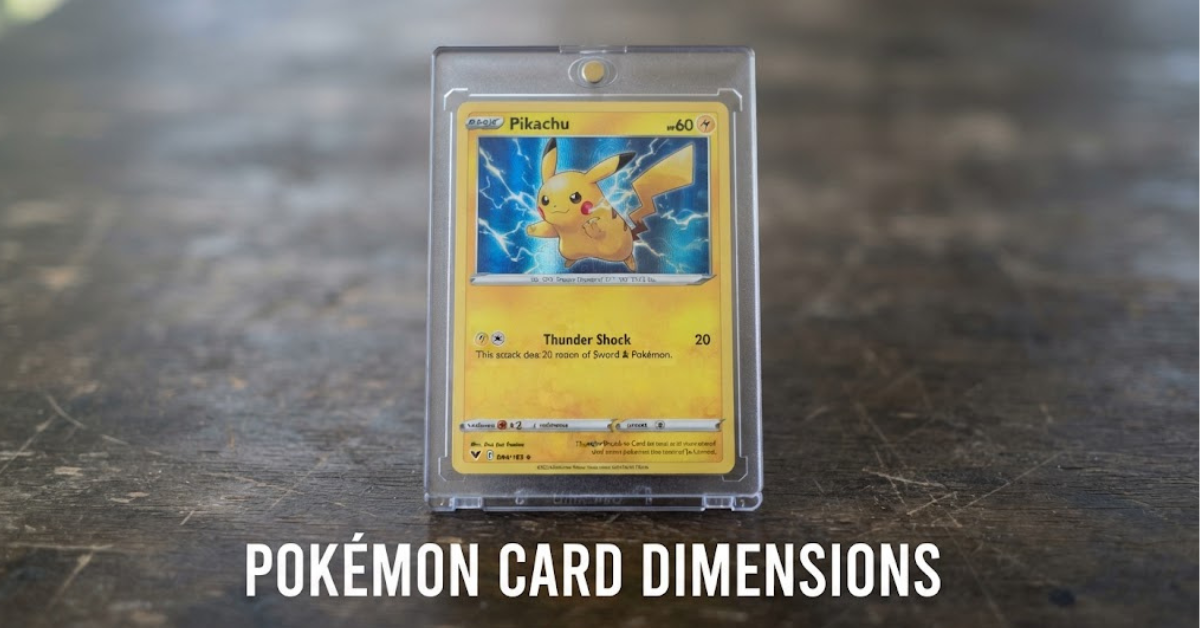
If you’ve ever bought Pokémon card sleeves, binders, or toploaders, you’ve probably wondered whether the product will actually fit. That’s where knowing the exact Pokémon card dimensions becomes surprisingly useful.
A standard Pokémon Trading Card Game card measures approximately 63 × 88 mm, or about 2.48 × 3.46 inches. You’ll often see this rounded to 2.5 × 3.5 inches because that is the familiar standard trading-card size used by many accessory manufacturers.
That small distinction matters if you’re designing a custom card, ordering storage supplies, printing a template, or trying to compare Pokémon cards with other trading card games.
Let’s look at the measurements in inches, millimeters, and centimeters, then cover thickness, sleeves, binders, toploaders, jumbo cards, and some common questions collectors have.
Pokémon Card Dimensions at a Glance
Here’s the quick answer if you only need the basic measurements.
| Measurement | Standard Pokémon Card |
| Width | 63 mm |
| Height | 88 mm |
| Width in inches | 2.48 in |
| Height in inches | 3.46 in |
| Width in cm | 6.3 cm |
| Height in cm | 8.8 cm |
| Approximate thickness | 0.3 mm |
| Common rounded description | 2.5 × 3.5 in |
The 63 × 88 mm dimensions are the commonly cited standard for Pokémon TCG cards. Card manufacturers and accessory companies often describe the same format as 2.5 × 3.5 inches.
For everyday purposes, the rounded 2.5 × 3.5-inch measurement is perfectly practical. If you’re creating a precise cutting template or designing a custom storage product, use the 63 × 88 mm figure.
What Size Is a Pokémon Card?
So, what size is a Pokémon card?
A standard Pokémon card is approximately:
63 mm wide × 88 mm tall
or:
6.3 cm wide × 8.8 cm tall
In inches, the direct conversion is approximately:
2.48 inches wide × 3.46 inches tall.
Many card-sleeve manufacturers round that to 2.5 × 3.5 inches when describing the standard size. Dragon Shield, for example, identifies its standard sleeves as 63 × 88 mm (2½ × 3½ inches) and specifically lists Pokémon among the compatible games.
How Big Is a Pokémon Card in Inches?
If you’re more familiar with inches, the answer can be simplified to approximately 2.5 × 3.5 inches.
However, there’s a useful technical distinction.
The direct conversion of 63 × 88 mm is approximately:
- 63 mm = 2.48 inches
- 88 mm = 3.46 inches
So technically, a standard Pokémon card is closer to 2.48 × 3.46 inches than exactly 2.50 × 3.50 inches.
Why do you see both measurements?
Because 2.5 × 3.5 inches is a convenient rounded description, while 63 × 88 mm is the more precise commonly cited metric measurement.
For buying sleeves, the rounded measurement is generally sufficient. For precision work, use the metric dimensions.
What Are the Dimensions of a Pokémon Card in Millimeters?
The commonly used Pokémon card dimensions are:
63 mm × 88 mm
The first number represents the width, while the second represents the height when the card is held vertically.
This gives the card its familiar rectangular shape.
If you’re creating a card-sized opening in a box or display, remember that the opening should normally be slightly larger than the card itself. A perfectly 63 × 88 mm opening may be too tight because manufacturing and cutting tolerances exist.
Pokémon Card Dimensions in Centimeters
Converting the measurements into centimeters is simple:
63 mm = 6.3 cm
88 mm = 8.8 cm
Therefore, a standard Pokémon card measures approximately:
6.3 cm × 8.8 cm
Here’s the complete conversion:
| Unit | Width | Height |
| Millimeters | 63 mm | 88 mm |
| Centimeters | 6.3 cm | 8.8 cm |
| Inches | 2.48 in | 3.46 in |
| Rounded inches | 2.5 in | 3.5 in |
This makes the card a little shorter than a full 3.5-inch height and slightly narrower than 2.5 inches when using the direct metric conversion.
How Thick Is a Pokémon Card?
Length and width get most of the attention, but card thickness matters when you’re choosing protective storage.
A standard Pokémon card is commonly reported at roughly 0.3 mm thick, although the exact thickness can vary somewhat with cardstock, printing, and card construction.
That sounds extremely thin—and it is.
But when you stack dozens or hundreds of cards, those tiny differences add up.
Thickness becomes particularly relevant when storing cards in:
- Toploaders
- Magnetic holders
- Deck boxes
- Grading submission holders
- Multi-card displays
Foil, textured, or otherwise specially finished cards can feel somewhat different from basic cards, so don’t assume every individual card will measure identically with a precision instrument.
Are Pokémon Cards the Same Size as Standard Trading Cards?
For practical purposes, Pokémon cards use the standard trading-card format.
The commonly cited 63 × 88 mm footprint is also used by several other major trading card games. Dragon Shield, for example, specifically lists Pokémon, Magic: The Gathering, Flesh and Blood, and Lorcana under its 63 × 88 mm standard-size sleeves.
That means collectors who own multiple standard-size TCGs can often use the same general category of sleeves and storage products.
But there’s an important exception: not every trading card game uses this format.
Pokémon Card Size vs. Yu-Gi-Oh! Cards
One of the most common size comparisons is Pokémon versus Yu-Gi-Oh!.
Yu-Gi-Oh! cards use a smaller format, commonly specified around 59 × 86 mm, while Pokémon cards are approximately 63 × 88 mm.
That difference might not look dramatic on paper, but it’s enough to affect sleeve fit.
This is why you shouldn’t simply buy sleeves labeled “trading card” without checking the intended card format.
If the package says standard size, it generally refers to the larger format used by Pokémon and several other Western TCGs.
What Size Sleeves Fit Pokémon Cards?
For standard Pokémon cards, look for sleeves specifically labeled:
- Standard size
- Pokémon size
- 63 × 88 mm compatible
- 2.5 × 3.5-inch trading-card size
Dragon Shield’s standard sleeves, for example, are listed as 63 × 88 mm and specifically identify Pokémon as compatible.
Sleeves themselves are larger than the card because the card needs to slide inside.
A commonly cited outer-sleeve size is around 66 × 91 mm, although exact dimensions vary between brands and sleeve styles.
Why Aren’t Sleeves Exactly the Same Size as the Card?
Imagine trying to put a 63 × 88 mm card into a sleeve that was also exactly 63 × 88 mm.
There would be virtually no room to insert it.
Sleeves need extra space so that:
- The card can slide inside
- The edges aren’t damaged during insertion
- The sleeve can be sealed or closed
- The card can move slightly without binding
That’s why you should look for compatibility with 63 × 88 mm cards, rather than expecting the sleeve itself to measure 63 × 88 mm.
Pokémon Card Dimensions and Toploaders
Toploaders are rigid plastic holders designed to provide more protection than a soft sleeve.
A common standard toploader format is around 3 × 4 inches, providing additional room around the 63 × 88 mm card. Exact internal dimensions vary by manufacturer.
The extra space is intentional.
A toploader needs to accommodate the card itself and, in many cases, a soft protective sleeve.
If you’re protecting a valuable card, don’t force a sleeved card into a holder that’s too tight. Pressure on the edges or corners can cause damage.
Pokémon Card Size for Binder Pages
Collectors frequently store Pokémon cards in 9-pocket binder pages.
Standard Pokémon cards are designed to fit the standard trading-card pocket format used by many collectible card binders.
When shopping for a binder, look for descriptions mentioning:
- Standard trading cards
- Pokémon TCG
- 63 × 88 mm cards
- 9-pocket trading-card pages
If you plan to keep cards sleeved inside binder pockets, check the manufacturer’s specifications. A pocket that comfortably holds an unsleeved card may be tighter once a protective sleeve is added.
Do Japanese Pokémon Cards Have Different Dimensions?
A common question is whether Japanese Pokémon cards require different physical storage because they’re printed for a different market.
The standard Japanese Pokémon card footprint is generally treated as the same 63 × 88 mm format used for standard Pokémon cards in other markets.
What can differ is the cardstock and production characteristics, including perceived thickness.
So if you collect both Japanese and English Pokémon cards, the basic card footprint doesn’t mean you need an entirely different sleeve size.
Always check the product description when purchasing specialty sleeves, especially if the manufacturer distinguishes between standard and smaller Japanese-size card formats. The phrase “Japanese size” on sleeve packaging can refer to other Japanese-format TCGs, such as Yu-Gi-Oh!, rather than Japanese-language Pokémon cards.
Are All Pokémon Cards the Same Size?
Standard Pokémon TCG cards generally share the same 63 × 88 mm footprint, regardless of whether the card is a common, holo, reverse holo, full-art, or another standard card treatment.
The artwork and rarity can change dramatically, but the basic length and width remain standardized.
What can change is the card’s thickness or surface construction.
This is why a textured or specialty card may feel slightly different in a holder even though its width and height are essentially the same.
What About Pokémon Jumbo Cards?
Here’s where things get interesting.
Not every Pokémon card-shaped collectible is the standard 63 × 88 mm size.
Pokémon has also released oversized or jumbo cards, particularly as promotional items and products included with certain releases.
These are much larger than standard playing cards and are not intended to fit ordinary Pokémon sleeves or standard binder pockets.
Because jumbo-card formats have varied across releases, there isn’t one single dimension that should be assumed for every oversized Pokémon card.
If you’re buying protection for a jumbo card, measure the specific card first or check the product dimensions associated with that particular release.
Pokémon Card Dimensions vs. a Credit Card
A standard credit card is approximately 85.60 × 53.98 mm under the widely used ID-1 card format.
A Pokémon card is approximately 88 × 63 mm.
That means a Pokémon card is:
- Slightly taller
- Noticeably wider
This comparison can be useful if you’re trying to visualize the card without having a ruler nearby.
A Pokémon card is broadly similar in overall rectangular footprint to a payment card, but it isn’t the same size.
Pokémon Card Dimensions vs. a Playing Card
The familiar “poker” playing-card format is commonly described as 2.5 × 3.5 inches, or approximately 63.5 × 88.9 mm.
Pokémon cards are commonly specified as 63 × 88 mm, so they’re extremely close in overall dimensions.
This is one reason standard playing-card and trading-card accessories can sometimes look interchangeable.
Still, if you’re making something specifically for Pokémon cards, use the actual 63 × 88 mm measurement rather than assuming every poker-sized product has identical tolerances.
Why Pokémon Card Dimensions Matter
You might wonder why a few millimeters deserve so much attention.
For casual collecting, they usually don’t.
But accurate dimensions become important when you’re:
- Buying sleeves
The wrong sleeve size can leave the card loose or make insertion difficult. - Choosing a toploader
You need enough room for the card and any sleeve you’re using. - Designing a custom card
Your cutting template needs to match the intended finished size. - Making a deck box
Internal dimensions need to account for both cards and sleeves. - Buying binder pages
Pocket dimensions determine whether sleeved cards fit comfortably. - Creating displays
A tight opening can put pressure on card edges and corners.
How to Measure a Pokémon Card Yourself
If you have a card in front of you, checking its dimensions takes less than a minute.
Step 1: Measure the Width
Place the card flat on a ruler.
Measure straight across the shorter edge.
A standard card should be approximately 63 mm wide.
Step 2: Measure the Height
Measure from the bottom edge to the top edge.
The expected measurement is approximately 88 mm.
Step 3: Check the Thickness
If you need thickness, a digital caliper is much more useful than a regular ruler.
Avoid pressing the caliper too hard against a valuable card.
Step 4: Compare the Results
Small manufacturing and cutting tolerances can occur. A tiny difference from the nominal dimension shouldn’t automatically be treated as evidence that a card is counterfeit.
Physical dimensions are only one characteristic among many.
Can Card Dimensions Help Identify a Fake Pokémon Card?
They can provide a clue, but dimensions alone aren’t enough to authenticate a Pokémon card.
A counterfeit card could potentially be cut to approximately the same size as a genuine card.
If you’re checking authenticity, consider multiple characteristics, such as:
- Printing quality
- Font and text
- Card coloring
- Alignment
- Back design
- Cardstock feel
- Surface finish
- Weight
- Dimensions
A noticeable dimensional difference can justify taking a closer look, but it shouldn’t be treated as definitive proof by itself.
Pokémon Card Dimensions for Custom Printing
If you’re creating a custom Pokémon-style card for artwork, a gift, or a personal project, the physical finished card size is an important starting point.
The standard nominal dimensions are:
63 × 88 mm
or approximately:
2.48 × 3.46 inches
However, printing a design requires more than simply setting the document to those dimensions.
You may need to account for:
- Bleed
- Trim area
- Safe text area
- Printer tolerances
- Rounded corners
- Final cutting
Don’t confuse the finished card size with the dimensions of the artwork file.
If you’re creating anything intended to be professionally printed, follow the printer’s specific bleed and file-preparation requirements.
Quick Pokémon Card Size Chart
Here’s a convenient reference you can bookmark:
| Item | Width | Height |
| Standard Pokémon card | 63 mm | 88 mm |
| Standard Pokémon card | 2.48 in | 3.46 in |
| Standard Pokémon card, rounded | 2.5 in | 3.5 in |
| Standard Pokémon card | 6.3 cm | 8.8 cm |
| Typical standard sleeve | ~66 mm | ~91 mm |
| Common toploader format | ~3 in | ~4 in |
| Yu-Gi-Oh! card | ~59 mm | ~86 mm |
Sleeve and toploader dimensions vary between manufacturers, so treat those accessory measurements as typical references rather than universal specifications.
Frequently Asked Questions About Pokémon Card Dimensions
What size is a Pokémon card?
A standard Pokémon card is approximately 63 × 88 mm, or about 2.48 × 3.46 inches. It is commonly described as 2.5 × 3.5 inches when rounded.
How big is a Pokémon card?
A standard Pokémon card is about 6.3 cm wide and 8.8 cm tall. In inches, that’s approximately 2.48 × 3.46 inches.
What are the dimensions of a Pokémon card?
The commonly cited dimensions of a standard Pokémon TCG card are 63 mm wide × 88 mm tall.
Are Pokémon cards 2.5 × 3.5 inches?
They’re commonly described that way, but the direct conversion of 63 × 88 mm is approximately 2.48 × 3.46 inches. The 2.5 × 3.5-inch figure is a convenient rounded description used for standard trading-card accessories.
How thick is a Pokémon card?
A standard Pokémon card is commonly reported as roughly 0.3 mm thick, although thickness can vary slightly depending on cardstock and card construction.
What size sleeves fit Pokémon cards?
Look for standard-size sleeves designed for 63 × 88 mm cards. Dragon Shield, for example, lists its standard 63 × 88 mm sleeves as compatible with Pokémon.
Do Pokémon cards fit Magic: The Gathering sleeves?
Yes. Both Pokémon and Magic: The Gathering use the standard 63 × 88 mm card format, so standard-size sleeves are generally designed to accommodate both.
Do Pokémon cards fit Yu-Gi-Oh! sleeves?
Not necessarily. Yu-Gi-Oh! uses a smaller card format, around 59 × 86 mm, so sleeves specifically designed for that smaller format aren’t the same as standard Pokémon sleeves.
Are Japanese Pokémon cards the same size as English Pokémon cards?
Standard Japanese Pokémon cards use the same general 63 × 88 mm footprint. Differences can occur in cardstock and production characteristics, but the basic length and width are the same.
Are all Pokémon cards exactly the same thickness?
Not necessarily. Standard cards are roughly 0.3 mm thick, but cardstock, printing, foil, and special surface treatments can introduce small differences.
Are Pokémon jumbo cards the same size as regular cards?
No. Jumbo Pokémon cards are oversized promotional collectibles and are substantially larger than the standard 63 × 88 mm cards. Their dimensions can vary by release.
Final Takeaway: Pokémon Card Dimensions
If you only remember one thing about Pokémon card dimensions, make it this:
A standard Pokémon card measures approximately 63 × 88 mm, or about 2.48 × 3.46 inches.
You’ll often see the size rounded to 2.5 × 3.5 inches, particularly on sleeve and accessory packaging.
The measurement matters most when you’re choosing sleeves, binders, toploaders, deck boxes, or designing a custom card. It also helps explain why Pokémon cards generally fit accessories marketed for other standard-size trading card games.
If you need a precise fit, use 63 × 88 mm as your starting point and check the manufacturer’s actual accessory dimensions. And if you’re dealing with a jumbo Pokémon card, don’t assume the standard measurements apply—measure that specific card before buying storage.