
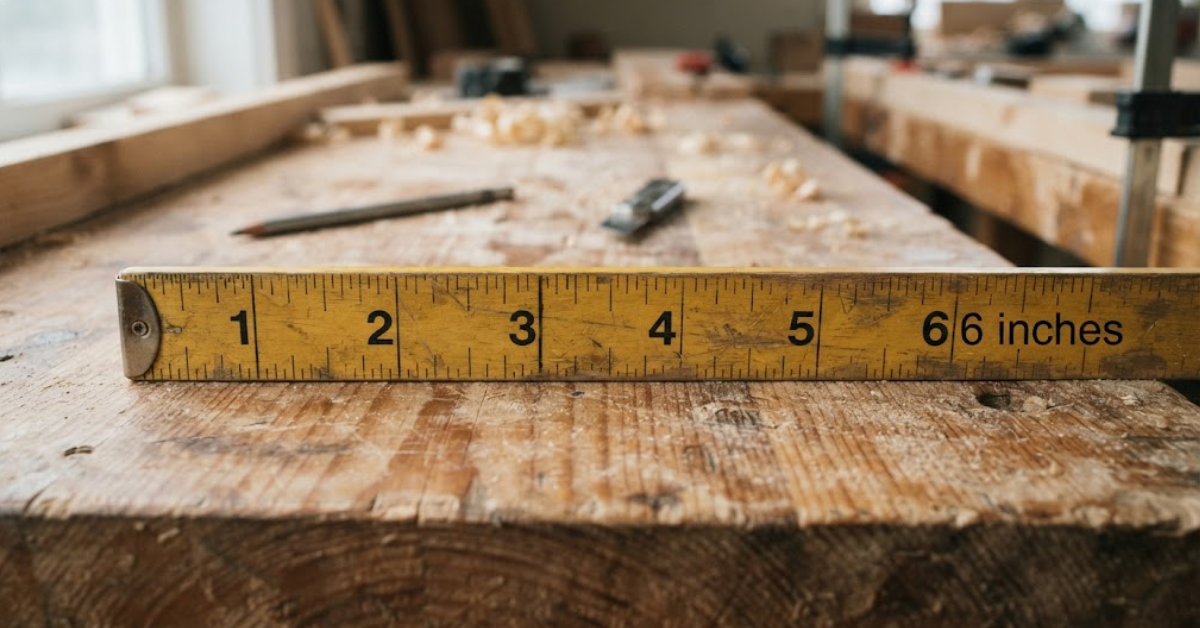
Six inches might sound like a straightforward measurement, but numbers don’t always give you a clear picture. If someone tells you an object is 6 inches long, you may immediately wonder what that actually looks like in real life.
So, how big is 6 inches? Six inches is exactly 15.24 centimeters, or about half a foot. It’s long enough to be noticeable but still small enough to fit comfortably in your hand.
In this guide, we’ll break down how long is 6 inches, compare it with familiar household objects, explain the measurement in centimeters and millimeters, and answer the common question, what is something that is 6 inches long?
How Big Is 6 Inches Exactly?
Let’s start with the precise measurement.
6 inches = 15.24 centimeters.
It also equals:
- 152.4 millimeters
- 0.5 feet
- 1/6 of a yard
- 0.1667 yards
- 0.1524 meters
The easiest measurement to remember is 6 inches = 15.24 cm.
If you use the metric system, imagine a line that’s a little more than 15 centimeters long. If you use imperial measurements, think of exactly half a foot.
How Long Is 6 Inches on a Ruler?
Finding six inches on a ruler is simple.
Start at the 0-inch mark and move along the ruler until you reach the number 6. The distance between those two points is exactly six inches.
Most standard rulers are 12 inches long, meaning six inches lands directly in the middle.
That’s one reason a 12-inch ruler is useful for visualizing this measurement: 6 inches is exactly half the length of a standard 12-inch ruler.
What Does 6 Inches Look Like on a Ruler?
On a typical ruler:
- 1 inch = 2.54 cm
- 2 inches = 5.08 cm
- 3 inches = 7.62 cm
- 4 inches = 10.16 cm
- 5 inches = 12.7 cm
- 6 inches = 15.24 cm
So if you’re looking at a metric ruler, six inches extends just beyond the 15-centimeter mark.
What Is Something That Is 6 Inches?
If you’re trying to picture six inches without a ruler, everyday objects are extremely helpful.
Here are several things that can be close to six inches, although exact dimensions vary by product:
1. Half of a Standard 12-Inch Ruler
This is the easiest and most accurate visual reference.
A standard ruler measuring 12 inches is twice as long as six inches. Simply imagine cutting it exactly in half.
The resulting length is 6 inches.
2. A Small Tablet or E-Reader
Some compact electronic devices have dimensions around the six-inch range.
Be careful with this comparison, though. When manufacturers describe a device as having a “6-inch display,” they’re usually referring to the diagonal screen measurement, not the device’s overall length or width.
That’s an important distinction.
3. A Large Smartphone’s Screen
A six-inch smartphone screen can provide another useful comparison.
But again, a 6-inch screen doesn’t mean the phone itself is six inches long. Screen sizes are normally measured diagonally from one corner to the opposite corner.
The actual phone may be shorter or longer depending on its aspect ratio and bezels.
4. A Small Kitchen Utensil
Some small kitchen tools, spatulas, tongs, measuring tools, and serving utensils can be approximately six inches long.
This varies by design, so consider these objects useful visual references rather than measuring standards.
5. A Pencil That Has Been Sharpened Several Times
A new standard pencil is generally longer than six inches, but a frequently used pencil can eventually become close to that length.
This makes a pencil a convenient comparison if you have one nearby.
6. A Small Banana
Some smaller bananas can be around six inches long, although banana sizes vary significantly.
If you’re comparing food portions or recipes, it’s better to measure rather than rely on this visual estimate.
7. A Dollar Bill and a Half
A U.S. dollar bill is 6.14 inches long.
That makes it one of the most useful real-world comparisons for six inches.
In fact, a dollar bill is only about 0.14 inch longer than six inches.
So if you’re wondering what is something that is 6 inches, a U.S. dollar bill is an excellent example of something that’s extremely close.
How Big Is 6 Inches Compared With a Hand?
Your hand can also give you a rough idea of the size.
For many adults, six inches can be somewhere around the distance from the base of the palm to a point along the fingers, depending on hand size and exactly how the measurement is taken.
But don’t treat your hand as a precision measuring instrument.
People have different hand sizes, finger lengths, and proportions. If you need an accurate six-inch measurement, use a ruler or measuring tape.
How Long Is 6 Inches Compared With a Foot?
A foot contains 12 inches.
Therefore:
6 inches = exactly 1/2 foot.
This is one of the simplest ways to visualize the measurement.
Imagine a standard 12-inch ruler. Six inches is precisely the distance from one end to the halfway point.
In centimeters, half a foot is 15.24 cm.
6 Inches in Centimeters
Converting six inches into centimeters is easy because one inch equals exactly 2.54 centimeters.
The calculation is:
6 × 2.54 = 15.24 cm
Therefore:
6 inches = 15.24 centimeters.
For everyday conversations, you can round this to approximately 15.2 centimeters.
If you’re working on a project where measurements need to be precise, however, use the full 15.24 cm figure.
6 Inches in Millimeters
Since one centimeter contains 10 millimeters:
15.24 cm × 10 = 152.4 mm
Therefore:
6 inches = 152.4 millimeters.
This conversion can be especially useful for engineering, manufacturing, crafts, and other situations where smaller measurements matter.
6 Inches Compared With 5 Inches
The difference between five and six inches is exactly one inch.
In centimeters:
- 5 inches = 12.7 cm
- 6 inches = 15.24 cm
- Difference = 2.54 cm
Although one inch sounds small, the difference can be quite noticeable when you’re comparing two objects side by side.
6 Inches Compared With 7 Inches
Seven inches is one inch longer than six.
Here’s the comparison:
| Measurement | Centimeters |
| 5 inches | 12.70 cm |
| 6 inches | 15.24 cm |
| 7 inches | 17.78 cm |
If you’re trying to picture six inches, imagine something midway between five and seven inches.
6 Inches vs. 10 Centimeters
This comparison is useful if you’re more comfortable with metric measurements.
Ten centimeters is approximately 3.94 inches.
Six inches, by contrast, is 15.24 centimeters.
That means six inches is considerably longer than 10 centimeters—by 5.24 centimeters.
So don’t confuse six inches with 10 centimeters. They’re noticeably different lengths.
6 Inches vs. 15 Centimeters
This is a much closer comparison.
6 inches = 15.24 centimeters.
Therefore, six inches is just 0.24 centimeter, or 2.4 millimeters, longer than 15 centimeters.
If you’re making a rough estimate, you can think of six inches as approximately 15 centimeters.
How to Measure 6 Inches Without a Ruler
Sometimes you need to estimate a measurement when you don’t have a measuring tool nearby.
Here are several practical options.
Use a U.S. Dollar Bill
A U.S. dollar bill is approximately 6.14 inches long.
If you have one available, it’s almost exactly six inches.
This is one of the better everyday references because the dimensions of U.S. currency are standardized.
Use a Standard Ruler
If accuracy matters, a ruler is the obvious choice.
Simply measure from zero to six inches.
Don’t measure from the physical edge if the edge doesn’t align perfectly with the ruler’s zero point.
Use a Smartphone
If you know your phone’s exact dimensions, you may be able to use it as a rough comparison.
However, phone dimensions differ between models, and a phone advertised with a six-inch display does not necessarily have a six-inch body length.
Use Your Hand
Your hand can give you a rough estimate.
For some people, certain hand measurements may be close to six inches, but individual variation makes this method unreliable for precise work.
Why Six Inches Is a Useful Measurement
Six inches appears in many everyday contexts.
You may encounter it when looking at:
- Craft materials
- Picture frames
- Small shelves
- Cables and cords
- Kitchen tools
- Hardware
- Plant containers
- Stationery
- Toys
- Electronic devices
- Clothing accessories
- Packaging dimensions
Understanding the approximate size makes product descriptions easier to interpret.
Instead of simply reading “6 inches,” you can immediately visualize something roughly half a foot long.
Don’t Confuse Screen Size With Object Size
One of the most common measurement mistakes involves electronics.
If a phone, tablet, or monitor is described as having a 6-inch screen, that measurement usually refers to the screen’s diagonal.
For example, a rectangular screen could have a diagonal of six inches while its width is significantly less than six inches.
So when shopping online, always check whether the listed measurement refers to:
- Screen diagonal
- Product length
- Product width
- Product height
- Product thickness
This small detail can make a huge difference.
Common Things Around 6 Inches Long
Here’s a quick reference list:
| Object | Approximate Relationship to 6 Inches |
| U.S. dollar bill | About 6.14 inches long |
| Half of a 12-inch ruler | Exactly 6 inches |
| Small kitchen utensil | May be close |
| Short pencil | May be close |
| Small banana | May be close |
| Compact electronic device | May have a dimension near 6 inches |
| Hand measurement | Varies considerably |
The key word here is approximate.
Manufactured objects can differ by brand and model, while natural objects such as bananas vary even more.
A Simple Mental Trick for Remembering 6 Inches
If you frequently need to estimate measurements, create a simple mental reference.
Remember these three facts:
6 inches = 15.24 cm
A 6 inches = 152.4 mm
6 inches = 1/2 foot
Of those three, the half-foot comparison is probably the easiest to remember.
Imagine taking a standard foot-long ruler and marking its exact midpoint. The distance from either end to that midpoint is six inches.
When You Should Measure Instead of Estimate
Visual comparisons are great for casual situations, but they aren’t always appropriate.
Use a proper measuring tool when:
- You’re cutting wood or fabric.
- You’re installing hardware.
- You’re checking whether furniture will fit.
- You’re buying replacement parts.
- You’re following a construction plan.
- You’re measuring a product for compatibility.
- You’re working with precise craft or engineering dimensions.
An estimate might be close enough for curiosity, but precision matters when the measurement affects whether something fits or works.
Frequently Asked Questions About 6 Inches
How big is 6 inches?
Six inches is exactly 15.24 centimeters or half a foot. It’s a relatively small measurement that you can visualize as half the length of a standard 12-inch ruler.
How long is 6 inches?
Six inches is 15.24 cm long. In imperial measurements, it represents exactly one-half of a foot.
What is something that is 6 inches?
A particularly close everyday example is a U.S. dollar bill, which measures approximately 6.14 inches long. Half of a standard 12-inch ruler is exactly six inches.
Is 6 inches half a foot?
Yes. One foot contains 12 inches, so six inches is exactly half a foot.
How many centimeters are in 6 inches?
There are exactly 15.24 centimeters in six inches.
How many millimeters are in 6 inches?
Six inches equals 152.4 millimeters.
Is 6 inches the same as 15 centimeters?
Not exactly. Six inches equals 15.24 centimeters, so it’s 0.24 cm longer than 15 centimeters.
Is a 6-inch phone six inches long?
Not necessarily. When a smartphone is described as having a six-inch display, the six-inch measurement normally refers to the screen’s diagonal rather than the phone’s physical length.
Can I use a dollar bill to measure 6 inches?
A U.S. dollar bill is about 6.14 inches long, so it provides a very close visual reference. It isn’t an exact six-inch measuring tool.
How can I measure six inches without a ruler?
You can use a U.S. dollar bill as a close approximation, compare the length with half of a 12-inch ruler, or use a known-size object. For accurate measurements, use a ruler or measuring tape.
Final Thoughts: How Big Is 6 Inches?
So, how big is 6 inches?
The exact answer is 15.24 centimeters, 152.4 millimeters, or half a foot. For an everyday 6 inches example, think of half of a standard 12-inch ruler or a U.S. dollar bill, which is just slightly longer.
Once you connect the number to familiar objects, 6 inches becomes much easier to picture. And if you’re trying to determine whether something will actually fit, don’t rely on a visual estimate alone—grab a ruler or measuring tape and check the exact dimensions.