A number on a scale doesn’t always tell you what a weight actually feels like. If you’ve ever wondered how much is 10 kg, the answer is simple mathematically—but much more interesting when you compare it with familiar things.
10 kilograms is equal to 22.05 pounds, or about 22 pounds. It is also equal to 10,000 grams, approximately 352.74 ounces, and about 1.57 stones.
Whether you’re checking luggage, buying groceries, choosing gym equipment, weighing a package, or simply trying to visualize 10 kilograms, this guide breaks the measurement down into useful, everyday terms.
How Much Is 10 KG?
10 kg means 10 kilograms, a metric unit of mass commonly used around the world.
Here are the main conversions:
| Unit | 10 KG Equals |
| Kilograms | 10 kg |
| Pounds | 22.05 lb |
| Ounces | 352.74 oz |
| Grams | 10,000 g |
| Milligrams | 10,000,000 mg |
| Stones | 1.57 stone |
| Metric tons | 0.01 metric ton |
For a quick mental reference, remember:
10 kg ≈ 22 pounds
That rounded figure is usually enough for everyday conversations. If you’re dealing with an airline baggage limit, shipping restriction, or another precise specification, use the exact conversion instead.
How Much Is 10 KG in Pounds?
One of the most common versions of this question is 10 kg to pounds.
One kilogram equals approximately 2.20462 pounds. So the calculation is:
10 × 2.20462 = 22.0462 pounds
Therefore:
10 kg = 22.05 pounds
In everyday language, you can simply call it about 22 pounds.
That makes 10 kilograms noticeably heavier than a 20-pound object, but not by a huge amount.
10 KG in Pounds and Ounces
If you prefer pounds and ounces, 10 kilograms is approximately:
22 pounds 0.74 ounces
Here’s the calculation:
- 10 kg ≈ 22.0462 pounds
- Whole pounds = 22
- Remaining 0.0462 pound × 16 ≈ 0.74 ounce
So you can think of 10 kg as roughly 22 pounds and ¾ of an ounce.
How Much Is 10 KG in Ounces?
Ten kilograms is approximately 352.74 ounces.
The conversion is based on:
1 kg ≈ 35.274 ounces
Therefore:
10 × 35.274 ≈ 352.74 ounces
Rounded to the nearest whole ounce, 10 kg is about 353 ounces.
Ounces are relatively small compared with kilograms, which is why the number looks much larger even though the actual mass hasn’t changed.
How Much Is 10 KG in Grams?
This is one of the easiest metric conversions.
There are exactly 1,000 grams in 1 kilogram.
Therefore:
10 × 1,000 = 10,000 grams
So:
10 kg = 10,000 grams
This conversion is particularly useful when dealing with food, ingredients, scientific measurements, and product packaging.
How Much Is 10 KG in Stones?
If you’re familiar with the British weight system, you may want to know 10 kg in stones.
One stone equals 14 pounds.
Since 10 kg is approximately 22.05 pounds:
22.05 ÷ 14 ≈ 1.57 stone
Therefore:
10 kg ≈ 1.57 stone
In stones and pounds, that’s approximately:
1 stone 8.05 pounds
So 10 kilograms is a little more than one and a half stones.
What Does 10 KG Look Like?
Weight itself isn’t visible, so the easiest way to understand how much is 10 kg is to connect it with familiar objects.
Here are some useful examples:
- A 10-liter quantity of water
- A large bag of rice
- A large bag of flour
- A loaded backpack
- A 10 kg dumbbell or kettlebell
- Some medium-sized packages
- A collection of heavy books
- A substantial amount of groceries
These are visualization examples rather than exact universal weights. Packaging, materials, and product sizes vary.
10 KG of Water: An Easy Comparison
Water provides one of the simplest ways to picture 10 kilograms.
Under ordinary conditions, 1 liter of water has a mass of approximately 1 kilogram. Therefore, 10 liters of water have a mass of approximately 10 kilograms.
Imagine filling a container with 10 liters of water. The water itself would weigh about 10 kg, before accounting for the weight of the container.
Another way to picture it is as ten 1-liter bottles of water. The water inside would total roughly 10 kg, although the bottles themselves add some additional mass.
Is 10 KG Heavy to Carry?
Whether 10 kg feels heavy depends on the person, the object, and how long it has to be carried.
For many adults, lifting a 10 kg object briefly is manageable. Carrying that same weight for a long distance, however, can feel considerably more demanding.
The shape of the object matters too. A compact object with a comfortable handle is generally easier to control than a bulky object with an awkward grip.
That’s why there’s no single answer to whether 10 kg is heavy.
Factors That Affect How Heavy 10 KG Feels
Several things can change your perception of the same 10 kg:
- Grip: A good handle makes an object easier to hold.
- Size: Bulky objects are often harder to control.
- Weight distribution: An uneven load can feel heavier.
- Distance: Carrying 10 kg for one minute is different from carrying it for an hour.
- Physical strength: Individual capacity varies.
- Movement: Lifting, carrying, pushing, and holding create different demands.
The number on the scale stays the same, but the experience can be very different.
How Heavy Is a 10 KG Backpack?
A backpack weighing 10 kg contains a substantial load.
For a short trip, some people may be able to carry it without much difficulty. But carrying a 10 kg backpack for a long period can become tiring, particularly when walking, climbing stairs, or hiking.
The way the backpack is packed also matters. Keeping heavier items close to your back and distributing the contents evenly can make the load easier to manage.
If you’re regularly carrying a heavy backpack, comfort, fit, and load distribution are worth paying attention to rather than looking only at the total number.
How Much Is 10 KG for Luggage?
A 10 kg suitcase or travel bag weighs approximately 22.05 pounds.
That’s a useful reference if you’re more accustomed to pounds than kilograms.
Whether 10 kg is within your airline’s cabin or checked-baggage allowance depends on the airline, route, fare, and specific baggage rules. Those limits can vary, so check your booking or the airline’s current baggage policy rather than assuming that every 10 kg bag is permitted.
For visualization, a 10 kg suitcase could contain a reasonable amount of clothing and personal belongings, depending on the suitcase itself and what you’re packing.
Is 10 KG a Good Gym Weight?
A 10 kg dumbbell weighs approximately 22.05 pounds.
For strength training, 10 kg can be a meaningful weight, but whether it is appropriate depends on the exercise and the individual.
For example, a person might find 10 kg manageable for certain lower-body movements while finding it much more challenging for repeated upper-body exercises.
When choosing exercise equipment, consider:
- Your current strength level.
- The specific exercise.
- Your ability to maintain proper technique.
- The number of repetitions you’re performing.
- Whether the weight can be controlled throughout the movement.
The “right” weight isn’t simply the heaviest one you can lift once.
10 KG Compared With 5 KG
The difference between 5 kg and 10 kg is exactly 5 kilograms.
In pounds:
- 5 kg ≈ 11.02 lb
- 10 kg ≈ 22.05 lb
So 10 kg is twice as heavy as 5 kg.
That’s an easy comparison to remember. If you can picture a 5 kg bag of something, imagine two identical bags together and you’re at approximately 10 kg.
10 KG Compared With 20 KG
Ten kilograms is exactly half of 20 kilograms.
In pounds:
- 10 kg ≈ 22.05 lb
- 20 kg ≈ 44.09 lb
So if you can picture a 20 kg object, 10 kg is exactly half its mass.
This can be particularly useful when comparing luggage, gym equipment, bulk food packages, or shipping weights.
10 KG Compared With 15 KG
Ten kilograms is two-thirds of 15 kilograms.
The conversions are approximately:
- 10 kg = 22.05 lb
- 15 kg = 33.07 lb
The difference is 5 kg, which is approximately 11.02 pounds.
So adding another 5 kg to a 10 kg load increases the total by about 11 pounds.
Everyday Objects That Can Help You Visualize 10 KG
If you’re still wondering how much is 10 kg, imagine a few familiar scenarios.
A 10 KG Bag of Rice
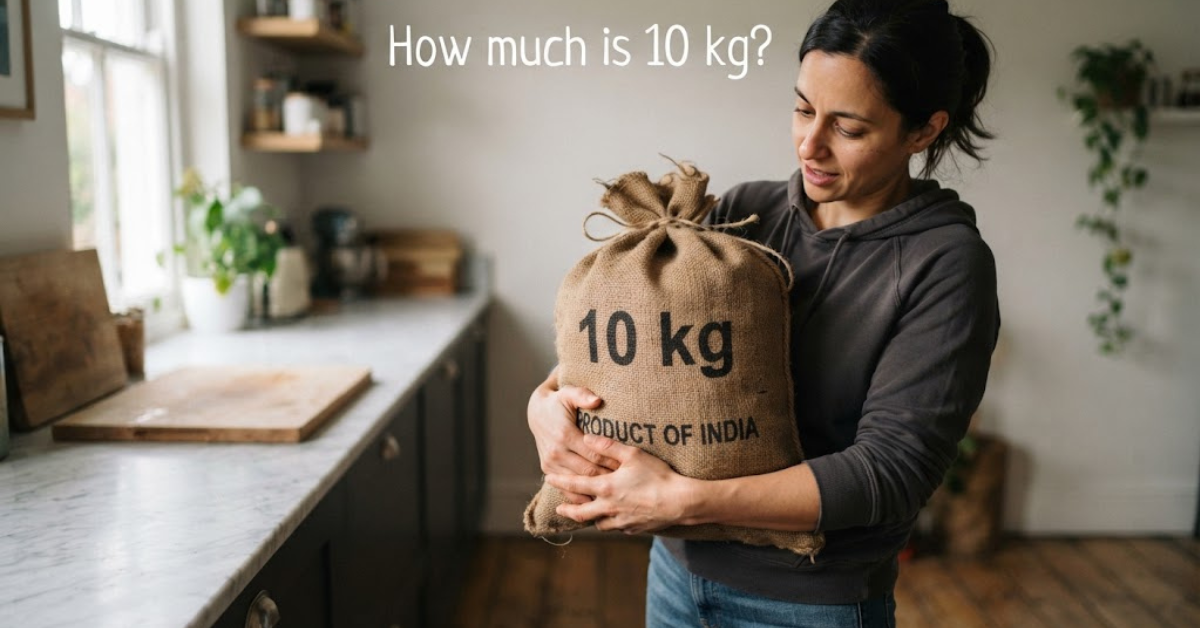
A 10 kg bag of rice is a straightforward real-world example. Pick one up and you’ll immediately get a sense of what the measurement feels like.
Ten Liters of Water
Ten liters of water have a mass of approximately 10 kg. This is another useful comparison because one-liter quantities are easy to visualize.
A 10 KG Dumbbell
A 10 kg dumbbell provides a compact example of the same mass. Because the weight is concentrated into a relatively small object, it can feel substantial when held at arm’s length.
A Loaded Backpack
A backpack filled with books, a laptop, clothing, and other items can reach 10 kg surprisingly quickly.
The exact weight depends on what’s inside, but a 10 kg backpack is a useful visualization of how much material that mass can represent.
How to Measure 10 KG Accurately
If you need to know whether an item actually weighs 10 kg, use a scale designed for the job.
Depending on the situation, you might use:
- Kitchen scale: For food and smaller objects.
- Luggage scale: For suitcases and travel bags.
- Bathroom scale: For body weight or larger objects when appropriate.
- Parcel scale: For packages.
- Platform scale: For bulky or heavier items.
For accurate results, place the object correctly on the scale and check that the display is set to kilograms rather than pounds or another unit.
10 KG Conversion Chart
Here’s a quick reference if you need the numbers at a glance:
| Conversion | Result |
| 10 kg to pounds | 22.05 lb |
| 10 kg to ounces | 352.74 oz |
| 10 kg to grams | 10,000 g |
| 10 kg to milligrams | 10,000,000 mg |
| 10 kg to stones | 1.57 st |
| 10 kg to metric tons | 0.01 t |
| 10 kg to kilograms | 10 kg |
The most important conversion is:
10 kg = 22.05 pounds
For everyday estimates, 10 kg ≈ 22 pounds is an easy number to remember.
How to Convert Kilograms Yourself
Knowing the formulas can be useful if you regularly switch between metric and imperial measurements.
Kilograms to Pounds
Multiply kilograms by 2.20462.
For 10 kg:
10 × 2.20462 = 22.0462 lb
Kilograms to Grams
Multiply kilograms by 1,000.
10 × 1,000 = 10,000 g
Kilograms to Ounces
Multiply kilograms by approximately 35.274.
10 × 35.274 ≈ 352.74 oz
Kilograms to Stones
First convert kilograms to pounds, then divide by 14.
22.0462 ÷ 14 ≈ 1.57 stone
These formulas make it easy to convert other weights as well.
Why Kilograms and Pounds Can Be Confusing
Kilograms and pounds measure the same basic quantity—mass—but they’re part of different measurement systems.
The kilogram belongs to the metric system, while the pound is commonly used in the United States and is also familiar in some other countries.
That’s why a number such as “10 kg” can seem unfamiliar to someone who normally thinks in pounds.
A simple conversion solves the problem:
10 kg is about 22 pounds.
Once you have that reference point, the measurement becomes much easier to understand.
Frequently Asked Questions About How Much Is 10 KG
How much is 10 kg in pounds?
10 kg is approximately 22.05 pounds. For a quick estimate, you can round it to 22 pounds.
How much is 10 kg in stones?
10 kg is approximately 1.57 stones, or about 1 stone and 8 pounds.
How much is 10 kg in pounds and ounces?
Ten kilograms is approximately 22 pounds and 0.74 ounces.
How many grams are in 10 kg?
There are exactly 10,000 grams in 10 kg.
How many ounces are in 10 kg?
There are approximately 352.74 ounces in 10 kg.
Is 10 kg heavy?
Ten kilograms is a substantial everyday weight, but whether it feels heavy depends on the person, object, distance, and activity.
What does 10 kg feel like?
A 10 kg object weighs about 22 pounds. You could visualize it as roughly 10 liters of water, a 10 kg bag of rice, or a 10 kg piece of exercise equipment.
Is 10 kg heavy for luggage?
A 10 kg suitcase weighs about 22.05 pounds. Whether that is allowed as carry-on or checked luggage depends on the specific airline and baggage rules.
Is 10 kg heavy for a dumbbell?
A 10 kg dumbbell weighs about 22.05 pounds. It may be light, moderate, or heavy depending on the exercise and the person’s strength and training experience.
Is 10 kg twice as heavy as 5 kg?
Yes. 10 kg is exactly twice the mass of 5 kg.
How much is 10 kg in pounds?
The direct conversion is:
10 kg = 22.0462 pounds
Rounded to two decimal places:
10 kg = 22.05 pounds.
Conclusion: How Much Is 10 KG?
So, how much is 10 kg? The simplest answer is that 10 kilograms equals approximately 22.05 pounds.
It also equals 10,000 grams, 352.74 ounces, and about 1.57 stones. For visualization, think of approximately ten liters of water, a 10 kg bag of rice, a loaded backpack, or a 10 kg dumbbell.
The number becomes much easier to understand once you connect it with something familiar. If you’re comparing luggage, shopping for bulk products, choosing exercise equipment, or converting measurements, 10 kg ≈ 22 pounds is the key figure to remember.
For other everyday weight questions, comparing kilograms with pounds, stones, ounces, and familiar household objects can make unfamiliar measurements much easier to picture.