
A gutter can look like a simple piece of plastic or metal attached to the edge of your roof. But get the gutter measurements wrong, and you can end up with overflowing rainwater, leaks, damaged fascias, or water running down the walls.
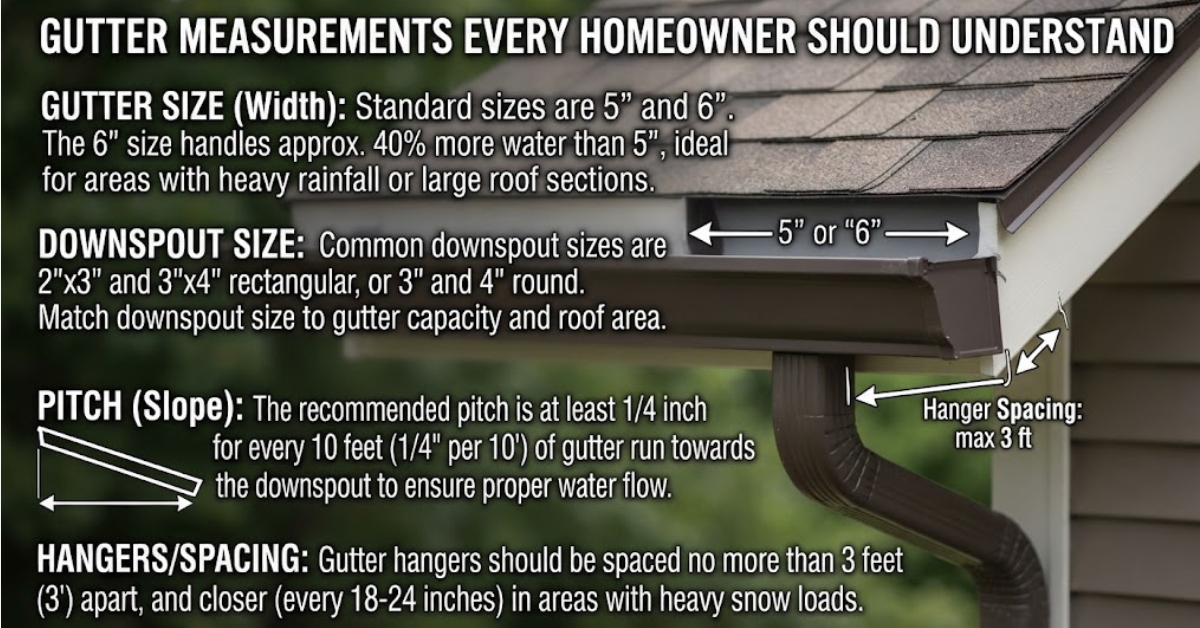
Understanding a few basic measurements makes choosing replacement guttering much easier. If you’re trying to work out how to measure gutter size UK homeowners commonly use, you need to look at more than just the width of the channel.
This guide explains the most important gutter dimensions, common gutter sizes UK homeowners will encounter, how downpipe sizes relate to gutters, and how to measure an existing system before buying replacements.
Why Gutter Measurements Matter
Your gutter system has one basic job: collect rainwater from the roof and move it safely into the downpipes and drainage system.
If the gutter is too small for the amount of water reaching it, heavy rain can overwhelm the channel. If the gutter or downpipe is unnecessarily large, you may spend more money and end up with a system that looks out of proportion to the property.
The correct size depends on several factors, including:
- Roof area
- Roof pitch
- Gutter profile
- Gutter width and depth
- Number and position of outlets
- Downpipe size
- Rainfall intensity
- Length of each gutter run
UK guttering suppliers offer several domestic profiles and sizes. For example, JDP’s current FloPlast range includes 112mm half-round, 114mm square, 114mm deep-capacity and 110mm Ogee systems, with different flow capacities.
What Gutter Measurements Should You Know?
When measuring guttering, several dimensions can be useful.
The most important are:
- Gutter width
- Gutter depth
- Gutter length
- Downpipe diameter or width
- Roof area draining into the gutter
- Distance to the nearest outlet
- Gutter fall or slope
These measurements serve different purposes.
For a straightforward replacement, identifying the existing gutter profile and nominal size may be enough. For a new installation or a system that has previously overflowed, you need to consider the roof area and drainage capacity as well.
Common Gutter Sizes UK Homeowners Should Know
There isn’t one universal gutter size used throughout the UK.
Different manufacturers use different profiles and nominal dimensions, so you should always check the manufacturer’s specifications before mixing components.
Here are some examples from a current FloPlast range:
| Gutter profile | Nominal width | Approx. depth | Typical matching downpipe |
| Half-round | 112mm | 52mm | 68mm round |
| Square Line | 114mm | 60mm | 65mm square |
| Hi-Cap Deep | 115mm | 75mm | 68mm or 80mm round |
| Niagara Ogee | 110mm | 80mm | 65mm, 68mm or 80mm round |
These figures demonstrate an important point: the number used to describe a gutter does not necessarily match the size of its downpipe.
112mm Half-Round Guttering
The 112mm half-round system is a common domestic guttering option.
In the FloPlast range referenced by JDP, the 112mm half-round gutter is approximately 112mm wide and 52mm deep and connects to a 68mm round downpipe.
It’s commonly used on ordinary domestic properties and is available in uPVC systems designed for relatively straightforward installation.
114mm Square Guttering
Square-profile guttering has a different shape and appearance from half-round guttering.
One current FloPlast system is listed as 114mm wide by 60mm deep and uses a 65mm square downpipe.
Because the profile is deeper, its capacity isn’t determined simply by comparing its width with a half-round gutter.
Deep-Capacity Guttering
Deep or high-capacity gutters are useful where more water needs to be handled.
For example, JDP lists a 114mm Hi-Cap system at approximately 75mm deep, with compatibility for 68mm or 80mm round downpipes.
This illustrates why gutter depth matters alongside width.
Ogee Guttering
Ogee gutters have a more decorative profile and are often chosen when homeowners want something more substantial-looking than a basic half-round system.
A current Niagara Ogee system listed by JDP measures approximately 110mm wide and 80mm deep and can be paired with different downpipe options depending on the system.
How to Measure Gutter Size UK Homeowners Can Follow
If you’re wondering how to measure gutter size UK, start with the existing gutter rather than guessing from the appearance.
Step 1: Identify the Gutter Profile
Look at the shape of the gutter from above or from the end.
Is it:
- Half-round?
- Square?
- Deep-flow?
- Ogee?
- Another proprietary profile?
The shape is important because two gutters with similar widths can have completely different depths and flow capacities.
Step 2: Measure the Gutter Width
For an existing open gutter, measure across the top opening at its widest point.
This is generally the useful nominal measurement when identifying an existing system. JDP specifically recommends measuring the width of the opening at the top of the gutter when sizing an existing system.
For example, your measurement might be approximately:
- 110mm
- 112mm
- 114mm
- 115mm
- 125mm
- 150mm
Don’t expect every measurement to match the product name exactly.
Manufacturing tolerances, the profile shape, and the way you measure can produce slightly different numbers.
Step 3: Measure the Depth
Measure from the top edge of the gutter down to its lowest internal point.
Depth becomes particularly important when comparing different profiles.
A 114mm gutter that is relatively deep isn’t necessarily equivalent to another 114mm gutter with a shallower profile.
Step 4: Measure the Downpipe
Next, measure the downpipe.
For a round downpipe, measure its diameter.
For a square or rectangular pipe, measure its width and depth.
Don’t assume that the downpipe must have the same nominal measurement as the gutter. Gutter and downpipe dimensions are deliberately different in many systems because water flows vertically through a downpipe more efficiently than horizontally through a gutter.
Step 5: Measure the Gutter Run
Measure the length of the gutter along the roof edge.
This matters because a long gutter run can carry a substantial volume of water toward an outlet.
Also note where the outlet is located.
An outlet at the centre and an outlet at the end can produce different drainage requirements. Manufacturer flow tables can therefore provide different capacity figures depending on outlet position.
Don’t Confuse Gutter Length With Gutter Size
This is an easy mistake.
When someone says they need a “4-metre gutter,” they’re talking about the length of the gutter section.
When they say “112mm gutter,” they’re talking about the nominal size/profile.
So a product could be:
112mm half-round × 4 metres long
The 112mm describes the gutter system, while 4 metres describes the length of the section.
Replacement guttering is often sold in standard lengths that are then cut to suit the building.
Gutter Size vs Downpipe Size
One of the most confusing parts of gutter shopping is the relationship between the gutter and downpipe.
You might expect a 112mm gutter to connect to a 112mm downpipe.
It doesn’t.
A current FloPlast example uses a 112mm half-round gutter with a 68mm round downpipe. A 114mm square system uses a 65mm square downpipe.
The reason is simple: the two components perform different jobs.
The gutter carries water horizontally along the roofline. The downpipe transports it vertically toward the drainage system.
Common UK Gutter and Downpipe Combinations
Examples from one current rainwater system include:
| Gutter | Downpipe | Listed maximum roof area* |
| 112mm Half Round | 68mm | 40m² |
| 114mm Square | 65mm | 73m² |
| 114mm Hi-Cap | 68/80mm | 88m² |
| 110mm Niagara Ogee | 65/68/80mm | 104m² |
| 170mm XtraFlo | 110mm | 206m² |
*These figures are specific to the referenced system and are not universal capacities for every manufacturer’s gutter with the same nominal size. JDP notes that flow capacity also depends on outlet position.
That’s why it’s better to think of gutter sizing as a system calculation, rather than simply choosing the biggest pipe that fits.
How Much Roof Area Can a Gutter Handle?
Your roof area is one of the most important factors when selecting guttering.
A small roof feeding into one gutter may require a relatively modest system. A large roof with several slopes directing water toward one section needs considerably more capacity.
For example, JDP’s current system information lists a maximum roof area of 40m² for its 112mm half-round system and 73m² for its 114mm square system under the stated product conditions.
But don’t treat those numbers as universal rules.
Flow capacity changes according to:
- Gutter design
- Outlet position
- Gutter slope
- Number of outlets
- Downpipe configuration
- Roof geometry
- Rainfall conditions
For a new installation, follow the selected manufacturer’s sizing tables rather than relying on a generic online chart.
What Is Effective Roof Area?
You may also encounter the term effective roof area.
This is more useful for gutter sizing than simply measuring the floor footprint of the building.
The roof’s pitch and geometry affect how much rainwater is directed toward a particular gutter run.
For a simple roof, estimating the contributing roof area may be relatively straightforward. More complicated roofs with valleys, multiple slopes, extensions, or several outlets require more careful calculation.
If you’re replacing a system that has always worked properly, a like-for-like replacement is often a practical starting point. JDP similarly notes that an existing correctly functioning system can generally be measured and replaced with a comparable system.
Gutter Fall: Another Measurement Homeowners Should Understand
Gutters aren’t necessarily installed perfectly level.
They are normally given a slight fall toward the outlet so that rainwater moves in the intended direction.
Manufacturer sizing tables can distinguish between a gutter installed level and one installed with a specified fall. JDP, for example, references a 1:350 fall in its domestic sizing guidance.
The exact installation requirement depends on the gutter system.
The important takeaway is this:
Don’t ignore the slope when replacing or installing guttering.
A gutter that doesn’t drain properly can hold standing water even if its dimensions are technically correct.
How to Measure a Gutter Run
Measuring the length of your guttering is relatively simple.
Start at one end and measure along the roofline to the other end.
For complicated buildings, divide the roofline into individual sections.
For example:
- Front elevation: 8m
- Left side: 5m
- Rear extension: 4m
- Right side: 5m
Total gutter run:
8 + 5 + 4 + 5 = 22 metres
However, don’t simply buy 22 metres of gutter and assume the job is complete.
You’ll also need to account for:
- Outlets
- Stop ends
- Corners
- Union pieces
- Brackets
- Downpipes
- Offsets
- Connectors
Measuring Existing Guttering Without Removing It
If your current guttering works well and you’re replacing it because it’s old, measuring the existing system can be the easiest approach.
Start by safely inspecting the gutter.
Then record:
- Profile shape
- Top width
- Internal depth
- Downpipe type
- Downpipe dimensions
- Gutter length
- Outlet locations
- Corners
- Number of downpipes
JDP specifically recommends measuring the existing gutter opening and identifying the profile when replacing an established system.
Don’t Rely Only on a Tape Measure
Measurements are useful, but they aren’t the whole story.
Take a photograph of the existing gutter profile from the end.
This can make it much easier to compare the shape with a manufacturer’s product catalogue.
It’s especially useful if you’re dealing with older uPVC, metal, or proprietary guttering.
What About 125mm and 150mm Gutter Sizes?
Larger gutter systems do exist in the UK.
JDP’s commercial rainwater information, for example, lists 125mm and 150mm half-round systems for larger roof applications. Its cited figures show that increasing the gutter size can substantially increase the maximum effective roof area under specified installation conditions.
These larger systems are more commonly associated with larger buildings and commercial or industrial applications rather than ordinary small domestic rooflines.
For a typical house, don’t automatically jump to a 125mm or 150mm gutter simply because bigger sounds better.
The right size is the one that matches the roof and drainage requirements.
Mini Guttering: Is It Suitable for a House?
Mini guttering is another size that can appear when shopping for rainwater systems.
However, it’s generally intended for small structures rather than normal house roof drainage.
JDP describes mini guttering as typically around 76mm wide and suitable for smaller projects such as sheds and greenhouses. For houses, it recommends guttering of at least around 100mm width.
So before buying a compact gutter system because it costs less, check what the manufacturer says it is designed for.
Gutter Measurements for Replacement Projects
If you’re replacing old guttering, use this checklist before ordering anything.
Your Gutter Measurement Checklist
Gutter:
-
Profile
-
Nominal width
-
Depth
-
Total length
-
Number of runs
Drainage:
-
Downpipe shape
-
Downpipe diameter/width
-
Number of downpipes
-
Outlet positions
-
Drain connection
Roof:
-
Approximate contributing roof area
-
Roof pitch
-
Number of roof sections draining into each run
-
Any valleys or unusual roof geometry
Fittings:
-
Internal corners
-
External corners
-
Stop ends
-
Union brackets
-
Outlets
-
Gutter brackets
-
Downpipe clips
-
Offsets and bends
Taking these measurements before visiting a supplier can save you from making multiple trips for missing components.
How Far Apart Should Gutter Brackets Be?
Bracket spacing is another measurement worth checking during installation.
The exact requirement depends on the manufacturer and gutter system.
For example, current installation information for a FloPlast 112mm half-round fascia bracket specifies brackets at a maximum of 1 metre apart and within 150mm of joints or fittings.
Don’t assume that every gutter system uses exactly the same spacing.
Follow the instructions for the specific product you’re installing.
Should You Mix Gutter Brands?
It’s tempting to buy whichever gutter component happens to be cheapest.
That’s not always a good idea.
Even when two gutters are advertised with similar nominal measurements, their profiles, connectors, seals, brackets, and dimensions can differ.
JDP specifically recommends avoiding unnecessary mixing and matching between different brands, styles, and sizes.
A better approach is to choose a complete compatible system.
If you have to connect two different systems, use a manufacturer-approved adaptor designed for that purpose.
Common Gutter Measurement Mistakes
A few measurement mistakes appear again and again.
Measuring Only the Gutter Length
Knowing that you need 15 metres of gutter doesn’t tell you what profile or capacity you need.
Measure the width, depth, profile, and drainage configuration too.
Assuming All 112mm Gutters Are Identical
They’re not necessarily interchangeable.
Nominal dimensions can look similar while profiles and fittings differ between manufacturers.
Matching the Gutter and Downpipe Numbers
A 112mm gutter doesn’t require a 112mm downpipe.
The components are usually sized differently.
Ignoring Outlet Position
A gutter with an outlet at the end can have different hydraulic performance from one with an outlet positioned in the centre.
Manufacturer sizing tables account for this difference.
Measuring From Ground Level
You can estimate some dimensions from the ground, but an accurate replacement measurement normally requires inspecting the existing gutter profile.
Never climb onto a roof or use a ladder without appropriate safety precautions.
When Should You Call a Professional?
Measuring a straight section of guttering is relatively simple.
The job becomes more complicated when you have:
- Multiple roof levels
- Large roof areas
- Several extensions
- Flat roofs feeding pitched roofs
- Internal valleys
- Unusual gutter profiles
- Persistent overflow
- Structural fascia damage
- Difficult ladder access
If your current guttering repeatedly overflows despite being clean, don’t assume the problem is simply a blockage.
The system may be incorrectly sized, poorly sloped, undersupported, or receiving more roof runoff than it was designed to handle.
Frequently Asked Questions About Gutter Measurements
What are the standard gutter sizes in the UK?
There isn’t one universal UK standard domestic gutter size. Common systems include approximately 112mm half-round, 114mm square, 114/115mm deep-capacity systems, and around 110mm Ogee systems, depending on the manufacturer.
How do I measure gutter size UK homeowners commonly use?
Measure the width of the gutter opening at the top, identify its profile, and measure its depth. Also measure the downpipe and note where the outlets are positioned.
Is 112mm guttering the same as 4-inch guttering?
Not exactly. Gutter systems are sold using nominal dimensions that don’t always correspond directly to an imperial measurement. Always check the manufacturer’s actual specifications.
What is the most common gutter size in the UK?
There isn’t a single universal answer because different manufacturers offer different systems. A 112mm half-round system is one common domestic option, while square, deep-flow, and Ogee profiles use different dimensions.
What size downpipe goes with a 112mm gutter?
For the FloPlast 112mm half-round system referenced by JDP, the matching downpipe is 68mm round. Other manufacturers may use different specifications.
How do I know what size gutter I need?
Start with your roof’s contributing area, then consider gutter profile, flow capacity, outlet position, gutter fall, and downpipe configuration. Manufacturer sizing tables are the safest way to select a specific system.
Is bigger guttering always better?
Not necessarily. A larger gutter can provide more capacity, but it may cost more, require different fittings, and look oversized on a small property. Proper sizing is preferable to simply choosing the largest available system.
Can I replace 112mm guttering with 114mm guttering?
Possibly, but don’t assume the two systems are interchangeable. Profile, brackets, unions, stop ends, and outlets can all differ. Check the complete system dimensions and manufacturer compatibility before replacing components.
How much guttering do I need?
Measure each roofline that requires guttering and add the lengths together. Then account for corners, outlets, stop ends, unions, brackets, and other fittings.
What happens if my gutter is too small?
A gutter with insufficient capacity can overflow during heavy rainfall. Water may spill over the front edge, run down walls, or contribute to damage around the roofline and foundations.
What happens if my gutter is too large?
An oversized gutter isn’t automatically harmful, but it can cost more and may look disproportionate. The better approach is to select a system based on the roof area and expected water flow.
Conclusion: Understanding Gutter Measurements
Understanding gutter measurements every homeowner should understand doesn’t require becoming a drainage engineer. You mainly need to know what you’re measuring and why each dimension matters.
Start with the gutter’s profile, width, depth, and length. Then look at the downpipe, outlet position, roof area, and gutter fall. These details together give you a much clearer picture of whether you’re choosing the right replacement system.
For anyone researching how to measure gutter size UK homeowners commonly encounter, remember that nominal sizes vary between manufacturers. A 112mm half-round system, for example, is not automatically interchangeable with every gutter that happens to have a similar measurement.
And when comparing gutter sizes UK suppliers offer, don’t choose based on width alone. Look at the complete rainwater system and its stated flow capacity.
Before ordering your next guttering system, take the time to measure what you already have, identify the profile, check the manufacturer’s compatibility information, and calculate the roof area feeding each gutter run. A few careful measurements now can save a lot of hassle when the next heavy downpour arrives.