
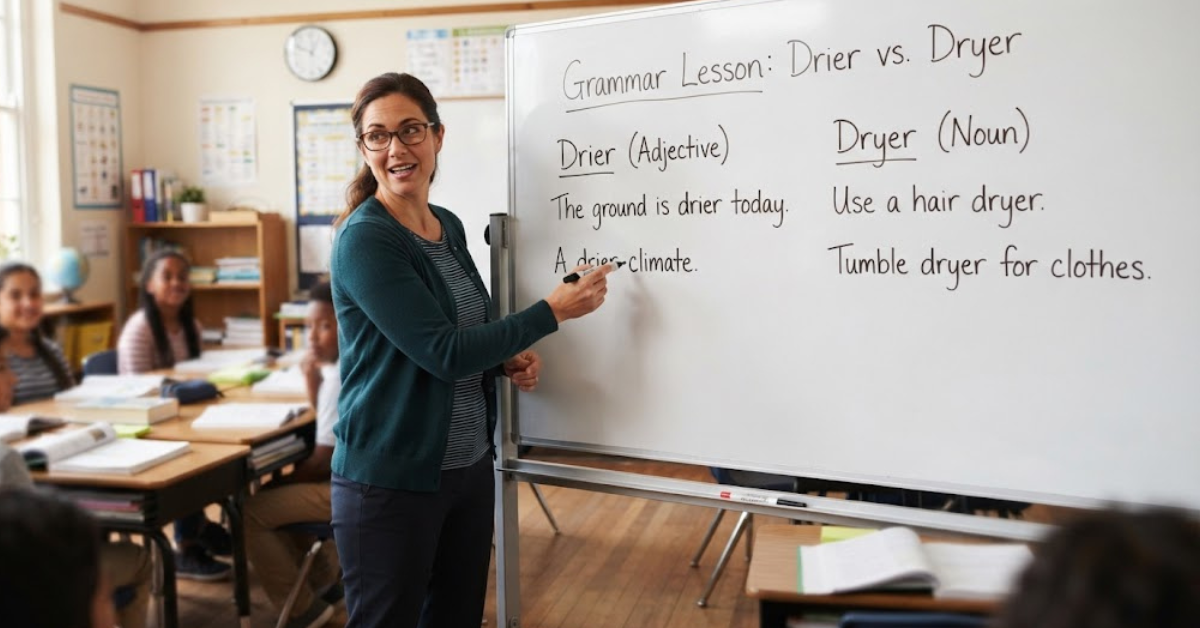
A single letter can completely change the meaning of a word. That’s exactly what happens with drier vs dryer. Both spellings are correct, but they are used in different situations.
The confusion usually comes from the fact that drier is related to the adjective dry, while dryer is commonly used for a machine or device that dries something. Knowing the difference makes it much easier to choose the right word in your writing.
Let’s break down dryer vs drier, look at real examples, and answer the common question: dryer or drier—which one should you use?
Drier vs Dryer: What’s the Difference?
The simplest way to remember the difference is:
- Drier → the comparative form of dry
- Dryer → something that dries another thing, especially a machine
For example:
This towel is drier than the other one.
Here, drier means “more dry.”
But:
I put my clothes in the dryer.
Here, dryer refers to the appliance that dries clothes.
So although the words look almost identical, they have different grammatical roles and meanings.
What Does Drier Mean?
Drier is the comparative form of the adjective dry.
When you compare two things and one contains less moisture than the other, you can describe it as drier.
Examples of drier
- This shirt is drier than that one.
- The weather is drier in the desert.
- My skin feels drier during winter.
- The second towel is drier than the first.
- The soil becomes drier during the summer.
In each example, drier means more dry.
The word can describe physical moisture, weather conditions, skin, food, soil, air, or even something figurative.
What Does Dryer Mean?
Dryer usually refers to a device, machine, or object that dries something.
The most familiar example is a clothes dryer, which uses heated or moving air to remove moisture from clothing.
Examples of dryer
- The clothes are in the dryer.
- We need to buy a new hair dryer.
- The hand dryer isn’t working.
- Put the towels in the dryer.
- The industrial dryer removes moisture from the material.
In these sentences, dryer is a noun referring to something that performs the action of drying.
Dryer vs Drier: An Easy Rule
When you’re deciding between dryer vs drier, ask yourself one simple question:
Am I comparing how dry something is, or am I talking about something that dries?
If you’re comparing dryness, use drier.
The air today is drier than yesterday.
If you’re talking about a machine or device, use dryer.
The clothes are inside the dryer.
This quick test works in most everyday situations.
Dryer or Drier: Which One Should You Use?
The answer depends entirely on the sentence.
Use “drier” when you mean “more dry”
Examples:
- The towel is drier now.
- This climate is drier than the coast.
- My hair becomes drier in cold weather.
- The ground is drier after several sunny days.
Use “dryer” when referring to a device
Examples:
- I need a new clothes dryer.
- The hair dryer stopped working.
- The bathroom has a hand dryer.
- The machine works as a grain dryer.
A useful mental shortcut is:
Drier = more dry
Dryer = a thing that dries
Why Are Drier and Dryer So Easy to Confuse?
The confusion comes from English spelling patterns.
Normally, when we form the comparative of an adjective, we often add -er:
- cold → colder
- fast → faster
- clean → cleaner
- dry → drier
Notice what happens with dry. The y changes to i before the -er ending:
dry → drier
But dryer is formed differently. It comes from dry + -er, where the resulting word functions as a noun meaning something that dries.
That gives us two different words:
dry → drier
dry → dryer
The spelling difference reflects the difference in meaning.
Drier as a Comparative Adjective
One of the easiest ways to recognize drier is to look for a comparison.
Words such as these often signal a comparative:
- than
- more
- less
- compared with
- compared to
For example:
This room is drier than the basement.
The climate is drier compared with the northern region.
You don’t always need an explicit comparison, though. The meaning can still be comparative from context.
After the heater was turned on, the air became drier.
Dryer as a Noun
Dryer is usually a noun describing an object or machine used for drying.
Common examples include:
Clothes dryer
A machine that removes moisture from clothing.
The clothes are still in the dryer.
Hair dryer
A handheld device that blows warm or cool air onto hair.
She used a hair dryer after taking a shower.
Hand dryer
A device found in some public restrooms that blows air onto wet hands.
The automatic hand dryer wasn’t working.
Industrial dryer
Equipment designed to remove moisture from materials during manufacturing or processing.
The factory installed a larger industrial dryer.
Drier vs Dryer in Everyday Sentences
Compare these pairs:
| Drier | Dryer |
| The towel is drier than before. | Put the towel in the dryer. |
| The climate is becoming drier. | The clothes dryer is full. |
| My skin feels drier today. | I bought a new hair dryer. |
| The soil is drier after the heatwave. | The machine is a commercial dryer. |
The context makes the distinction clear.
Can Drier Ever Mean a Machine?
This is where things get slightly more complicated.
In some varieties of English, particularly depending on context and regional usage, drier can occasionally be encountered as a spelling for a device that dries something. However, dryer is the much more familiar and widely recognized spelling for the appliance or machine.
For modern everyday writing, dryer is the safest choice when you’re referring to a device.
For example:
clothes dryer
hair dryer
hand dryer
These forms are standard and immediately understood.
British English vs American English
English spelling can vary between regions, but the distinction between drier and dryer is generally maintained in both British and American English.
You may encounter drier more frequently when it is clearly the comparative form of dry:
The climate is drier this year.
And dryer is commonly used for appliances:
The tumble dryer needs repairing.
Interestingly, British English often uses tumble dryer, while American English commonly says clothes dryer.
The underlying distinction remains the same: drier describes increased dryness, while dryer generally names something used to dry.
Drier vs Dryer: Common Mistakes
Mistake 1: “The weather is dryer.”
If you’re comparing the weather’s dryness, drier is usually correct.
The weather is drier this year.
Mistake 2: “Put the clothes in the drier.”
For a clothes-drying appliance, dryer is the standard choice.
Put the clothes in the dryer.
Mistake 3: Assuming one spelling is always correct
Neither word is universally “more correct.”
Both drier and dryer are legitimate English words. The correct choice depends on what you’re trying to say.
How to Remember Drier vs Dryer
Here’s an easy memory trick:
Think of the “I” in drier
Drier describes something becoming more dry.
dry → drier
Think:
Drier = describes dryness.
Think of the “Y” in dryer
Dryer is often a thing that dries something.
clothes dryer
hair dryer
hand dryer
Think:
Dryer = device.
This isn’t a perfect grammatical rule for every possible use, but it’s an excellent shortcut for everyday English.
Frequently Asked Questions
Is it drier or dryer?
Both are correct, but they have different meanings. Drier is generally the comparative form of dry, meaning “more dry.” Dryer usually refers to a machine or device that dries something.
Is “dryer” a real word?
Yes. Dryer is a standard English word commonly used for devices such as clothes dryers, hair dryers, and hand dryers.
Is “drier” grammatically correct?
Yes. Drier is the standard comparative form of dry.
For example:
The air is drier today than yesterday.
Should I say “dryer or drier” for a clothes machine?
Use dryer for the appliance.
I put the clothes in the dryer.
Which is correct: “the weather is drier” or “the weather is dryer”?
The weather is drier is correct when you’re saying the weather has become more dry.
Is “hair drier” correct?
You may occasionally encounter hair drier, but hair dryer is the standard and much more common spelling for the device.
What is the difference between drier and dryer?
Drier usually means “more dry,” while dryer generally refers to something that dries, especially an appliance.
Can “dryer” be used as an adjective?
In ordinary usage, dryer is primarily a noun when it refers to a drying device. It can also appear in contexts where it means something designed to dry, but drier is the normal comparative adjective.
Conclusion: Drier vs Dryer
The difference between drier vs dryer becomes much easier once you focus on meaning rather than spelling.
Drier generally means more dry:
The towel is drier now.
Dryer generally refers to a machine or device that dries something:
The towel is in the dryer.
So, when you’re wondering dryer or drier, ask whether you’re describing the level of dryness or naming something that performs the drying. That simple distinction will help you choose the right word in most situations.
Once you remember drier = more dry and dryer = a drying device, this commonly confusing pair becomes much easier to use correctly.