
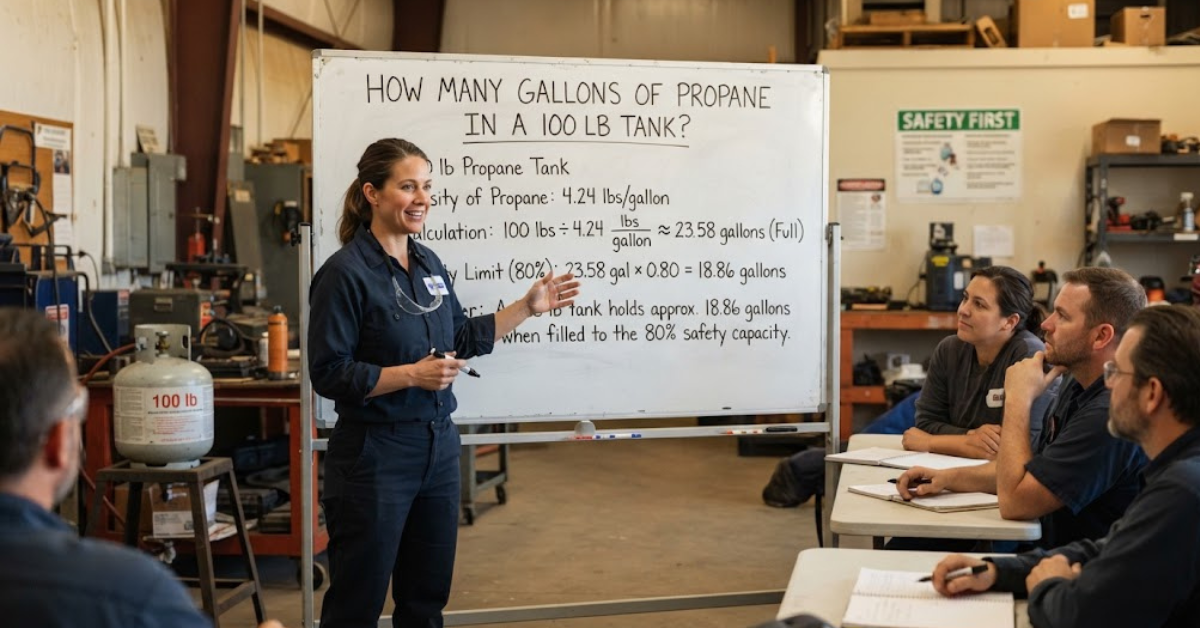
If you’re looking at a 100 lb propane tank and wondering how much fuel it actually contains, you’re not alone. Propane tanks are commonly labeled in pounds, while propane is often discussed and sold in gallons. So, how many gallons of propane are in a 100 lb tank?
The quick answer is about 23.6 U.S. gallons of liquid propane when converting 100 pounds directly to volume. One U.S. gallon of liquid propane weighs approximately 4.24 pounds at around 60°F, so 100 ÷ 4.24 gives about 23.6 gallons.
However, there’s an important detail: a 100 lb propane cylinder is not normally filled to 100% of its physical volume. Propane cylinders are generally filled to about 80% of their volumetric capacity, leaving room for the liquid propane to expand as temperatures change.
That distinction is what causes much of the confusion.
How Many Gallons Are in a 100 lb Propane Tank?
A 100 lb propane cylinder corresponds to approximately 23.6 gallons of liquid propane based on the standard conversion of 4.24 pounds per gallon.
Here’s the basic calculation:
100 pounds ÷ 4.24 pounds per gallon = 23.58 gallons
Rounded to one decimal place:
100 lb of propane ≈ 23.6 gallons
This is a conversion of 100 pounds of propane into liquid volume. It should not be confused with the empty space inside the cylinder or the amount you will necessarily receive during a particular fill.
Quick 100 lb propane conversion
| Measurement | Approximate amount |
| Propane weight | 100 lb |
| Propane volume | 23.6 U.S. gallons |
| Propane per gallon | 4.24 lb |
| Propane per pound | 0.236 gallon |
| Propane energy | About 2.36 million BTU* |
*The energy figure is an approximate calculation and can vary with the heating-value convention being used.
The 23.6-gallon conversion is based on liquid propane at approximately 60°F. Because propane’s density changes with temperature, the volume associated with a given weight can vary somewhat.
Does a 100 lb Tank Actually Hold 23.6 Gallons?
This is where things get a little more complicated.
When someone says a tank is a 100 lb propane tank, the “100 lb” designation refers to the amount of propane the cylinder is designed to contain at its rated fill, not the empty weight of the cylinder.
A propane cylinder also has its own steel weight. The empty cylinder is called the tare weight, or TW, and that number is stamped on the tank.
So if your cylinder weighs, for example, around 70 pounds empty, adding 100 pounds of propane would make the total weight roughly 170 pounds.
The exact empty weight varies by cylinder, manufacturer, model, and accessories.
100 lb propane tank: the important numbers
Think of the tank this way:
- 100 lb: rated propane contents
- About 23.6 gallons: equivalent liquid volume of 100 lb of propane
- Tank weight: separate from the propane
- 80% fill limit: refers to the cylinder’s volumetric capacity and provides expansion space
This is why you shouldn’t assume that an 80% reading on a gauge means there are only 80 pounds of propane inside.
Why Are Propane Tanks Filled to 80%?
The 80% rule is one of the most important things to understand when dealing with propane.
Liquid propane expands as its temperature rises. If a container were filled completely with liquid propane and then exposed to warmer temperatures, there would be little or no room for that expansion.
That is why propane cylinders are designed with space above the liquid level.
NFPA 58 describes volumetric filling for cylinders as limiting liquid LP-gas to 80% of the container’s capacity, with the space above the liquid providing room for expansion.
So the 80% figure is primarily about physical tank volume, not simply taking 100 pounds and multiplying it by 80%.
That’s an important distinction.
A common calculation mistake
You may see calculations like this:
100 lb × 80% = 80 lb
Then someone converts 80 pounds to gallons and concludes that a full 100 lb tank contains only about 18.9 gallons.
That can be misleading when applied to a properly designated 100 lb propane cylinder.
The “100 lb” rating already refers to the intended propane fill weight. The 80% limit relates to the cylinder’s physical capacity and the required vapor space.
In other words, don’t automatically apply another 80% reduction to the 100-pound propane rating.
How Many Gallons Is 100 Pounds of Propane?
The conversion is straightforward if you’re simply converting propane weight to liquid volume.
Use this formula:
Gallons = pounds of propane ÷ pounds per gallon
Using the commonly used 4.24 lb/gal value:
100 ÷ 4.24 = 23.58 gallons
So:
100 lb of propane ≈ 23.6 U.S. gallons
The reverse calculation is equally useful:
Gallons × 4.24 = pounds of propane
For example:
- 5 gallons ≈ 21.2 lb
- 10 gallons ≈ 42.4 lb
- 15 gallons ≈ 63.6 lb
- 20 gallons ≈ 84.8 lb
- 23.6 gallons ≈ 100 lb
These are approximate because liquid propane density changes with temperature.
How Much Propane Is in a 100 lb Tank at Different Levels?
If you know the amount of propane by weight, converting it to gallons is easy.
| Propane remaining | Approx. gallons |
| 100 lb | 23.6 gal |
| 90 lb | 21.2 gal |
| 80 lb | 18.9 gal |
| 70 lb | 16.5 gal |
| 60 lb | 14.2 gal |
| 50 lb | 11.8 gal |
| 40 lb | 9.4 gal |
| 30 lb | 7.1 gal |
| 20 lb | 4.7 gal |
| 10 lb | 2.4 gal |
For a quick estimate, you can remember:
1 pound of liquid propane ≈ 0.236 gallon.
That makes mental calculations fairly simple.
How to Tell How Much Propane Is Left in a 100 lb Tank
A 100 lb cylinder may not have the same convenient gauge information that you see on a large residential propane tank.
One practical method is weighing the cylinder.
Look for the TW, or tare weight, stamped on the collar or body of the cylinder. This tells you approximately how much the empty cylinder weighs.
Then:
Propane weight = total tank weight − tare weight
Once you know the approximate propane weight, divide by 4.24 to estimate the liquid gallons.
Example
Suppose:
- Total tank weight = 125 lb
- Tare weight = 65 lb
Then:
125 − 65 = 60 lb of propane
Now convert that to gallons:
60 ÷ 4.24 ≈ 14.2 gallons
So the cylinder would contain roughly 14.2 gallons of liquid propane under that approximation.
Always use the actual TW stamped on your cylinder rather than assuming every 100 lb tank weighs the same empty.
How Long Does a 100 lb Propane Tank Last?
There’s no single answer because propane consumption depends on the appliance using it.
A 100 lb propane tank can last very different lengths of time depending on whether you’re running a small cooking appliance or a high-output heater.
The biggest factors include:
- Appliance BTU rating
- Hours of operation
- Number of appliances
- Outdoor temperature
- Heating requirements
- Generator load
- Appliance efficiency
- Whether the appliance runs continuously or intermittently
Approximate propane consumption by BTU
A useful rule of thumb is that one gallon of propane contains roughly 91,500 BTU of energy.
If an appliance consumes 100,000 BTU per hour, its theoretical propane consumption at full output would be approximately:
100,000 ÷ 91,500 ≈ 1.09 gallons per hour
At roughly 23.6 gallons, 100 pounds of propane could theoretically provide around:
23.6 ÷ 1.09 ≈ 21.6 hours
But this is an energy calculation, not a promise of actual runtime. Appliances cycle on and off, and their rated BTU input and real operating conditions matter.
For lower-BTU appliances, the same tank can last considerably longer.
How Many BTUs Are in a 100 lb Propane Tank?
Liquid propane contains roughly 91,500 BTU per gallon under commonly used heating-value estimates.
Using 23.6 gallons:
23.6 × 91,500 ≈ 2.16 million BTU
So 100 pounds of propane contains approximately 2.16 million BTU of energy.
The actual useful heat delivered by an appliance will be lower than the fuel’s total energy content because appliances have efficiency losses.
This distinction becomes especially important when comparing propane heaters, furnaces, generators, and other equipment.
100 lb Propane Tank vs. 20 lb Tank
The familiar barbecue cylinder is usually a 20 lb propane cylinder. A 100 lb tank therefore represents roughly five times as much propane by weight.
Here’s a simple comparison:
| Tank size | Approx. propane weight | Approx. liquid propane |
| 20 lb | 20 lb | 4.7 gal |
| 30 lb | 30 lb | 7.1 gal |
| 40 lb | 40 lb | 9.4 gal |
| 100 lb | 100 lb | 23.6 gal |
These gallon figures are weight-to-volume conversions using approximately 4.24 lb per gallon.
A 100 lb cylinder can therefore provide substantially more fuel between refills than a standard 20 lb grill cylinder.
What Is the Difference Between a 100 lb Tank and a 100 Gallon Tank?
This is another common source of confusion.
A 100 lb propane tank and a 100 gallon propane tank are not the same thing.
The first is described by the weight of propane it is designed to contain. The second refers to the tank’s water capacity, which is a volume measurement.
For example, a large stationary propane tank may be described as a “100-gallon tank,” but it is normally filled to a maximum of about 80% of its volumetric capacity under typical cylinder/tank filling practices.
That means the numbers 100 lb and 100 gallons cannot be used interchangeably.
In simple terms
- 100 lb tank: about 23.6 gallons of propane by weight conversion
- 100 gallon tank: a much larger storage container, with its usable propane amount determined by its fill limit
Always check whether a propane tank is being described by pounds of propane or by water capacity/gallons of tank volume.
Does Temperature Change the Number of Gallons?
Yes.
Propane is unusual in that the amount of fuel is often discussed by both weight and volume, but those measurements behave differently as temperature changes.
A gallon of liquid propane occupies slightly different volumes at different temperatures because the liquid expands when warmed and contracts when cooled.
That is one reason propane is commonly handled and sold using weight-based measurements for portable cylinders.
The commonly used conversion of 4.24 lb per U.S. gallon is based around 60°F.
So if you’re trying to calculate exactly how much fuel is in a cylinder, remember that a gallon is a volume measurement while a pound is a mass measurement.
Can You Use a Propane Gauge to Measure Gallons?
Some propane tanks have percentage gauges, but those gauges should generally be treated as estimates rather than laboratory-precise measurements.
A gauge reading gives you an indication of the liquid level. It doesn’t necessarily tell you the exact number of gallons remaining.
For a rough estimate, you can use:
Estimated gallons remaining = tank capacity × approximate gauge fraction
But make sure you understand what capacity the gauge is referencing before doing the calculation.
If you need a more accurate estimate for a portable cylinder, weighing the cylinder and subtracting its tare weight can be useful.
How Much Does a Full 100 lb Propane Tank Weigh?
A “100 lb propane tank” does not weigh only 100 pounds when full.
The 100 pounds refers to the propane.
You also have to account for the weight of the empty steel cylinder.
For example, if a particular cylinder has a tare weight of 70 pounds:
70 lb tank + 100 lb propane = 170 lb total
The actual number will vary depending on the cylinder.
That’s why a full 100 lb propane cylinder can be difficult to move by hand. Use appropriate handling equipment and follow the manufacturer’s instructions.
What Are 100 lb Propane Tanks Used For?
A 100 lb propane cylinder is useful when a standard grill-sized cylinder isn’t enough fuel but a large permanent propane tank isn’t practical.
Common applications include:
- Larger outdoor cooking equipment
- Construction heaters
- Temporary heating
- Food-service equipment
- Generators
- Some RV applications
- Outdoor appliances
- Agricultural or work-site equipment
The correct tank size depends on the appliance and its fuel requirements.
It’s also important to follow local regulations, manufacturer instructions, and applicable propane-cylinder safety requirements.
How Much Does It Cost to Fill a 100 lb Propane Tank?
The cost depends on the propane price where you live and whether you’re charged by the gallon, pound, exchange, delivery, or another pricing method.
If a supplier charges $3.00 per gallon, for example, and you purchase the equivalent of 23.6 gallons:
23.6 × $3.00 = $70.80
At $4.00 per gallon:
23.6 × $4.00 = $94.40
These are examples, not current market prices.
Your actual cost can also include service fees, taxes, delivery charges, minimum purchase requirements, or other local pricing factors.
Is a 100 lb Propane Tank Bigger Than a 20 lb Tank?
Yes. A 100 lb cylinder contains about five times as much propane by weight as a 20 lb cylinder.
Using the 4.24 lb-per-gallon conversion:
- 20 lb ≈ 4.7 gallons
- 100 lb ≈ 23.6 gallons
So a 100 lb cylinder can offer substantially longer runtime, although the actual difference depends on the appliance consuming the propane.
100 lb Propane Tank: Quick Reference Chart
Here’s the information worth remembering:
| Question | Answer |
| How many gallons are in 100 lb of propane? | About 23.6 U.S. gallons |
| How much does 1 gallon weigh? | About 4.24 lb |
| How many gallons is 1 lb? | About 0.236 gallon |
| How much energy is in 100 lb? | Roughly 2.16 million BTU |
| Is a 100 lb tank 100 gallons? | No |
| Does the cylinder itself weigh 100 lb? | No |
| Does propane expand with heat? | Yes |
| Why is expansion space needed? | To accommodate temperature-related liquid expansion |
| Can exact gallons vary? | Yes, somewhat with temperature and measurement method |
Common Mistakes When Calculating Propane Tank Capacity
A few simple mistakes can produce surprisingly wrong answers.
1. Confusing pounds with gallons
A pound measures mass, while a gallon measures volume.
You need propane’s density to convert one into the other.
2. Assuming every propane gallon weighs exactly the same
The commonly used figure is approximately 4.24 lb per gallon at around 60°F. Temperature affects liquid density.
3. Confusing tank size with tank capacity
A “100 lb propane tank” doesn’t mean the steel container weighs 100 pounds.
It refers to the propane capacity by weight.
4. Applying the 80% rule twice
The 80% figure concerns the physical volumetric filling limit. You shouldn’t automatically multiply the 100 lb propane rating by another 80% when determining the intended propane contents of a 100 lb cylinder.
5. Treating a gauge as an exact measurement
Tank gauges are useful for estimating the remaining fuel level, but they aren’t necessarily precise enough to determine an exact gallon count.
Frequently Asked Questions About 100 lb Propane Tanks
How many gallons of propane are in a 100 lb tank?
A 100 lb propane tank corresponds to approximately 23.6 U.S. gallons of liquid propane using the standard conversion of about 4.24 pounds per gallon.
Is a 100 lb propane tank really 23.6 gallons?
The 23.6-gallon figure is the approximate liquid volume equivalent of 100 pounds of propane. It isn’t saying the physical tank has 23.6 gallons of geometric space available for propane at all times.
How much does a gallon of propane weigh?
One U.S. gallon of liquid propane weighs approximately 4.24 pounds at around 60°F. Temperature can change the exact volume-to-weight relationship.
How many gallons are in an 80 lb propane tank?
Using 4.24 lb per gallon:
80 ÷ 4.24 ≈ 18.9 gallons
So 80 pounds of propane is approximately 18.9 U.S. gallons.
How many gallons are in a 50 lb propane tank?
50 ÷ 4.24 ≈ 11.8 gallons
Therefore, 50 pounds of propane is approximately 11.8 gallons.
How many gallons are in a 40 lb propane tank?
40 ÷ 4.24 ≈ 9.4 gallons
A 40 lb propane cylinder therefore corresponds to about 9.4 gallons of liquid propane.
How many gallons are in a 20 lb propane tank?
20 ÷ 4.24 ≈ 4.7 gallons
A standard 20 lb propane cylinder contains approximately 4.7 gallons of propane when filled to its rated propane weight.
How long will a 100 lb propane tank last?
There isn’t one universal runtime. A 100 lb tank contains about 23.6 gallons of propane, but how quickly those gallons are consumed depends on the appliance’s BTU input and how long it operates.
A high-output heater can consume propane much faster than a grill or small cooking appliance.
Can I calculate propane remaining by weighing the tank?
Yes, as an estimate. Subtract the cylinder’s stamped tare weight from its total weight to estimate the propane weight, then divide that result by approximately 4.24 lb per gallon.
Is a 100 lb propane tank the same as a 100 gallon tank?
No. A 100 lb propane cylinder and a 100 gallon tank are different sizes described using different measurements. Never assume that “100 lb” means “100 gallons.”
Why isn’t a propane tank filled completely?
Liquid propane expands as it warms. Leaving vapor space helps accommodate this expansion and is an important part of safe cylinder filling. NFPA 58 describes an 80% volumetric filling limit for cylinders under its standard volumetric filling method.
Final Takeaway: How Many Gallons of Propane in a 100 lb Tank?
So, how many gallons of propane are in a 100 lb tank?
The simple conversion is about 23.6 U.S. gallons of liquid propane. That’s based on approximately 4.24 pounds of propane per gallon at around 60°F.
But remember that propane cylinders aren’t simply giant containers filled completely with liquid. The 100 lb designation refers to the propane’s rated weight, while the cylinder itself has a separate tare weight and is designed with expansion space.
If you’re trying to determine how much fuel you have left, check the tank’s tare weight, weigh the cylinder when appropriate, and use the propane weight-to-volume conversion for an estimate. For safety-critical questions about filling, storage, connections, or appliance operation, follow the cylinder manufacturer’s instructions and applicable local propane regulations.
Understanding the difference between pounds, gallons, tank capacity, and fill level makes propane calculations much easier—and can save you from ordering the wrong amount of fuel or misjudging how long a tank will last.