Have you ever stopped while writing and wondered whether itself or its self is the correct form? You are not alone. The two expressions look almost identical, but they do not work in the same way.
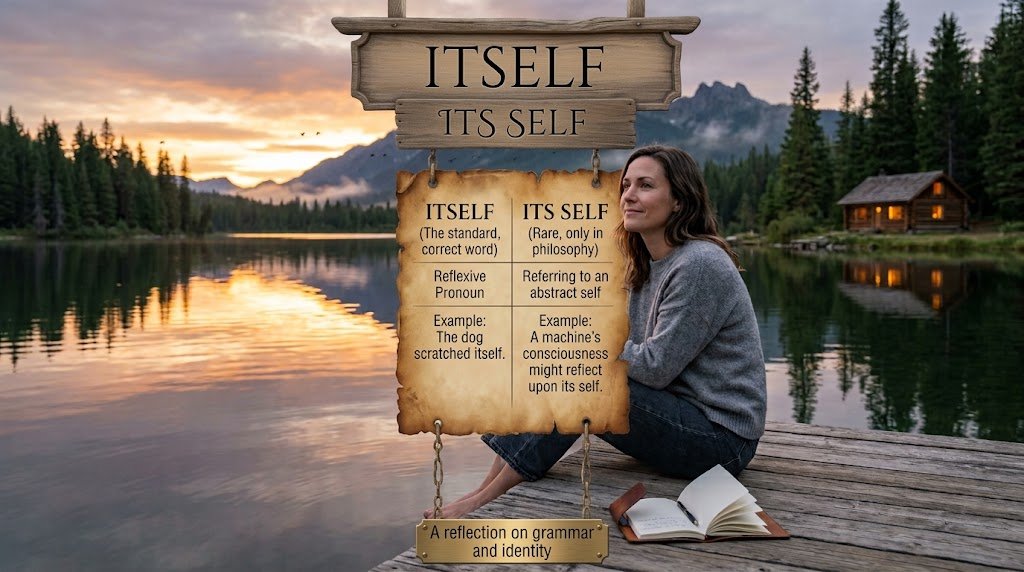
In standard English, itself is the normal and correct form when you need a reflexive or emphatic pronoun. Its self, with two separate words, is much less common and is used only when self is being treated as a separate noun.
Understanding the difference is easier than it first appears. Once you know what role each word plays in a sentence, choosing the right form becomes straightforward.
Itself or Its Self: What Is the Difference?
The main difference comes down to grammar.
Itself is a reflexive pronoun. It refers back to a thing, animal, organization, or other non-human subject that has already been mentioned.
For example:
- The machine switched itself off.
- The cat cleaned itself.
- The company has established itself as a market leader.
- The door opened by itself.
Here, itself functions as one word.
Its self, on the other hand, contains the possessive determiner its and the noun self. This construction can be grammatically possible when self is being discussed as a distinct concept or entity.
For example:
- The robot’s programmed identity was different from its self in the original design.
However, this construction is unusual in ordinary English. In most everyday sentences, itself is the form you want.
What Does Itself Mean?
Itself is the reflexive form of the pronoun it.
Reflexive pronouns are used when the subject and object of a sentence refer to the same thing.
Compare these examples:
- The dog hurt itself.
- The child hurt himself.
- She hurt herself.
- They hurt themselves.
The word itself tells us that the action comes back to the same thing represented by it.
It can also be used for emphasis.
For example:
The building itself is worth visiting.
In this sentence, itself emphasizes the building. The meaning is that the building, rather than just its surroundings or other attractions, is worth visiting.
When Should You Use Itself?
There are several common situations where itself is the correct choice.
1. When a Thing Acts on Itself
Use itself when the subject and object refer to the same thing.
Examples:
- The computer restarted itself.
- The bird injured itself.
- The plant can protect itself from insects.
- The system automatically updates itself.
Without itself, the meaning can become incomplete or unclear.
2. For Emphasis
Itself can emphasize a noun or pronoun.
For example:
- The idea itself is interesting.
- The product itself is not expensive.
- The city itself is beautiful.
- The problem itself is easy to solve.
Here, itself does not mean that the noun literally performs an action on itself. Instead, it adds emphasis.
3. After Certain Prepositions
You may also see itself after a preposition when referring back to something previously mentioned.
Examples include:
- The plan has problems within itself.
- The system can operate on itself.
- The machine moves by itself.
The exact construction depends on the meaning of the sentence, but itself remains a single word.
What Does “Its Self” Mean?
Its self is grammatically different because its and self are separate words.
The word its shows possession. It tells us that something belongs to or is associated with another thing.
For example:
- The company changed its policy.
- The dog wagged its tail.
- The machine lost its power.
The word self is a noun referring to an individual’s identity, nature, or being.
So, in a very specific context, its self can mean something like “the self or identity belonging to it.”
This wording is uncommon in normal conversation and general writing. It tends to appear in philosophical, psychological, literary, or highly technical discussions where self is being treated as an independent concept.
For everyday English, writing its self when you mean the reflexive pronoun is usually a mistake.
Itself vs. Its Self Examples
Looking at the two forms side by side makes the distinction clearer.
| Expression | Typical use | Example |
| itself | Reflexive pronoun | The machine repaired itself. |
| itself | Emphasis | The machine itself is expensive. |
| its | Shows possession | The machine lost its power. |
| its self | Rare, special construction | The philosophical discussion examined its self. |
The important point is that itself is by far the more common form.
Common Mistakes With Itself
One of the most common mistakes is separating itself into two words.
Incorrect in normal reflexive usage:
The computer turned its self off.
Correct:
The computer turned itself off.
Another example:
Incorrect:
The company introduced its self to the market.
Correct:
The company introduced itself to the market.
The same rule applies when itself is being used for emphasis.
Incorrect:
The product its self is not the problem.
Correct:
The product itself is not the problem.
Itself or It Self?
Another variation that sometimes causes confusion is it self.
In standard English, it self is not normally used as a grammatical unit. When you need the reflexive pronoun, the correct spelling is:
itself
There should be no space between it and self.
For example:
- The door closed itself.
- The program fixed itself.
- The animal protected itself.
So if you are writing an ordinary sentence and are deciding between itself, it self, and its self, itself will almost always be the correct choice.
Why Is Itself Written as One Word?
English reflexive pronouns are generally written as single words.
Consider:
- myself
- yourself
- himself
- herself
- itself
- ourselves
- yourselves
- themselves
These words combine a personal pronoun or possessive form with self or selves.
That is why itself follows the same pattern.
You would not normally write:
- my self
- your self
- her self
- its self
when you are using a standard reflexive pronoun.
Instead, you write:
- myself
- yourself
- herself
- itself
There are special contexts where expressions such as my self can appear because self is being used as a separate noun. But that is a different grammatical situation.
How to Remember the Difference
A simple trick can help.
Ask yourself:
Am I talking about something doing something to itself, or am I emphasizing the thing?
If the answer is yes, use itself.
For example:
The phone turned itself off.
The phone is both the subject and the thing affected by the action.
Or:
The phone itself is not expensive.
Here, itself emphasizes the phone.
If you genuinely mean the self belonging to something, its self may be possible. But that is a specialized construction, not the normal reflexive form.
Itself in Formal and Informal Writing
The word itself is perfectly acceptable in both formal and informal English.
You can use it in:
- Academic writing
- Business writing
- Emails
- Blog posts
- News articles
- Everyday conversations
- Technical documents
Examples:
The research itself provides useful evidence.
The software can update itself automatically.
The policy itself needs to be reviewed.
There is no need to replace itself with a more complicated expression. It is a standard English pronoun.
Itself vs. Other Reflexive Pronouns
Understanding itself becomes easier when you compare it with the other reflexive pronouns.
- I → myself
- You → yourself
- He → himself
- She → herself
- It → itself
- We → ourselves
- You → yourselves
- They → themselves
For example:
I taught myself Spanish.
She prepared herself for the interview.
They introduced themselves.
The machine switched itself off.
The form changes depending on the subject.
A Quick Test for Itself
If you are unsure whether itself belongs in a sentence, replace it mentally with another reflexive pronoun.
For example:
The dog washed itself.
Imagine the subject were she:
She washed herself.
That sounds natural, so itself is also correct for the non-human subject.
Another example:
The company itself made the announcement.
You could compare it with:
The manager herself made the announcement.
This shows that itself is functioning as an emphatic reflexive pronoun.
Frequently Asked Questions
Is “itself” one word?
Yes. Itself is normally written as one word when it is used as the reflexive or emphatic form of it.
Is “its self” ever correct?
It can be grammatically possible when its is functioning as a possessive determiner and self is being used as a separate noun. However, this is uncommon and usually appears in specialized philosophical, psychological, or literary contexts.
Which is correct: itself or its self?
For normal English usage, itself is correct. Use it when referring back to it or emphasizing a thing.
Is “it self” correct?
Not when you need the reflexive pronoun. The correct form is itself, without a space.
Can itself be used for emphasis?
Yes. For example: “The house itself is beautiful.” Here, itself emphasizes the house.
What is the difference between its and itself?
Its shows possession, while itself is a reflexive or emphatic pronoun.
For example:
The company changed its name.
The company introduced itself.
Is “its self” the same as “itself”?
No. Although the expressions look similar, they have different grammatical structures. Itself is the standard reflexive pronoun, while its self uses self as a separate noun.
Final Thoughts
When deciding between itself or its self, the answer is usually simple: choose itself.
Use itself when a thing acts on itself or when you want to emphasize that thing. The two-word form its self has a much narrower use and should not replace the standard reflexive pronoun.
A good rule to remember is this: if you could use myself, yourself, himself, or herself in a similar sentence, itself is almost certainly the form you need.
Once you get used to that pattern, this small grammar question becomes much easier to handle.