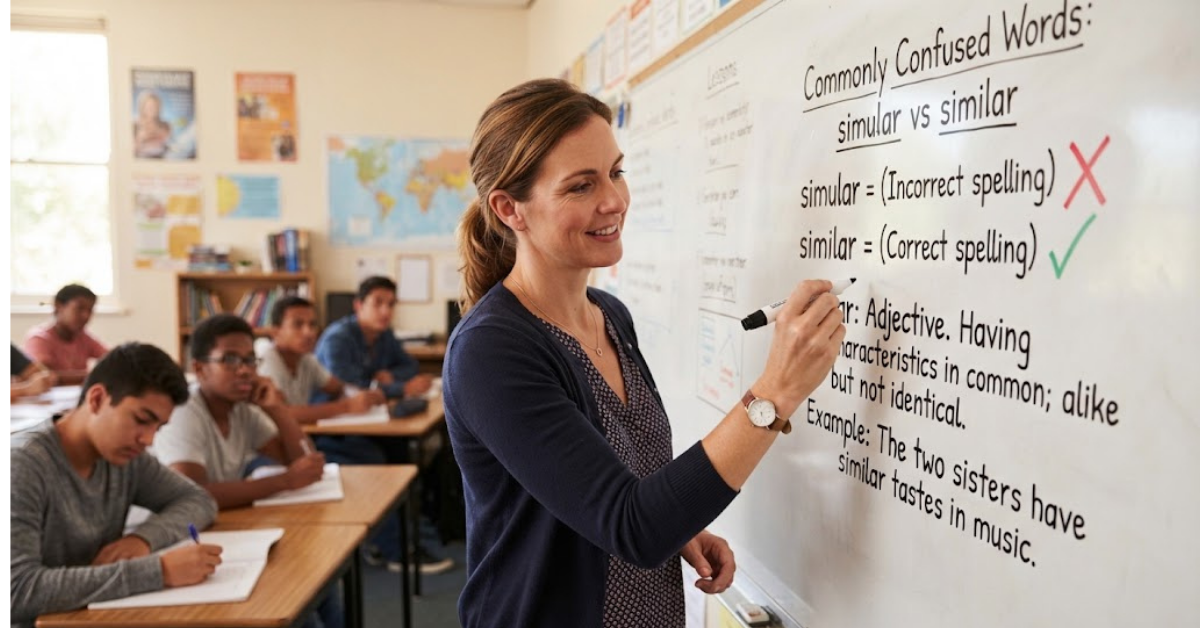
Have you ever typed a word and suddenly wondered if you got one letter wrong? If you’re choosing between simular vs similar, the correct spelling is similar.
“Simular” is a common spelling mistake, not the standard spelling of the English word. The confusion often happens because similar is pronounced differently from how some people expect it to sound, making the i and u easy to mix up.
In this guide, we’ll explain simular vs similar, define the word similar, look at common examples, and share an easy trick for remembering the correct spelling.
Simular vs Similar: Which One Is Correct?
The correct spelling is similar.
| Spelling | Correct? | Example |
| Similar | Yes | The two designs look similar. |
| Simular | No | The two designs look simular. |
The standard English word is:
S-I-M-I-L-A-R — similar
There is no standard English spelling simular for the adjective meaning “alike” or “having qualities in common.”
So, whenever you’re deciding between simular or similar, choose similar.
Correct spelling
Similar
Incorrect spelling
Simular
If you’re writing an email, essay, report, website, or social media post, similar is the form you should use.
What Does Similar Mean?
Similar means having qualities, characteristics, appearances, or features that are alike, although the things being compared are not necessarily identical.
For example:
The two houses have similar designs.
This means the houses share some design features, but they are not exactly the same.
Other examples include:
- The two products are similar in price.
- We have similar interests.
- These colors look similar.
- Their experiences were similar.
- The two situations are remarkably similar.
The word is useful whenever you want to compare two or more things that have something in common.
Similar as an Adjective
Similar is primarily used as an adjective.
An adjective describes a person, place, thing, or idea. In this case, similar describes the relationship between things that resemble one another.
For example:
Sarah and Maria have similar opinions.
Here, similar describes the relationship between their opinions.
Another example:
The two cars are similar.
The adjective tells us that the cars share certain characteristics.
Simular vs Similar: What Is the Difference?
The difference is straightforward:
- Similar = correct English spelling
- Simular = misspelling
Simular does not normally function as an alternative spelling of similar in standard English.
For example:
Incorrect:
The two answers are simular.
Correct:
The two answers are similar.
Another example:
Incorrect:
We had a simular experience.
Correct:
We had a similar experience.
The meaning you want determines the word, but when you mean “alike,” the correct spelling is similar.
Why Do People Spell Similar as Simular?
The mistake is understandable for several reasons.
1. Pronunciation can be misleading
The pronunciation of similar does not always make the spelling immediately obvious. Depending on accent and speaking speed, the middle of the word can sound less distinct than it looks when written.
This can lead someone to hear a vowel sound and choose u instead of i.
2. English spelling isn’t always phonetic
English contains many words whose pronunciation cannot be predicted perfectly from their spelling.
As a result, people sometimes spell unfamiliar or less frequently written words according to how they sound.
3. The incorrect version looks plausible
Simular looks like it could be an English word. The ending is familiar, and the overall structure resembles similar.
That visual familiarity can make the mistake surprisingly easy to overlook.
4. Fast typing
Sometimes the explanation is simply speed. When you’re typing quickly, a single vowel can easily be entered incorrectly.
How to Spell Similar Correctly
A useful way to remember the spelling is to focus on the middle:
SIM-I-LAR
The word begins with:
SIM
Think of similar as starting with sim-, just like:
- similarity
- similarly
- simulate
However, be careful with simulate: although it looks related, similar and simulate have different meanings and etymological histories.
The simplest memory trick is:
Similar has “i” after the m: sim-i-lar.
So remember:
SIMILAR
SIMULAR
Similar and Similarity
A useful way to understand similar is to connect it with the noun similarity.
Similar describes things that are alike:
The two paintings are similar.
Similarity refers to the quality or degree of being alike:
There is a strong similarity between the paintings.
This relationship can help reinforce the spelling.
Common related words
- Similar — adjective
- Similarity — noun
- Similarly — adverb
Examples:
The two plans are similar.
There is a clear similarity between the plans.
Similarly, both companies changed their policies.
Notice that all three forms begin with simil-.
Similar vs Same: Are They the Same?
Not exactly.
This is an important distinction.
Same generally means identical or exactly matching in the relevant respect.
Similar means alike in some ways but not necessarily identical.
Compare:
The two shirts are the same.
This suggests they are identical or effectively identical.
Now compare:
The two shirts are similar.
This means they have some characteristics in common, such as color, style, or material, but they may still be different.
So:
- Same = identical or matching
- Similar = alike but not necessarily identical
Similar vs Alike
Similar and alike have closely related meanings, but their grammar is slightly different.
You can say:
The two buildings are similar.
You can also say:
The two buildings are alike.
But you would not normally say:
The two buildings are similar to each other in every grammatical construction where alike could appear.
A particularly common structure is:
similar to
For example:
This phone is similar to my old one.
The word similar is commonly followed by to, not with.
Common structure
similar to something
Examples:
- This design is similar to the original.
- Her situation is similar to mine.
- The new model is similar to the previous version.
How to Use Similar in a Sentence
Here are several natural examples:
- The two houses look similar.
- We have similar interests.
- This product is similar to the one I bought last year.
- Their stories are surprisingly similar.
- The two computers have similar specifications.
- I had a similar experience at work.
- These two colors are very similar.
These examples show how frequently the word appears in everyday and professional English.
Common Phrases With Similar
Learning common combinations can make the word easier to remember.
Similar to
This situation is similar to what happened last year.
The Similar in appearance
The twins are similar in appearance.
Similar in size
The two boxes are similar in size.
Similar interests
We have similar interests.
The Similar situation
Many people have faced a similar situation.
Similar results
Both experiments produced similar results.
These phrases appear frequently in conversation, academic writing, business communication, and online content.
What Is the Opposite of Similar?
The opposite of similar depends on the context.
Common opposites include:
- Different
- Dissimilar
- Unlike
- Distinct
- Unrelated
For example:
The two products are similar.
Opposite:
The two products are different.
Another example:
Their opinions are similar.
Opposite:
Their opinions are completely different.
The most common everyday opposite is different.
Similar in Formal and Informal English
Similar is a standard English word that works comfortably in both casual and formal writing.
You might use it in:
- Everyday conversation
- Emails
- Academic essays
- Business reports
- Scientific writing
- Product descriptions
- News articles
- Technical documentation
For example, a casual sentence might be:
Your jacket looks similar to mine.
A more formal sentence could be:
The study produced results similar to those observed in earlier research.
The word itself remains unchanged.
Common Spelling Mistakes With Similar
The most common mistake is:
Simular
Correct:
Similar
You may also see other accidental variations when people type quickly. The safest approach is to remember the standard spelling:
S-I-M-I-L-A-R
If you’re unsure, checking the word in a dictionary or using a spell-checker can help.
Is “Simular” Ever Correct?
In standard modern English, simular is not the accepted spelling of the adjective meaning “alike.”
If you encounter simular in an English sentence where the intended meaning is “similar,” it is most likely a spelling error.
Therefore, use:
Similar
rather than:
Simular
How to Avoid the Simular Spelling Mistake
If you frequently confuse simular vs similar, try these simple techniques:
- Remember SIM-I-LAR.
- Focus on the two i sounds/letters in the middle of the word.
- Connect similar with similarity and similarly.
- Write the word in a few sentences.
- Use spell-check when preparing important documents.
- Remember that simular is not the standard spelling.
A particularly useful memory connection is:
SIMILAR → SIMILARITY → SIMILARLY
All three begin with simil-.
Simular or Similar in a Sentence
Compare the following examples.
Incorrect:
The new design is simular to the old one.
Correct:
The new design is similar to the old one.
Incorrect:
They have simular interests.
Correct:
They have similar interests.
Incorrect:
The two problems are simular.
Correct:
The two problems are similar.
Once you remember similar, this common spelling mistake becomes much easier to avoid.
Frequently Asked Questions
Is it simular or similar?
Similar is correct. Simular is a spelling mistake.
How do you spell similar?
The correct spelling is:
S-I-M-I-L-A-R — similar.
Is “simular” a word?
Simular is not the standard English spelling of the word meaning “alike.” If you mean “alike,” use similar.
What does similar mean?
Similar means having qualities or characteristics that are alike without necessarily being exactly the same.
What is the difference between similar and same?
Same generally means identical or matching, while similar means alike in certain respects but not necessarily identical.
What is the difference between similar and alike?
Both words mean that things have qualities in common. However, similar is commonly used in the structure similar to, while alike is often used after a linking verb, as in “The two houses look alike.”
Is similar an adjective?
Yes. Similar is primarily an adjective.
Example:
The two products are similar.
What is the noun form of similar?
The noun form is similarity.
Example:
There is a strong similarity between the two designs.
What is the adverb form of similar?
The adverb is similarly.
Example:
Similarly, the second study produced comparable results.
What is the opposite of similar?
Common opposites include different, dissimilar, unlike, and distinct.
Should I write “similar to” or “similar with”?
The standard construction is usually similar to.
For example:
This model is similar to the previous one.
Conclusion: Simular vs Similar
When choosing between simular vs similar, the correct spelling is similar. Simular is a common spelling error and should not be used when you mean “alike” or “having qualities in common.”
Remember the spelling as:
S-I-M-I-L-A-R
You can also connect it with similarity and similarly, which share the simil- spelling pattern.
So, the next time you wonder “simular or similar?”, choose similar with confidence. Whether you’re writing an email, essay, report, or casual message, similar is the standard English form.