Thirty inches might sound straightforward, but numbers on their own aren’t always easy to picture. If someone tells you that a table is 30 inches high, a box is 30 inches long, or an object measures 30 inches, you may still wonder what that actually looks like.
So, how tall is 30 inches? Thirty inches is exactly 2 feet 6 inches, or 76.2 centimetres. It’s also 0.762 metres.
In this guide, we’ll break down 30 inches, convert it into different units, and compare it with familiar household objects and the human body. By the end, you’ll have a much better mental picture of how big 30 inches really is.
How Tall Is 30 Inches?
The simplest answer is:
30 inches = 2 feet 6 inches
Because one foot contains 12 inches:
30 ÷ 12 = 2 feet with 6 inches remaining
So you can write 30 inches as:
2’6″
In metric measurements:
30 inches = 76.2 cm
That makes 30 inches just over three-quarters of a metre.
30 Inches at a Glance
| Measurement | Equivalent |
| Inches | 30 inches |
| Feet and inches | 2 ft 6 in |
| Decimal feet | 2.5 ft |
| Centimetres | 76.2 cm |
| Metres | 0.762 m |
| Millimetres | 762 mm |
| Yards | 0.8333 yd |
For everyday use, 2 feet 6 inches and 76.2 cm are the most useful conversions.
How Big Is 30 Inches?
When someone asks how big is 30 inches, the answer depends on what direction you’re measuring.
Thirty inches is a length, not a specific shape or volume. A 30-inch measurement could describe:
- The height of a piece of furniture
- The width of a television
- The length of a board
- The diameter of a circular object
- The height of a small child
- The length of a storage container
- The width of a countertop
So two objects can both measure 30 inches while looking completely different.
For example, a 30-inch-long board is narrow and elongated, while a 30-inch-wide circular object covers a much larger area.
The number tells you the distance between two points. The shape determines how that measurement looks.
30 Inches Compared to a Human
One of the easiest ways to visualize a measurement is to compare it with the human body.
30 inches is 2 feet 6 inches, or 76.2 cm.
For an adult, that’s considerably shorter than full body height. A 30-inch vertical measurement reaches only partway up the body.
If you’re standing beside a 30-inch object, it would generally come to somewhere around the knee or lower-thigh region, depending on your height and proportions.
That’s only a rough visualization because people’s leg lengths and body proportions vary.
A 30-Inch Vertical Object
Imagine placing a measuring tape vertically on the floor.
At the 30-inch mark, you’ve reached:
2 feet + 6 inches
For an adult, this is well below waist height.
For a child, however, 30 inches can represent a much more substantial portion of their total height.
That’s why saying “30 inches tall” means something very different depending on whether you’re describing furniture, an adult, or a child.
Is 30 Inches Half a Person’s Height?
For most adults, no.
An adult who is 5 feet 6 inches tall, for example, is 66 inches tall. Thirty inches would therefore be less than half of that person’s total height.
Someone who is 6 feet tall measures 72 inches. In that case, 30 inches represents:
30 ÷ 72 × 100 ≈ 41.7%
So a 30-inch height is a little under half of a 6-foot person’s height.
This is a useful way to understand why 30 inches looks relatively short next to a typical adult.
30 Inches in Feet
If you’re more familiar with feet than inches, the conversion is easy.
There are 12 inches in one foot.
So:
30 ÷ 12 = 2.5 feet
Therefore:
30 inches = 2.5 feet
However, when describing height, people usually don’t say “2.5 feet tall.”
They would normally say:
2 feet 6 inches
The decimal version is more useful for mathematical calculations, while feet and inches are more natural for everyday height descriptions.
30 Inches in Centimetres
To convert inches into centimetres, use the standard conversion:
1 inch = 2.54 centimetres
Therefore:
30 × 2.54 = 76.2 cm
So:
30 inches = 76.2 centimetres
You may also see this rounded to:
- 76.2 cm — exact conversion
- 76 cm — rounded to the nearest centimetre
- 0.762 m — metres
If you’re measuring furniture or another physical object, 76.2 cm is the most precise of these common versions.
30 Inches in Metres
Since 100 centimetres make one metre:
76.2 ÷ 100 = 0.762 metres
Therefore:
30 inches = 0.762 metres
For a quick mental estimate, you can think of 30 inches as approximately 0.76 metres.
That’s slightly more than three-quarters of a metre.
30 Inches Compared With Common Heights
Looking at nearby measurements can make 30 inches easier to visualize.
| Measurement | Inches | Centimetres |
| 1 ft 6 in | 18 in | 45.72 cm |
| 2 ft | 24 in | 60.96 cm |
| 2 ft 6 in | 30 in | 76.2 cm |
| 3 ft | 36 in | 91.44 cm |
| 3 ft 6 in | 42 in | 106.68 cm |
| 4 ft | 48 in | 121.92 cm |
| 5 ft | 60 in | 152.4 cm |
| 6 ft | 72 in | 182.88 cm |
This puts 30 inches neatly between 2 feet and 3 feet.
It’s exactly 6 inches taller than 2 feet and 6 inches shorter than 3 feet.
30 Inches Compared to 2 Feet
This is perhaps the simplest comparison.
Two feet equals:
24 inches
Thirty inches equals:
30 inches
The difference is:
30 − 24 = 6 inches
So 30 inches is exactly half a foot longer than 2 feet.
Another way to look at it is:
2 feet 6 inches = 30 inches
30 Inches Compared to 3 Feet
Three feet equals:
36 inches
Thirty inches is therefore:
36 − 30 = 6 inches shorter than 3 feet
So 30 inches sits directly in the middle of the range between 2 and 3 feet.
That makes it particularly easy to visualize:
2 feet → 30 inches → 3 feet
with exactly 6 inches separating each point.
Everyday Objects That Are Around 30 Inches
If you’re trying to understand how big is 30 inches, everyday objects can provide useful reference points.
Depending on the specific model or design, measurements around 30 inches can be found in:
- Small tables
- Some desks
- Coffee tables
- Kitchen appliances
- Suitcases
- Storage boxes
- Shelving units
- Small televisions
- Computer monitors
- Pieces of lumber
- Countertop sections
However, don’t assume that an object described as “30 inches” measures 30 inches in every direction.
For example, a television advertised as a 30-inch screen normally refers to the diagonal screen measurement, not its width.
That’s an important distinction.
What Does a 30-Inch TV Actually Mean?
Television sizes are commonly described using the diagonal measurement of the screen.
So if a TV is marketed as having a 30-inch screen, that doesn’t mean it is 30 inches wide.
The measurement runs diagonally from one corner of the display to the opposite corner.
The actual width and height depend on the screen’s aspect ratio and bezel design.
This is a good example of why the phrase “30 inches” needs context.
A 30-inch-long table and a 30-inch TV don’t necessarily have the same physical dimensions.
How Long Is 30 Inches on a Ruler?
Most ordinary rulers are 12 inches long.
That means:
30 inches = 2 full 12-inch rulers + 6 inches
So if you placed two standard 12-inch rulers end-to-end, you’d have:
24 inches
You’d need another 6 inches to reach 30.
This is a handy way to visualize 30 inches when you don’t have a long measuring tape available.
How to Measure 30 Inches
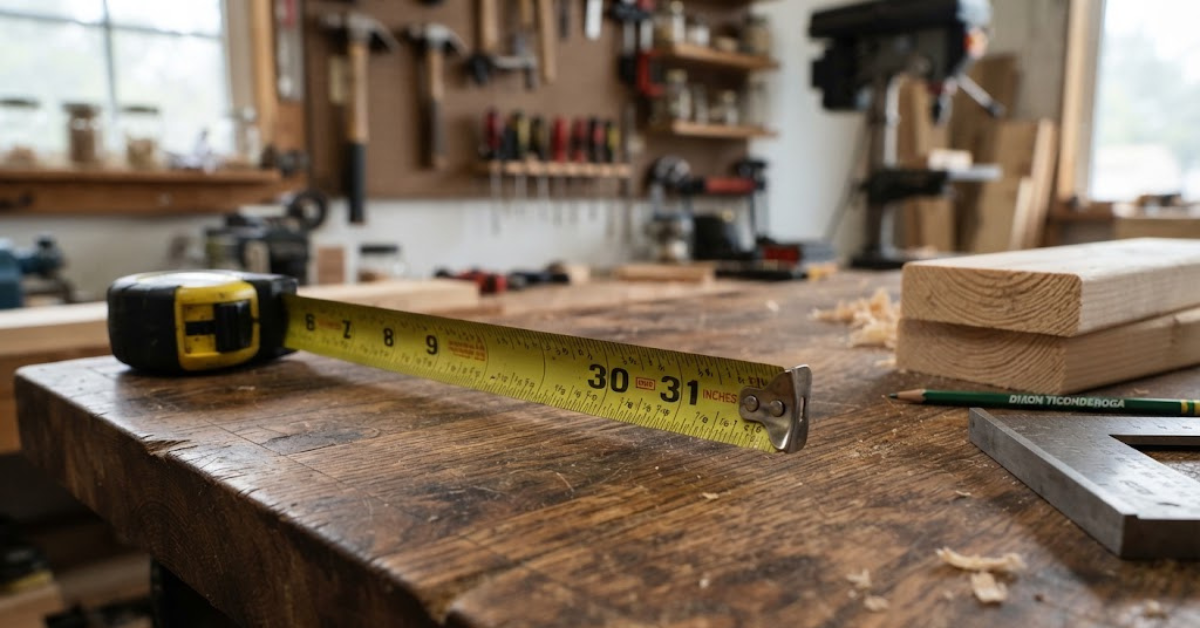
If you need to physically measure a 30-inch distance, a tape measure is the easiest option.
Simply extend the tape from the starting point to the 30-inch mark.
On a tape measure showing feet and inches, the mark will correspond to:
2 feet 6 inches
On a metric tape, look for:
76.2 cm
For More Accurate Measurements
Follow these simple steps:
- Start at the zero mark.
- Keep the tape straight.
- Avoid bending or sagging.
- Read the measurement directly at the endpoint.
- Check whether your tape is displaying inches, centimetres, or both.
If the measurement is important for construction, furniture, or another project, don’t rely on visual estimation.
Even a small measuring error can matter when two pieces need to fit together.
30 Inches for Furniture Measurements
Thirty inches appears frequently in furniture dimensions.
For example, a table might be approximately 30 inches high, although the exact height varies depending on its purpose.
A dining table, desk, side table, and coffee table are designed at different heights, so you should always check the manufacturer’s specifications rather than assuming that every 30-inch table serves the same purpose.
When shopping for furniture, pay attention to all three dimensions:
- Height
- Width
- Depth
A product listed as 30 inches wide isn’t necessarily 30 inches tall.
30 Inches Compared With a Human Arm
Another way to visualize 30 inches is to think about arm length.
A person’s arm span and individual limb measurements vary considerably, so there isn’t one universal human arm length that equals 30 inches.
For many adults, however, 30 inches is a substantial portion of the distance from the shoulder to the hand.
It’s better to use this as a rough visual comparison rather than an exact biological measurement.
For an accurate reference, a ruler or tape measure remains the better choice.
How Much Is 30 Inches in Other Units?
Here’s a more complete conversion table.
| Unit | 30 Inches |
| Inches | 30 |
| Feet | 2.5 |
| Feet & inches | 2 ft 6 in |
| Centimetres | 76.2 cm |
| Metres | 0.762 m |
| Millimetres | 762 mm |
| Yards | 0.8333 yd |
| Miles | 0.0004735 mi |
The most useful conversions for everyday situations are usually 30 inches = 2 feet 6 inches = 76.2 cm.
Is 30 Inches a Large Measurement?
It depends entirely on what you’re measuring.
For a piece of furniture, 30 inches can be a normal or substantial dimension.
For a person’s height, 30 inches is relatively short compared with adult height.
The length of a board, it is fairly manageable.
For the diagonal size of a screen, it’s a moderate display size.
This is why measurements should always be considered in context.
A number alone doesn’t tell you whether something is “large” or “small.”
30 Inches vs 36 Inches
Comparing 30 inches with 36 inches is useful because 36 inches equals exactly 3 feet.
The difference is:
36 − 30 = 6 inches
Therefore, 30 inches is:
6 inches shorter than 3 feet
In centimetres:
- 30 inches = 76.2 cm
- 36 inches = 91.44 cm
The difference is 15.24 cm.
So if you are looking at a 30-inch and 36-inch object, the 36-inch measurement is half a foot longer.
30 Inches vs 24 Inches
The difference between 24 and 30 inches is also exactly 6 inches.
Since 24 inches equals 2 feet:
30 inches = 2 feet 6 inches
This gives you a simple mental reference:
- 24 inches = 2 feet
- 30 inches = 2 feet 6 inches
- 36 inches = 3 feet
Each step increases by exactly 6 inches.
A Quick 30-Inch Visual Guide
If you need to picture 30 inches quickly, remember this sequence:
12 inches = 1 foot
24 inches = 2 feet
30 inches = 2 feet 6 inches
36 inches = 3 feet
48 inches = 4 feet
So 30 inches is closer to 2 feet than 3 feet, but exactly halfway between them.
Another useful mental shortcut is to think of 30 inches as about 76 centimetres.
That gives you a good approximation even when you’re more comfortable with metric measurements.
Common Mistakes When Measuring 30 Inches
Even simple measurements can cause confusion.
Mistake 1: Confusing 2.5 Feet With 2 Feet 5 Inches
They’re not the same.
2.5 feet = 2 feet 6 inches.
The decimal represents half of a foot, and half of 12 inches is 6 inches.
Mistake 2: Assuming 30 Inches Means 30 Inches Wide
It depends on the context.
A product might use 30 inches to describe its:
- Height
- Width
- Depth
- Length
- Diameter
- Diagonal
Always check what dimension the manufacturer is referring to.
Mistake 3: Confusing Screen Size With Screen Width
A 30-inch television or monitor usually refers to its diagonal screen measurement.
The physical width will be less than 30 inches.
Mistake 4: Relying on Visual Estimates
Humans aren’t particularly good at judging exact distances by sight.
If a project requires a 30-inch measurement, use a tape measure instead of guessing.
Frequently Asked Questions About 30 Inches
How tall is 30 inches?
30 inches is 2 feet 6 inches tall, which is equal to 76.2 centimetres or 0.762 metres.
How big is 30 inches?
30 inches is a length of 2 feet 6 inches or 76.2 cm. How large it appears depends on what you’re measuring and whether the measurement represents height, width, length, diameter, or diagonal.
What is 30 inches in feet?
30 inches equals 2.5 feet, or 2 feet 6 inches.
What is 30 inches in cm?
30 inches = 76.2 cm.
To calculate it, multiply 30 by 2.54.
Is 30 inches 2 feet 6 inches?
Yes. Two feet equals 24 inches, and adding 6 inches gives 30 inches.
Is 30 inches half of 5 feet?
Yes. Five feet equals 60 inches, and 30 inches is exactly half of 60 inches.
How does 30 inches compare to a human?
For most adults, 30 inches represents considerably less than their full height. A 30-inch vertical object would generally reach somewhere around the lower-thigh to knee region, depending on the person’s height and proportions.
Is 30 inches close to 3 feet?
Yes. Three feet is 36 inches, so 30 inches is exactly 6 inches shorter.
Is 30 inches a good height for a table?
It can be, depending on the type of table and its intended use. Many tables are designed around this general height range, but the ideal dimension depends on the furniture’s purpose and the user’s needs.
How many centimetres are in 30 inches?
There are 76.2 centimetres in 30 inches.
How many millimetres are in 30 inches?
30 inches equals 762 millimetres.
How can I measure 30 inches without a tape measure?
You can use two standard 12-inch rulers plus another 6 inches. However, if accuracy matters, a proper tape measure is the better option.
Is 30 inches the same as 76 cm?
Not exactly. 30 inches is 76.2 cm. Seventy-six centimetres is slightly shorter, although the difference is small for casual comparisons.
Conclusion: Understanding 30 Inches
So, how tall is 30 inches? The simplest answer is 2 feet 6 inches, or 76.2 centimetres.
When thinking about 30 inches compared to a human, remember that it represents less than half the height of most adults. As a physical object, however, 30 inches can be a useful and substantial measurement for furniture, shelves, boards, screens, and many other everyday items.
If you’re wondering how big is 30 inches, the best mental shortcut is to picture a distance of 2 feet 6 inches or roughly 76 centimetres. It’s exactly halfway between 2 feet and 3 feet, making it relatively easy to visualize once you have those reference points.
The next time you encounter a 30-inch measurement, don’t just look at the number. Convert it into the unit you’re most comfortable with, compare it with something familiar, and consider what dimension the measurement actually describes. That’s the easiest way to turn 30 inches from an abstract number into a measurement you can picture.