
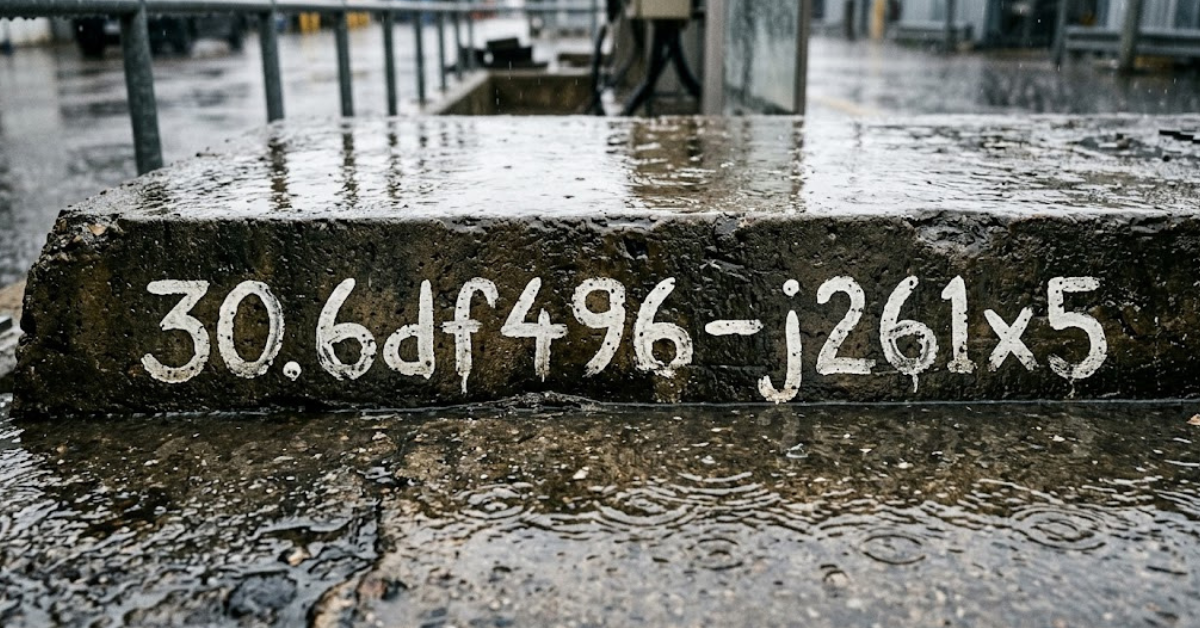
Have you ever come across a strange combination of letters, numbers, and symbols online and wondered whether it refers to a chemical, a product, or something you should mix with water? The phrase 30.6df496–j261x5 with water is an example of a search term that raises questions but does not provide an obvious answer.
The important thing to understand is that the code does not have a verified, widely established identity as a chemical substance, food ingredient, or water additive based on the available public information. Several websites discuss possible interpretations, but their explanations do not establish what the code actually represents.
In this guide, we’ll look at what the phrase might mean, how to investigate its origin, and why you should never assume that an unfamiliar code is safe to mix with water.
What Is 30.6df496–j261x5 With Water?
The phrase combines two elements: an unusual alphanumeric string, 30.6df496–j261x5, and the words “with water.”
On its own, the string does not provide enough information to identify a particular substance or product. It could be an internal reference, a software-generated identifier, a product or batch code, a sample number, or something else entirely. These are possible explanations, not confirmed meanings.
The words “with water” are equally ambiguous. Depending on where the phrase originated, they might refer to a water-related test, a product description, an experimental condition, or simply the wording of an online search.
The most reliable starting point is to find the original source where the complete phrase appeared.
Breaking Down the 30.6df496–j261x5 Code
The combination of numbers, letters, a decimal point, and a hyphen can make the string look scientific. However, the appearance of a code does not establish its purpose.
Consider its components:
- 30.6: This could be a number within an identifier, but there is no verified evidence that it represents a concentration, temperature, measurement, or chemical quantity.
- df496: This section contains letters and numbers that might be part of an internal reference. Its meaning is unknown.
- j261x5: This may be another section of the identifier, but no confirmed interpretation is available from the string alone.
- With water: This indicates a connection in the search phrase, but it does not prove that the code describes a substance intended to be added to water.
It would be misleading to assign a specific scientific meaning to any of these sections without supporting documentation.
What Could 30.6df496–j261x5 With Water Refer To?
There are several reasonable possibilities worth investigating. The key is to treat them as possibilities rather than established facts.
1. A Product or Batch Identifier
Manufacturers often use alphanumeric codes to distinguish products, production runs, or individual batches. Such codes can help companies trace a product if a quality issue occurs.
For example, the U.S. Food and Drug Administration explains that lot numbers can identify a particular batch of a product made by a specific company at a specific facility.
However, this does not confirm that 30.6df496–j261x5 is a lot number. The manufacturer or original label would need to establish that connection.
2. A Water-Quality or Laboratory Reference
Water testing involves collecting samples and recording results. Laboratories may use sample identifiers to connect a physical sample with its analysis, collection date, location, and other relevant details.
If you encountered this code in a laboratory report, it might be worth checking whether it appears beside a sample number, test result, or reference field. Still, the code itself is not evidence that it belongs to a water-quality test.
3. A Technical or Software Identifier
Software systems, databases, devices, and industrial equipment can generate codes that are meaningful only within their original system.
If the phrase appeared in an application, device log, website, or technical document, the surrounding information may explain its purpose. Without that context, interpreting it as a chemical or physical substance would be guesswork.
4. An Unclear Online Search Phrase
Sometimes unusual combinations of characters circulate across websites without a clearly documented original meaning. Different pages may repeat the same phrase and offer different explanations, even when none provides verifiable evidence.
That is why the number of websites discussing a code is not proof that any one interpretation is correct. Look for original documentation, a named manufacturer, a technical reference, or a credible laboratory source.
Does 30.6df496–j261x5 React With Water?
There is no reliable information establishing that 30.6df496–j261x5 is a specific chemical substance, so its reaction with water cannot be determined from the code alone.
To understand whether a material reacts with water, scientists need to know what the material is. They may then examine its chemical properties, concentration, temperature conditions, and other relevant factors.
For a verified substance, useful information might include:
- Its recognized chemical name or substance identifier.
- A manufacturer’s technical data sheet.
- A safety data sheet, when applicable.
- Documented compatibility and handling instructions.
- Reliable test results describing its interaction with water.
Without this information, claims that the code dissolves, changes color, produces gas, or creates a particular mixture are unsupported.
Do not experiment by mixing an unidentified substance with water. Water is not a universal neutralizer, and some materials can react dangerously with it.
Is 30.6df496–j261x5 With Water Safe?
The safety of this phrase cannot be assessed until the underlying item, if any, has been identified. An unfamiliar code is not enough to determine whether a substance is safe to drink, handle, dilute, or use in cooking.
The World Health Organization’s drinking-water guidelines explain that water safety depends on assessing potential hazards and managing risks through appropriate monitoring and control measures.
If you encounter the code on a container, label, or report, follow these precautions:
- Do not ingest it or add an unidentified material to drinking water.
- Check the original packaging for the product name, manufacturer, intended use, and warnings.
- Look for documentation that explicitly identifies the code and explains what it means.
- Contact the manufacturer or laboratory using contact information from a trustworthy source.
- Follow professional safety guidance if the material is potentially hazardous or its identity remains unclear.
If the code appears on a drinking-water report, look for the actual test results, units, applicable standards, and laboratory details. A code by itself neither proves contamination nor establishes that the water is safe.
How to Find the Real Meaning of the Code
If you want a reliable answer about 30.6df496–j261x5 with water, focus on where you encountered it rather than trying to decode the characters through guesswork.
Step 1: Identify the Source
Was the phrase printed on a bottle, included in a laboratory report, displayed on a device, or found on a website? The source determines which information is relevant.
Step 2: Examine the Surrounding Text
Look for words such as “batch,” “sample ID,” “model,” “concentration,” “test result,” or “reference number.” These details may help establish whether the code is a label, a measurement, or a technical identifier.
Step 3: Search the Exact String
Search for the code exactly as written, including the hyphen and decimal point. If you find several pages discussing it, check whether they cite an original source or simply repeat similar claims.
Step 4: Verify the Information Independently
Use the manufacturer’s documentation, the relevant laboratory, or an appropriate regulatory or scientific resource. For water-quality concerns, seek actual test results and applicable safety standards rather than relying on a mysterious code.
Step 5: Avoid Unsupported Conclusions
If the original source cannot be found, the accurate conclusion is that the code remains unidentified. That is more useful than inventing a scientific explanation that could mislead readers.
Why Is the Phrase Appearing in Online Searches?
An unusual search phrase can attract attention because it looks technical and does not immediately explain itself. People naturally want to know whether it refers to a chemical, product, experiment, or safety concern.
When websites publish explanations of the same phrase, those pages may become easier to find in search results. But repeated coverage does not independently validate the claims being made.
For this reason, readers should distinguish between three things:
- A verified fact: Information supported by reliable documentation.
- A plausible interpretation: An explanation that could fit the context but has not been confirmed.
- An unsupported claim: A statement presented as fact without adequate evidence.
Applying these distinctions is particularly important when a phrase appears to concern drinking water, chemicals, or food safety.
Frequently Asked Questions
1. What does 30.6df496–j261x5 with water mean?
Its exact meaning has not been established by reliable public documentation. It may be an identifier or a search phrase associated with a water-related context, but the code alone does not confirm its purpose.
2. Is 30.6df496–j261x5 a chemical?
There is no verified evidence identifying it as a recognized chemical substance. Its alphanumeric appearance is not enough to determine whether it represents a chemical, product, software value, or internal reference.
3. Can you mix 30.6df496–j261x5 with water?
Do not mix an unidentified material with water based only on this phrase. First establish what the code refers to and consult appropriate handling instructions.
4. Does 30.6df496–j261x5 affect drinking-water quality?
There is no verified evidence from the code alone that it indicates contaminated water or a water-quality problem. To assess water safety, examine documented test results and relevant health-based standards.
5. Could it be a water-testing code?
It is one possibility if the phrase came from a laboratory or water-quality report. However, that interpretation needs confirmation from the laboratory or the original document.
6. Is 30.6df496–j261x5 a product or batch number?
It could resemble an internal product or batch identifier, but its format alone cannot confirm that. Look for a manufacturer, a label, or documentation that links the string to a particular product.
7. How can I verify the code?
Find the original source, inspect the surrounding information, and contact the organization that issued the label or document. If it relates to water testing, request the sample details and actual analytical results.
8. Should I be worried if I see this phrase online?
Not automatically. An unfamiliar code is not proof of danger, contamination, or a chemical reaction. The sensible response is to verify its source before drawing conclusions.
Conclusion
The phrase 30.6df496–j261x5 with water may look like a technical formula, but its exact identity and meaning remain unverified. It should not be treated as a recognized chemical, food ingredient, or water additive without reliable evidence.
The most useful next step is to identify where the code originated and examine the documentation surrounding it. Whether it appears on a product label, a laboratory report, or a website, the original context matters far more than the characters alone.
If your concern involves drinking water or an unidentified material, prioritize reliable test results, manufacturer documentation, and established safety guidance. Understanding what a code actually represents is the first step toward making an informed decision.