
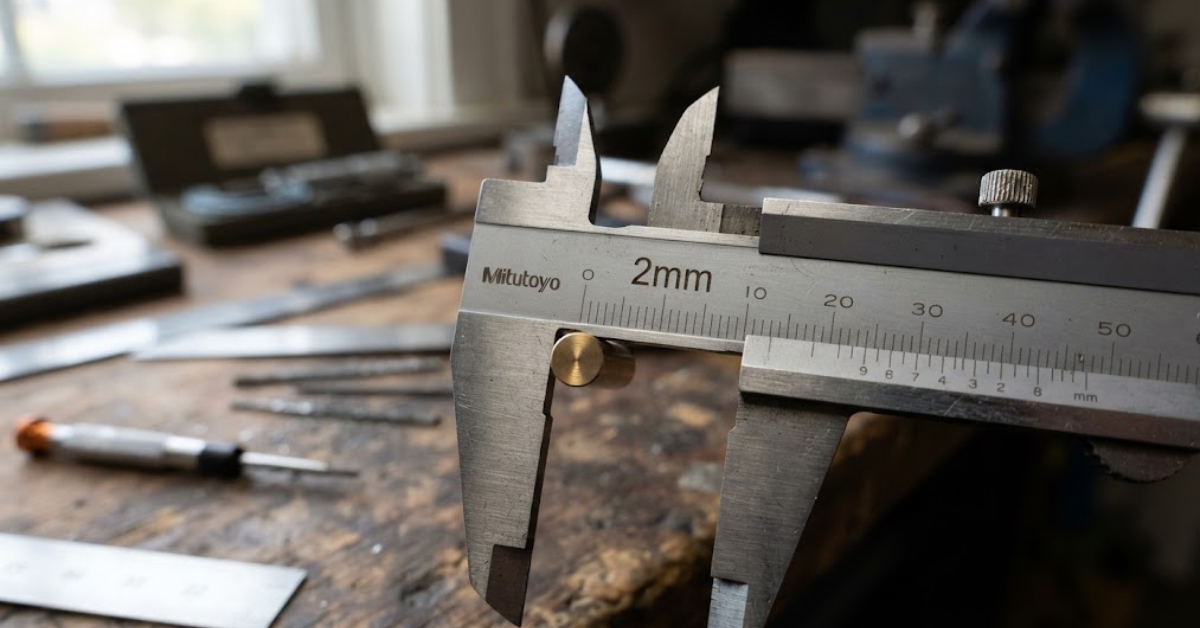
A measurement can sound tiny until you actually know what it looks like. 2mm is a good example. Two millimeters is small enough to be easy to overlook, but it can make a noticeable difference when you’re working with jewelry, paper, electronics, tools, screws, or other precisely sized objects.
So, how big is 2mm?
Two millimeters equals 0.2 centimeters, 0.0787 inches, or about 0.079 inches. In everyday terms, it’s roughly the thickness of two standard 1mm layers placed together.
Let’s put 2mm into perspective and look at several simple ways to understand this measurement.
How Big Is 2mm?
2mm means two millimeters.
A millimeter is a metric unit of length equal to one-thousandth of a meter.
That means:
1 millimeter = 0.001 meter
So:
2mm = 0.002 meter
It is also equal to:
- 0.2 centimeters
- 0.0787 inches
- 0.00787 feet
- 2,000 micrometers
- 0.002 kilometers
Of these conversions, centimeters and inches are usually the most useful for everyday comparisons.
2mm in Inches
If you’re more familiar with inches, 2mm is approximately:
2mm = 0.07874 inches
For a quick estimate, you can think of it as about 0.08 inches.
That may sound extremely small, and it is. One-tenth of an inch is 0.1 inch, so 2mm is slightly less than one-tenth of an inch.
Here’s a quick comparison:
| Measurement | Approximate size |
| 1mm | 0.0394 inches |
| 2mm | 0.0787 inches |
| 3mm | 0.1181 inches |
| 4mm | 0.1575 inches |
| 5mm | 0.1969 inches |
| 10mm | 0.3937 inches |
This shows that 2mm is still considerably smaller than half an inch.
2mm in Centimeters
Converting 2mm to centimeters is particularly simple.
There are 10 millimeters in 1 centimeter.
Therefore:
2mm ÷ 10 = 0.2cm
So:
2mm = 0.2 centimeters
This is one of the easiest conversions to remember.
For comparison:
- 1mm = 0.1cm
- 2mm = 0.2cm
- 5mm = 0.5cm
- 10mm = 1cm
- 20mm = 2cm
2mm in Inches, Centimeters, and Other Units
Here’s a complete quick-reference table.
| Unit | 2mm equals |
| Millimeters | 2mm |
| Centimeters | 0.2cm |
| Meters | 0.002m |
| Inches | 0.0787in |
| Feet | 0.00656ft |
| Yards | 0.00219yd |
| Micrometers | 2,000µm |
For most everyday situations, you only need to remember:
2mm = 0.2cm ≈ 0.079in
What Does 2mm Look Like?
Numbers don’t always make measurements easy to visualize.
If you don’t have a ruler nearby, imagine a very thin strip approximately two millimeters wide or thick. It’s small enough that you wouldn’t normally describe it as a large gap or substantial thickness.
A ruler with millimeter markings is the easiest way to see it accurately.
On a standard metric ruler, the small lines between the centimeter marks represent individual millimeters. 2mm is simply the distance between the second and zero millimeter marks.
2mm Compared With a Ruler
A metric ruler is one of the best references for understanding 2mm.
Most rulers have:
- Centimeter markings
- Millimeter markings
- Longer lines for centimeters
- Shorter lines for individual millimeters
If you look closely at the space between 0cm and 1cm, there are 10 millimeters.
The second small marking represents 2mm.
This makes 2mm much easier to understand visually than trying to imagine 0.0787 inches.
2mm Compared With 1mm
One of the simplest comparisons is another millimeter.
2mm is exactly twice as long as 1mm.
Think of it as:
1mm + 1mm = 2mm
That distinction matters when you’re measuring thin materials. A 2mm sheet, wire, gap, or component is twice the thickness or length of a 1mm equivalent, assuming you’re measuring the same dimension.
2mm Compared With 5mm
Five millimeters is:
5mm = 0.5cm
Two millimeters is:
2mm = 0.2cm
So 2mm is 40% of 5mm.
The difference is only 3mm, but that can be significant in applications where precise measurements matter.
For example, a 2mm material and a 5mm material can feel very different when used for jewelry, crafting, mechanical components, or protective coverings.
2mm Compared With 1 Centimeter
This is another useful reference.
1 centimeter = 10mm
Therefore:
2mm is one-fifth of a centimeter.
You can picture a centimeter divided into five equal sections:
10mm ÷ 5 = 2mm
So five sections of 2mm would make exactly 1cm.
Is 2mm Thick or Thin?
Whether 2mm is considered thick or thin depends entirely on what you’re measuring.
For a sheet of metal, 2mm may be relatively thin.
For a piece of paper, 2mm would be quite thick.
A gap between mechanical components, 2mm could be substantial.
For jewelry, a 2mm band or chain can be described as relatively delicate compared with wider designs.
The important point is that 2mm describes a precise measurement, not a universal category of thickness.
Common Things That Can Help You Visualize 2mm
Everyday objects can provide useful perspective, but it’s important not to assume that a particular object always has an exact 2mm dimension. Manufacturing tolerances and product designs vary.
Instead, use these as rough visual references:
- A small gap on a ruler between millimeter markings
- A very thin strip of material
- Two 1mm layers placed together
- A small jewelry component
- A narrow mechanical clearance
- A thin piece of plastic, metal, or wood
For an exact measurement, always use a ruler, caliper, or another appropriate measuring tool rather than relying on an object comparison.
Where Is a 2mm Measurement Commonly Used?
A 2mm measurement appears in many different fields.
Jewelry
Jewelry makers may use millimeters to describe:
- Ring widths
- Chain thickness
- Bead diameters
- Wire thickness
- Gemstone sizes
- Pendants and other components
A 2mm jewelry measurement can therefore refer to either width, diameter, thickness, or another dimension depending on the product.
Crafting
Craft materials can also be measured in millimeters.
For example, 2mm might describe the thickness of:
- Foam sheets
- Cardboard
- Acrylic
- Wood
- Plastic
- Craft wire
When shopping for materials, check exactly which dimension the 2mm specification describes.
Electronics
Small electronic components and physical clearances often require precise measurements.
A difference between 1mm and 2mm can matter when components need to fit inside a compact enclosure.
Mechanical Work
Engineers and mechanics routinely work with millimeter measurements.
A 2mm gap, washer, sheet, wire, or component can have a specific functional purpose, making accurate measurement important.
Printing and Paper
Paper thickness can also be discussed using millimeters, although paper is frequently specified by weight, such as GSM, depending on the market.
A product described as 2mm thick should not automatically be compared with ordinary printer paper because the materials and measurement methods can be very different.
How to Measure 2mm Accurately
If you need to check whether something is actually 2mm, visual estimation isn’t enough.
Using a Ruler
A metric ruler is suitable for many basic measurements.
- Place the object against the ruler.
- Align one edge with the zero mark.
- Look at the millimeter markings.
- Check whether the other edge reaches the 2mm mark.
For very small objects, make sure you’re looking directly above the measurement rather than viewing it from an angle.
Using a Digital Caliper
For more precise work, a digital caliper is much better.
Calipers can measure small dimensions such as:
- Thickness
- Outside diameter
- Inside diameter
- Depth
They’re especially useful when the difference between 1.9mm and 2.0mm matters.
2mm vs 0.2cm
These measurements look different, but they’re exactly the same length.
2mm = 0.2cm
Why?
Because:
1cm = 10mm
Therefore:
2 ÷ 10 = 0.2
So if a product specification says 0.2cm, it’s describing the same measurement as 2mm.
2mm vs 0.08 Inches
These are also almost exactly the same measurement.
The precise conversion is:
2mm = 0.07874 inches
Rounded to two decimal places:
2mm ≈ 0.08 inches
However, don’t confuse 0.08 inches with 0.8 inches. The latter is ten times larger.
That extra zero makes a major difference when working with small measurements.
How Many 2mm Sections Are in 1 Inch?
One inch equals exactly 25.4mm.
So:
25.4 ÷ 2 = 12.7
There are therefore 12.7 lengths of 2mm in one inch.
Since 2mm doesn’t divide evenly into an inch, you won’t get a whole number of 2mm sections.
This is another reason metric measurements can be easier to work with when you’re dealing with very small dimensions.
How Many Millimeters Are in 2mm?
This sounds obvious, but it’s useful when comparing different specifications.
2mm contains exactly 2 millimeters.
If you need to convert it to micrometers:
2mm = 2,000 micrometers
Since:
1mm = 1,000 micrometers
then:
2 × 1,000 = 2,000µm
Micrometers are commonly used when measurements become even smaller.
Quick 2mm Conversion Chart
For everyday use, the two most useful conversions are:
| Measurement | Equivalent |
| 2mm | 2 millimeters |
| 2mm | 0.2 centimeters |
| 2mm | 0.002 meters |
| 2mm | 0.07874 inches |
| 2mm | 0.00656 feet |
| 2mm | 2,000 micrometers |
2mm = 0.2cm
2mm ≈ 0.079in
Why Accurate 2mm Measurements Matter
A difference of a few millimeters may sound insignificant, but small measurements can have a big effect in precision-based applications.
For example, if a component is designed around a 2mm clearance, changing that dimension can affect whether another component fits properly.
The same principle applies to:
- Manufacturing
- Engineering
- Construction
- Jewelry
- Electronics
- Model making
- DIY projects
- 3D printing
- Crafts
When tolerances are tight, don’t rely on visual estimates.
Tips for Measuring Small Dimensions
If you’re regularly working with measurements around 2mm, a few habits can make things easier.
- Use metric measurements whenever possible.
Millimeters are convenient for small dimensions. - Choose the right measuring tool.
Use a ruler for basic work and calipers for precision. - Check the zero point.
Make sure your measurement starts at the correct reference point. - Look straight at the scale.
Viewing a ruler from an angle can cause reading errors. - Don’t round too early.
Keep the precise measurement until the final calculation. - Check the product specification carefully.
A 2mm measurement could refer to thickness, diameter, width, or another dimension.
Frequently Asked Questions About 2mm
How big is 2mm?
2mm is 0.2 centimeters or approximately 0.079 inches. It’s a very small measurement, equal to two individual millimeters.
Is 2mm the same as 0.2cm?
Yes. 2mm = 0.2cm because there are 10 millimeters in one centimeter.
How many inches is 2mm?
2mm equals approximately 0.07874 inches, which rounds to about 0.08 inches.
Is 2mm bigger than 1mm?
Yes. 2mm is exactly twice as long or thick as 1mm.
Is 2mm the same as 2 centimeters?
No. They’re very different.
2mm = 0.2cm, while 2cm = 20mm.
So 2 centimeters is 10 times larger than 2mm.
How thick is 2mm?
2mm represents a thickness of 0.2cm or approximately 0.079 inches. Whether that is considered thin or thick depends on the material and application.
Can I measure 2mm with a normal ruler?
Yes, provided the ruler has millimeter markings. For greater precision, particularly when measuring very small objects, a digital caliper is more appropriate.
How many micrometers are in 2mm?
There are 2,000 micrometers in 2mm because one millimeter equals 1,000 micrometers.
How much is 2mm in feet?
2mm is approximately 0.00656 feet.
For most practical situations, however, inches or centimeters are more useful comparisons.
How much is 2mm in meters?
2mm = 0.002 meters.
A millimeter is one-thousandth of a meter, so two millimeters are two-thousandths of a meter.
Final Thoughts on 2mm
2mm is a small measurement, but it becomes much easier to understand once you put it into familiar units.
The key conversions are:
- 2mm = 0.2cm
- 2mm = 0.002m
- 2mm ≈ 0.07874 inches
- 2mm ≈ 0.08 inches
- 2mm = 2,000 micrometers
If you need to visualize 2mm, a metric ruler is your best starting point. And if you’re working on a project where a fraction of a millimeter matters, switch to a digital caliper rather than relying on an everyday object as a reference.
Once you understand how 2mm compares with centimeters, inches, and other common measurements, even very small dimensions become much easier to picture and work with.