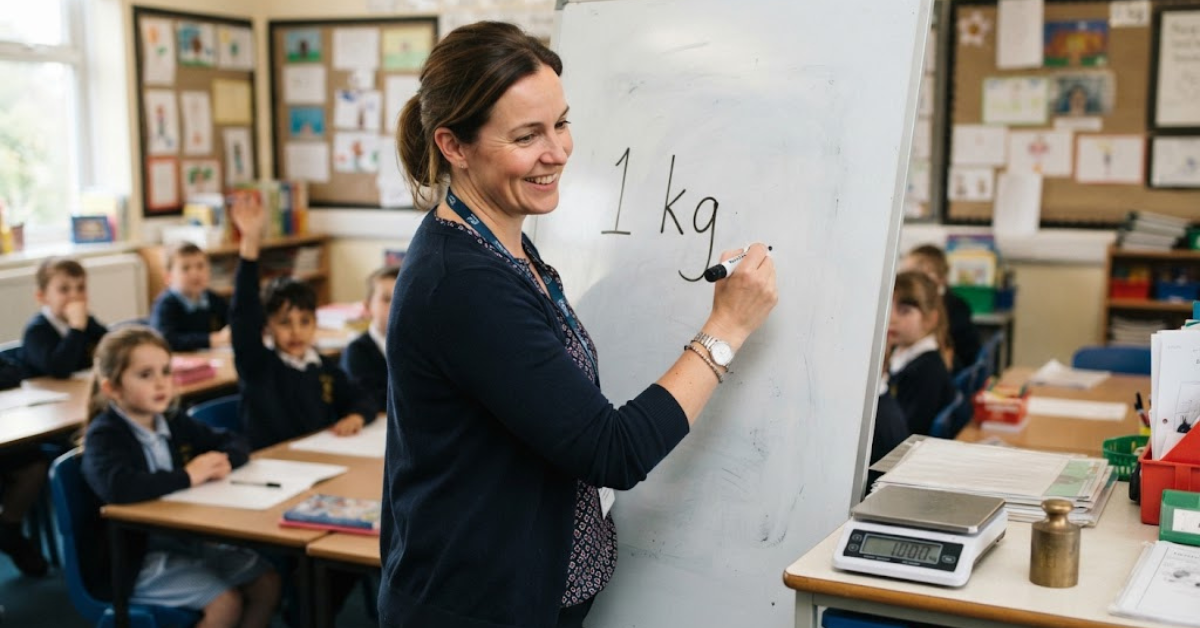
A kilogram is one of those measurements you see everywhere, yet it can be surprisingly difficult to picture. 1 kg sounds straightforward, but how heavy is it in pounds? How many grams or ounces does it contain? And what does one kilogram actually feel like in your hands?
The good news is that the basic conversion is simple: 1 kg equals 1,000 grams, approximately 2.205 pounds, or about 35.27 ounces.
Whether you’re converting a recipe, checking a package weight, comparing grocery products, or simply trying to understand metric measurements, knowing what 1 kg represents makes everyday measurements much easier.
What Is 1 kg?
Kg is the abbreviation for kilogram, the standard unit of mass in the International System of Units (SI).
A kilogram is larger than a gram and smaller than a metric ton. The metric system is built around powers of 10, so converting between these units is relatively easy.
The basic relationship is:
1 kilogram = 1,000 grams
That means a 1 kg bag of rice contains 1,000 grams of rice, assuming the package is labeled by mass.
The kilogram is widely used around the world to measure food, luggage, body mass, household goods, and many other objects.
How Much Is 1 kg in Pounds?
If you’re used to the U.S. customary system, the most useful conversion is:
1 kg ≈ 2.205 pounds
For everyday purposes, you can round this to:
1 kg ≈ 2.2 lb
The exact conversion is based on the international definition of the pound:
1 kilogram = 2.20462262185 pounds
So if something weighs exactly 1 kg, it weighs a little more than 2.2 pounds.
Quick kilogram-to-pound chart
| Kilograms | Pounds |
| 0.25 kg | 0.55 lb |
| 0.5 kg | 1.10 lb |
| 1 kg | 2.20 lb |
| 1.5 kg | 3.31 lb |
| 2 kg | 4.41 lb |
| 3 kg | 6.61 lb |
| 5 kg | 11.02 lb |
| 10 kg | 22.05 lb |
A useful shortcut is to multiply kilograms by 2.2 when you only need a quick estimate.
How Many Grams Are in 1 kg?
This is the easiest conversion of all:
1 kg = 1,000 grams
Because there are 1,000 grams in a kilogram, the conversion works in both directions:
- 1 kg = 1,000 g
- 0.5 kg = 500 g
- 0.25 kg = 250 g
- 2 kg = 2,000 g
- 5 kg = 5,000 g
If a recipe calls for 1 kilogram of an ingredient, that’s exactly 1,000 grams.
How Many Ounces Are in 1 kg?
One kilogram equals approximately:
35.27 ounces
More precisely:
1 kg = 35.27396 oz
For practical purposes, 35.27 ounces is the number to remember.
This is another useful conversion when you’re comparing products sold in metric and imperial units.
Kilograms to ounces
| Kilograms | Ounces |
| 0.25 kg | 8.82 oz |
| 0.5 kg | 17.64 oz |
| 1 kg | 35.27 oz |
| 1.5 kg | 52.91 oz |
| 2 kg | 70.55 oz |
| 3 kg | 105.82 oz |
Because there are 16 ounces in an avoirdupois pound, this also makes sense:
2.2046 lb × 16 ≈ 35.27 oz
How Much Is 1 kg in Stones?
Stones are another unit of mass commonly encountered in the United Kingdom, particularly for body weight.
1 stone = 14 pounds
Since 1 kg is approximately 2.205 pounds:
1 kg ≈ 0.1575 stone
So, roughly speaking:
1 kg ≈ 0.16 stone
This isn’t usually a particularly useful conversion unless you’re working with body-weight measurements.
For context:
1 stone ≈ 6.35 kg
How Much Is 1 kg in Pounds and Ounces?
Sometimes pounds and ounces are more useful than a decimal number.
Since:
1 kg ≈ 2.2046 lb
that’s equivalent to approximately:
2 pounds and 3.27 ounces
So you can think of 1 kg as roughly:
2 lb 3.3 oz
That’s a little heavier than 2 pounds.
How Much Is 1 kg in Grams and Milligrams?
The metric system makes this conversion straightforward.
1 kg = 1,000 g
And since:
1 gram = 1,000 milligrams
then:
1 kg = 1,000,000 milligrams
So:
- 1 kg = 1,000 grams
- 1 kg = 1,000,000 milligrams
A milligram is much too small to be a practical unit for most objects weighing a kilogram, but it’s useful for understanding how metric units scale.
1 kg in Other Metric Units
The kilogram fits neatly into the broader metric system.
| Unit | Equivalent to 1 kg |
| Grams | 1,000 g |
| Milligrams | 1,000,000 mg |
| Metric tons | 0.001 t |
| Centigrams | 100,000 cg |
| Decagrams | 100 dag |
| Hectograms | 10 hg |
| Kilograms | 1 kg |
The metric system’s base-10 structure makes these conversions much easier than many traditional measurement systems.
What Does 1 kg Look Like?
Knowing the numerical conversion is useful, but sometimes you simply want to know:
What does 1 kg actually feel like?
A few everyday objects can help.
A 1-liter container of water is a convenient reference because one liter of water has a mass very close to 1 kilogram under ordinary conditions.
Other objects can also come close, depending on their exact contents and construction.
For example:
- A medium-sized bag of food may weigh 1 kg.
- A large bottle or container filled with water can be close to 1 kg.
- Some household objects are manufactured in 1 kg weights.
- A 1 kg bag of rice, flour, sugar, or other food provides an easy physical reference.
The exact size of a 1 kg object depends entirely on its density.
A kilogram of feathers and a kilogram of metal have the same mass, but they occupy dramatically different amounts of space.
Is 1 kg Heavy?
It depends on what you’re comparing it with.
For a small object, 1 kg can feel fairly heavy. For something like a suitcase or piece of furniture, it’s relatively light.
A useful comparison is that 1 kg is about 2.2 pounds.
So if you’ve ever held a 2-pound object, you’ve experienced roughly the weight of 1 kilogram.
Your perception can also change depending on the shape of an object. A compact 1 kg object can feel different from a bulky 1 kg object even though their masses are identical.
1 kg vs. 1 Pound
This comparison helps explain the difference between metric and imperial measurements.
1 kg ≈ 2.205 lb
So a kilogram is a little more than twice the mass of a pound.
Conversely:
1 pound ≈ 0.454 kg
Here’s a quick comparison:
| Measurement | Approximate Equivalent |
| 1 lb | 0.454 kg |
| 2 lb | 0.907 kg |
| 1 kg | 2.205 lb |
| 2.5 lb | 1.134 kg |
| 5 lb | 2.268 kg |
This is why a product labeled 1 kg will generally weigh more than a 2-pound package.
1 kg vs. 500 Grams
Because 1 kilogram contains 1,000 grams:
500 grams = 0.5 kg
Therefore:
1 kg = two 500-gram portions
This is particularly useful when shopping for groceries.
For example, if a store sells a product in 500 g packages, you would need two packages to have 1 kg.
1 kg vs. 2 kg
The comparison is even simpler:
2 kg = 2,000 grams
and:
2 kg ≈ 4.41 pounds
So 1 kg is exactly half the mass of 2 kg.
| Mass | Pounds |
| 0.5 kg | 1.10 lb |
| 1 kg | 2.20 lb |
| 1.5 kg | 3.31 lb |
| 2 kg | 4.41 lb |
| 3 kg | 6.61 lb |
How to Convert Kilograms to Pounds
If you need to convert another kilogram measurement into pounds, use this formula:
Pounds = kilograms × 2.20462262185
For example, suppose you have 3 kg.
3 × 2.20462262185 = 6.6139 lb
So:
3 kg ≈ 6.61 lb
For quick mental calculations, multiplying by 2.2 is usually sufficient.
How to Convert Pounds to Kilograms
To convert pounds back into kilograms, divide by approximately 2.205.
The formula is:
Kilograms = pounds ÷ 2.20462262185
For example:
10 lb ÷ 2.20462262185 ≈ 4.54 kg
So 10 pounds is approximately 4.54 kilograms.
How to Convert 1 kg to Ounces
Since one kilogram is approximately 2.2046 pounds and one pound contains 16 ounces:
2.20462262185 × 16 = 35.27396 ounces
Therefore:
1 kg ≈ 35.27 oz
For everyday calculations, you can use 35.3 ounces.
1 kg in Cooking and Baking
Kilograms and grams are particularly common in recipes that use the metric system.
If a recipe calls for:
1 kg of flour
it means:
1,000 grams of flour
It does not mean 1 liter or 1 cup.
This distinction matters because mass and volume are different measurements.
A kilogram tells you how much something weighs, while liters, milliliters, cups, and tablespoons describe volume.
The amount of space occupied by 1 kg depends on the ingredient’s density.
Is 1 kg the Same as 1 Liter?
Not always.
This is a common misunderstanding.
A liter measures volume, while a kilogram measures mass.
For water, 1 liter has a mass close to 1 kilogram under standard reference conditions. But that relationship doesn’t apply universally.
For example, 1 liter of oil has a different mass from 1 liter of water because oil is less dense.
Likewise, 1 kg of flour does not occupy the same volume as 1 kg of water.
So don’t automatically substitute kilograms for liters in a recipe.
How to Measure 1 kg Accurately
If accuracy matters, the best option is a digital scale.
For household use, the process is simple:
- Place an empty container on the scale.
- Press the tare or zero button.
- Add the material.
- Stop when the display reaches 1,000 grams or 1 kg.
A kitchen scale is especially useful for food.
For heavier objects, use an appropriate platform, luggage, bathroom, or shipping scale depending on the situation.
Why Is the Kilogram So Common?
The kilogram is the standard SI unit of mass and is used internationally in science, commerce, manufacturing, transportation, and everyday life.
You’ll commonly see kilograms used for:
- Food packages
- Body weight
- Luggage
- Shipping
- Industrial materials
- Sports equipment
- Household goods
- Agricultural products
Countries that use the metric system generally rely on kilograms and grams rather than pounds and ounces.
1 kg for Shipping and Package Weight
If you’re shipping something internationally, package weight may be listed in kilograms.
A package weighing 1 kg is approximately 2.2 pounds.
This conversion can be useful when comparing shipping restrictions or checking whether a package falls within a particular weight limit.
Keep in mind that shipping companies may calculate charges using actual weight, dimensional weight, or both, depending on the service.
Common 1 kg Conversions at a Glance
Here’s the quick-reference version:
1 kg =
- 1,000 grams
- 2.2046 pounds
- 35.274 ounces
- 0.1575 stone
- 1,000,000 milligrams
- 0.001 metric ton
For most everyday situations, the three conversions worth remembering are:
1 kg = 1,000 g ≈ 2.2 lb ≈ 35.3 oz
Frequently Asked Questions About 1 kg
How many pounds is 1 kg?
1 kilogram equals approximately 2.205 pounds. For quick calculations, you can round it to 2.2 pounds.
How many grams are in 1 kg?
There are exactly 1,000 grams in 1 kilogram.
How many ounces are in 1 kg?
One kilogram equals approximately 35.27 ounces.
Is 1 kg heavier than 2 pounds?
Yes. 1 kg is approximately 2.205 pounds, so it is slightly heavier than 2 pounds.
Is 1 kg equal to 1 liter?
No, not generally. A kilogram measures mass, while a liter measures volume. One liter of water has a mass close to 1 kg, but other substances have different densities.
What is 1 kg in pounds and ounces?
One kilogram is approximately 2 pounds and 3.3 ounces.
How much is 1 kg in stone?
One kilogram is approximately 0.1575 stone. A stone is equal to 14 pounds.
What does 1 kg look like?
There’s no single appearance for 1 kg because different materials have different densities. A 1-liter container of water provides a convenient everyday reference because its mass is close to 1 kg.
Is 1 kg a lot of weight?
It depends on the object and situation. 1 kg is about 2.2 pounds, so it is relatively light compared with large household objects but noticeable when holding a compact item.
How do I convert 1 kg to pounds?
Multiply the kilogram value by 2.20462262185. For 1 kg, this produces approximately 2.205 pounds.
How much is 500 grams compared with 1 kg?
500 grams is exactly 0.5 kg, so two 500-gram portions equal 1 kg.
How much is 1 kg of food?
The answer depends on the food. One kilogram always represents the same mass, but the volume and physical appearance can vary considerably between ingredients.
Conclusion: How Much Is 1 kg?
If you need the quick answer, 1 kg equals exactly 1,000 grams, approximately 2.205 pounds, and about 35.27 ounces.
It’s also about ⅛ of a metric ton and roughly 0.1575 stone. For everyday visualization, think of 1 kg as a little more than 2 pounds.
The most important thing to remember is that kilograms measure mass, not volume. That’s why 1 kg of water, flour, fruit, or metal can look completely different even though they all have the same mass.
If you’re converting recipes, checking package weights, comparing products, or simply getting more comfortable with metric measurements, remembering 1 kg ≈ 2.2 lb gives you a quick and useful starting point.