A single letter can completely change a word’s meaning. That’s exactly what happens with jibe vs jive. The two words sound similar, and they’re sometimes confused in everyday writing, but they have different meanings and histories.
So, should you say “jibe or jive”? The answer depends on what you’re trying to express. Jibe can mean to agree or correspond, or it can refer to a sailing maneuver. Jive is associated with a style of dance and music and can also mean teasing, deceiving, or speaking insincerely.
Let’s break down the difference so you can choose the right word with confidence.
Jibe vs Jive: The Quick Answer
Here’s the simplest way to remember jibe vs jive:
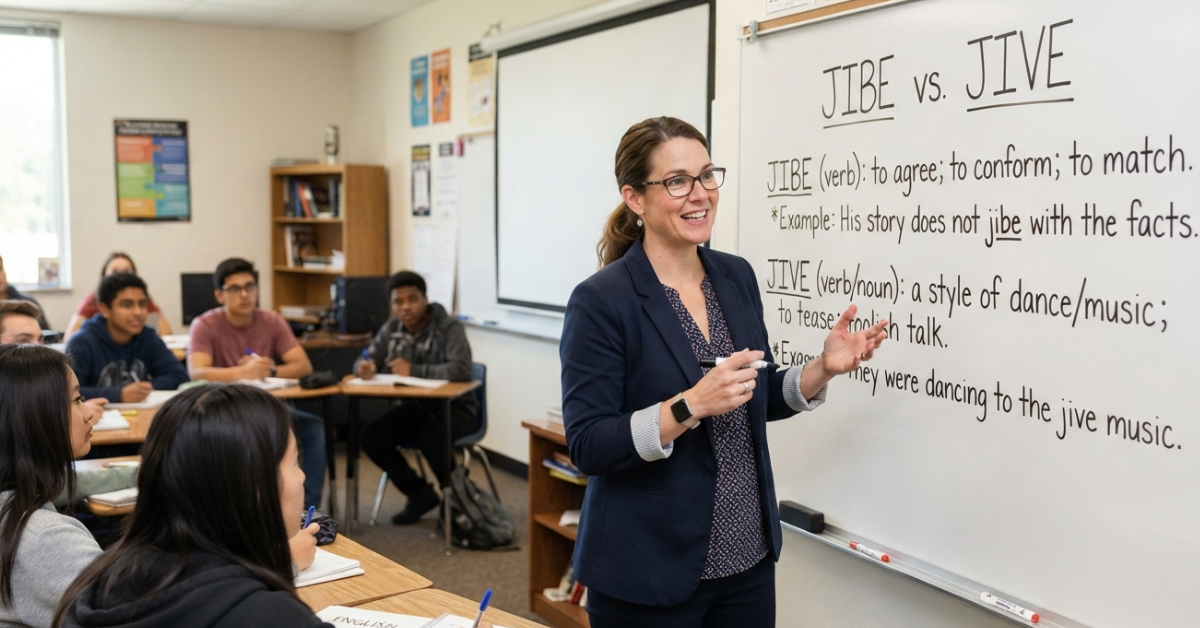
- Jibe = agree, correspond, or fit together; also a sailing maneuver.
- Jive = a type of dance or music; informal speech that can mean nonsense, deception, or teasing.
For example:
“Your story doesn’t jibe with the evidence.”
But:
“They spent the evening dancing to jive music.”
The words may sound alike in some accents, but they’re not interchangeable in standard usage.
What Does Jibe Mean?
Jibe has several meanings, but one of its most common modern uses is as a verb meaning to agree, correspond, or be consistent with something.
For example:
“His explanation doesn’t jibe with what we saw.”
Here, jibe means that two things don’t match or agree.
You might also see it in phrases such as:
- “The numbers don’t jibe.”
- “Her account doesn’t jibe with the facts.”
- “The evidence jibes with his explanation.”
In each case, the basic idea is agreement or consistency.
Jibe as a Sailing Term
There’s another completely legitimate meaning of jibe.
In sailing, to jibe is to turn a sailing vessel so that the stern passes through the wind and the sail moves to the opposite side.
For example:
“The crew prepared to jibe as the wind shifted.”
This technical meaning is particularly common in sailing terminology.
What Does Jive Mean?
Jive has a very different history and meaning.
It is strongly associated with music and dancing, particularly the lively style of dance that developed alongside jazz and swing traditions.
For example:
“The band played a fast jive.”
The word can also be used informally as a verb or adjective in other ways.
Depending on context, jive can refer to:
- A style of dance
- A type of music or musical language
- Playful or teasing talk
- Deceptive or insincere speech
- Nonsense or empty talk
For example:
“Don’t give me that jive.”
In this sentence, jive suggests nonsense, deception, or insincere talk.
Jive vs Jibe: Why Are They Confused?
The confusion is understandable because jibe and jive are pronounced similarly in many varieties of English.
When two words sound alike but have different spellings and meanings, writers can easily substitute one for the other.
There’s also a long history of overlap between the words in informal usage. In particular, jive has sometimes been used where jibe is traditionally preferred in the sense of “agree” or “correspond.”
That usage appears in dictionaries and can be encountered in edited writing, but jibe remains the clearest choice when you mean “agree” or “be consistent with.”
Jibe or Jive: Which One Should You Use?
A useful rule is to ask yourself what you mean.
Use “jibe” when you mean:
Agree or correspond
“The witness’s statement doesn’t jibe with the police report.”
A sailing maneuver
“The captain ordered the crew to jibe.”
Use “jive” when you mean:
A type of dance or music
“They learned how to jive at the dance class.”
Nonsense, deception, or insincere talk
“I don’t believe his jive.”
This simple distinction will help you avoid most spelling mistakes.
Jibe vs Jive Examples
Seeing the words side by side makes the difference much easier to remember.
| Word | Meaning | Example |
| Jibe | Agree or correspond | “The facts don’t jibe with his story.” |
| Jibe | Sailing maneuver | “The sailor prepared to jibe.” |
| Jive | Dance or music | “They danced the jive.” |
| Jive | Nonsense or deceptive talk | “That’s just jive.” |
More Examples With Jibe
- “The two accounts don’t jibe.”
- “The results jibe with our expectations.”
- “The sailor carefully executed a jibe.”
- “Her explanation doesn’t jibe with the evidence.”
More Examples With Jive
- “They performed a lively jive.”
- “He loves old jazz and jive music.”
- “Stop giving me that jive.”
- “The comedian used playful jive talk.”
Does “Jibe” Mean Agree?
Yes. In modern English, jibe can mean to agree, correspond, or be consistent with something.
For example:
“The data doesn’t jibe with the conclusion.”
That means the data doesn’t agree with or support the conclusion.
This is one of the most important meanings to remember when deciding between jibe vs jive.
Does “Jive” Mean Agree?
You’ll sometimes encounter jive used in the sense of “agree” or “be compatible,” particularly in informal writing.
However, if you’re writing a sentence where you mean that two things match, agree, or correspond, jibe is the safer and more traditional choice.
For example:
Preferred:
“The evidence doesn’t jibe with his claim.”
rather than:
“The evidence doesn’t jive with his claim.”
The second form is encountered in real-world usage, but it can be viewed as a nonstandard or informal variant.
Jibe or Jive in Formal Writing
If you’re writing an essay, report, article, business document, or academic paper, choosing the traditional form can prevent confusion.
Use jibe when you mean:
- Agree
- Correspond
- Match
- Be consistent
- A sailing maneuver
Use jive when you’re discussing:
- Dance
- Music
- Jazz or swing culture
- Playful or deceptive talk
When in doubt, replace the word with its meaning. If “agree” makes sense, jibe is probably what you want.
A Simple Memory Trick for Jibe vs Jive
Here’s an easy way to keep the two words straight:
JIBE = things “fit” together.
Think:
“The facts jibe.”
The facts fit or agree with each other.
JIVE = music, dancing, or nonsense.
Think:
“Let’s jive.”
That’s dancing.
This isn’t a perfect explanation of the words’ histories, but it’s a handy trick for everyday writing.
Why “Jive” and “Jibe” Sound So Similar
English spelling doesn’t always provide reliable clues about pronunciation. Over time, words can develop similar pronunciations even when their origins and meanings are different.
That’s especially true with jibe and jive. Their similar sounds make them easy to confuse when writing from memory.
The solution isn’t to focus on pronunciation. Instead, focus on meaning.
Ask:
“Am I talking about agreement, sailing, dancing, music, or nonsense?”
The answer will usually tell you which spelling you need.
Frequently Asked Questions
Is it jibe or jive?
Both are correct words, but they have different meanings. Jibe commonly means to agree or correspond and is also a sailing term. Jive refers to a type of dance or music and can also mean deceptive or nonsensical talk.
Is it jive or jibe when you mean “agree”?
Use jibe when you mean “agree,” “match,” or “correspond.”
For example:
“Her story doesn’t jibe with the evidence.”
Is “jive” ever used to mean “agree”?
Yes, jive is sometimes used informally to mean “agree” or “be compatible,” but jibe is the traditional and clearer choice for this meaning.
What does jibe mean?
Jibe can mean to agree, correspond, or be consistent with something. In sailing, jibe also describes a maneuver in which a boat turns so the stern passes through the wind.
What does jive mean?
Jive can refer to a dance or style of music. Informally, it can also describe playful, deceptive, or nonsensical talk.
Is “jibe with” correct?
Yes. “Jibe with” is a standard construction meaning “agree with” or “be consistent with.”
For example:
“The results don’t jibe with the original prediction.”
Is “jive with” wrong?
Not necessarily. Jive with appears in informal usage and is sometimes used to mean “agree with” or “fit with.” However, jibe with is the more traditional choice when you mean “correspond” or “agree.”
How can I remember jibe vs jive?
Think jibe = agree and jive = dance. If you’re talking about whether two things match, choose jibe. If you’re talking about dancing, music, or jive talk, choose jive.
Conclusion: Jibe vs Jive
The difference between jibe vs jive becomes much easier once you focus on meaning rather than pronunciation. Jibe generally means to agree, correspond, or be consistent, and it also describes a sailing maneuver. Jive, meanwhile, is connected with dance and music and can also describe nonsense, teasing, or deceptive talk.
So, when you’re deciding between jibe or jive, remember the basic rule: things jibe when they agree; people jive when they’re dancing or talking jive. When you’re writing, using the word that matches the intended meaning will keep your sentence clear and precise.