
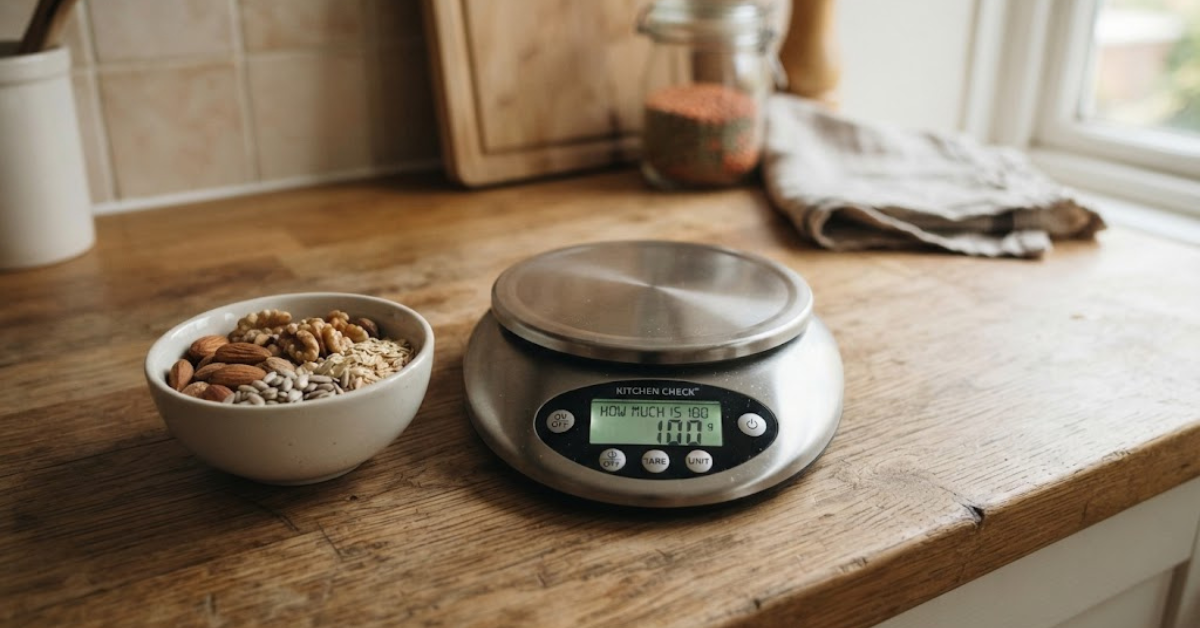
Ever looked at a recipe calling for 100 grams and wondered what that actually looks like? If you don’t have a kitchen scale nearby, the number can feel surprisingly abstract.
So, how much is 100 gram in everyday terms? The exact answer is 100 grams = 0.1 kilograms, 3.53 ounces, and about 0.22 pounds. It’s a relatively small amount of weight, but its physical size can vary dramatically depending on what you’re measuring.
A hundred grams of flour won’t take up the same amount of space as 100 grams of sugar, water, or nuts. That’s because grams measure weight (mass), while cups and other volume measurements measure space.
In this guide, we’ll break down 100 grams into familiar units and everyday food examples so you can get a much better sense of how much it actually is.
How Much Is 100 Gram Exactly?
The most important conversion to remember is:
100 grams = 0.1 kilograms
It’s also equal to:
- 3.527 ounces
- 0.2205 pounds
- 100,000 milligrams
- 0.1 kilograms
For quick everyday calculations, you can round 100 grams to approximately 3.5 ounces.
100-Gram Conversion Table
| Unit | 100 Grams Equals |
| Grams | 100 g |
| Kilograms | 0.1 kg |
| Ounces | 3.53 oz |
| Pounds | 0.22 lb |
| Milligrams | 100,000 mg |
| Metric tons | 0.0001 metric ton |
If you’re following a recipe from another country, these conversions can be especially useful.
How Much Is 100 Grams in Ounces?
One of the most common questions is how 100 grams compares with ounces.
100 grams = approximately 3.53 ounces.
For quick kitchen estimates, you can think of 100 grams as roughly 3½ ounces.
The exact conversion is:
100 ÷ 28.3495 = 3.5274 ounces
If a recipe asks for 100 grams and your kitchen scale is set to ounces, entering approximately 3.53 oz will give you the equivalent weight.
How Much Is 100 Grams in Pounds?
There are 16 ounces in a pound, so 100 grams is considerably less than one pound.
100 grams ≈ 0.22 pounds.
Another useful way to remember it is that 500 grams is approximately 1.1 pounds, making 100 grams about one-fifth of that amount.
You can also think of 100 grams as slightly less than a quarter of a pound.
A quarter pound is approximately 113.4 grams, so 100 grams is about 13.4 grams lighter.
How Much Is 100 Grams in Kilograms?
This conversion is simple.
There are 1,000 grams in one kilogram.
Therefore:
100 ÷ 1,000 = 0.1 kg
So:
100 grams = 0.1 kilograms
Or, put another way:
10 × 100 grams = 1 kilogram
This makes 100 grams a convenient reference point when estimating larger weights.
How Much Is 100 Grams in Milligrams?
If you need a smaller unit, 100 grams equals:
100,000 milligrams
That’s because one gram contains 1,000 milligrams.
Therefore:
100 × 1,000 = 100,000 mg
This conversion is more relevant to scientific, pharmaceutical, laboratory, and technical measurements than everyday cooking.
What Does 100 Grams Look Like?
This is where things get interesting.
Unlike length measurements, you can’t look at “100 grams” and know exactly how large the object will be.
A hundred grams of something dense can look quite small, while 100 grams of a lightweight ingredient can occupy a much larger container.
For example:
- 100 g of water takes up about 100 mL
- 100 g of sugar occupies considerably less than 100 mL
- 100 g of flour takes up more space than 100 g of sugar
- 100 g of popcorn can occupy a surprisingly large volume
The weight stays the same, but the volume changes.
How Much Is 100 Grams of Water?
Water provides one of the easiest ways to visualize 100 grams.
Under ordinary conditions, 100 grams of water is approximately 100 milliliters.
That’s roughly:
- 3.4 U.S. fluid ounces
- A little less than half a standard U.S. cup
- About 6.7 tablespoons
The exact relationship between grams and milliliters depends on density, but water is close enough to 1 gram per milliliter for this simple kitchen comparison.
100 Grams of Water
| Measurement | Approximate Amount |
| Weight | 100 g |
| Volume | 100 mL |
| U.S. fluid ounces | 3.38 fl oz |
| U.S. cups | 0.42 cup |
| Tablespoons | 6.7 tbsp |
This is why recipes sometimes make it seem as though grams and milliliters are interchangeable. They’re not universally interchangeable—the similarity works particularly well for water because of its density.
How Much Is 100 Grams of Flour?
Flour is much less dense than water, so 100 grams of flour takes up considerably more physical space than 100 grams of water.
Depending on the type of flour and how it is measured, 100 grams of all-purpose flour is roughly around ¾ to ⅞ of a U.S. cup.
The exact volume varies because flour can be scooped, spooned, sifted, or compressed.
That’s one reason professional baking recipes often use grams instead of cups.
Why Flour Measurements Vary
Two people can fill a cup with flour and end up with different weights.
If one person packs the flour tightly and another gently spoons it into the cup, their cups won’t contain the same mass.
A kitchen scale eliminates much of that uncertainty.
How Much Is 100 Grams of Sugar?
Granulated sugar is denser than flour.
As a rough kitchen reference, 100 grams of granulated sugar is approximately ½ cup.
Again, this is an approximate volume conversion because the exact volume can vary slightly depending on the sugar type and how it’s packed.
Powdered sugar, brown sugar, and granulated sugar don’t have identical densities, so you shouldn’t automatically use the same cup conversion for all of them.
How Much Is 100 Grams of Rice?
Dry rice is another common ingredient where people ask about gram-to-cup conversions.
Approximately 100 grams of uncooked rice is around ½ cup, although the exact amount varies by rice variety and grain shape.
Long-grain rice, short-grain rice, basmati, jasmine, and other varieties can have different densities.
If a recipe specifies 100 grams of rice, using a scale is the most reliable approach.
How Much Is 100 Grams of Butter?
Butter is relatively easy to visualize because packaged butter often comes in standardized portions.
In the United States, a standard stick of butter weighs 113.4 grams, or 4 ounces.
That means:
100 grams of butter is slightly less than one standard U.S. stick.
It’s approximately:
0.88 of a stick
This is a particularly useful reference for baking.
| Butter Amount | Approximate Weight |
| 1 stick | 113.4 g |
| 100 g | 100 g |
| Difference | 13.4 g |
So if you’re trying to measure 100 grams of butter without a scale, you’d need a little less than one standard 113.4-gram stick.
How Much Is 100 Grams of Chicken?
For meat such as chicken, 100 grams is a relatively small serving.
It’s approximately 3.5 ounces.
A small chicken breast portion can easily weigh more than 100 grams, while 100 grams of cooked chicken can represent a modest serving.
The weight can also change during cooking because water is lost as meat cooks.
That’s why recipes and nutrition labels should be interpreted carefully when comparing raw versus cooked weight.
How Much Is 100 Grams of Meat?
The same general rule applies to beef, pork, turkey, and other meats.
100 grams of meat ≈ 3.53 ounces.
As a rough visual comparison, 100 grams of cooked meat can be around the size of a small palm-sized portion, but hand size varies substantially.
If you’re tracking portions for a recipe or nutrition calculation, a scale is much more reliable than using your hand.
How Much Is 100 Grams of Cheese?
Cheese varies widely in density and shape.
One hundred grams of a hard cheese may look quite different from 100 grams of soft cheese.
If you’re dealing with a block of cheese, cutting off a portion labeled or weighed as 100 grams gives you an accurate measurement. If you’re shredding cheese, the same weight can occupy more space because of the air between the shreds.
This is another good example of why weight and volume aren’t interchangeable.
How Much Is 100 Grams of Nuts?
Nuts are relatively calorie-dense foods, so 100 grams can represent a substantial amount of food despite not occupying a huge amount of space.
The exact number of nuts varies according to the type.
For example, 100 grams of almonds won’t contain the same number of individual pieces as 100 grams of cashews or walnuts.
So if you’re asking how much 100 grams is for portion control, it’s better to think in terms of weight rather than piece count.
How Much Is 100 Grams Compared With Common Foods?
Here’s a useful overview.
| Food | Approximate 100-g Reference |
| Water | ~100 mL |
| Butter | Slightly less than 1 U.S. stick |
| Granulated sugar | ~½ cup |
| All-purpose flour | ~¾–⅞ cup |
| Dry rice | ~½ cup |
| Meat | ~3.5 oz |
| Cheese | Varies by type |
| Nuts | Varies by type |
These are rough volume comparisons, not universal conversions. Different brands, varieties, densities, and measuring methods can change the result.
How Much Is 100 Grams Without a Scale?
If you don’t have a kitchen scale, you can estimate 100 grams using familiar objects—but estimates won’t be as accurate.
One useful reference is a standard U.S. stick of butter, which weighs 113.4 grams.
So 100 grams is approximately:
88% of one stick of U.S. butter.
Another way to visualize it is with water:
100 grams of water ≈ 100 mL
If you have a measuring cup with milliliter markings, measuring 100 mL of water gives you approximately 100 grams.
But remember: this works because water has a density close to 1 g/mL. It doesn’t mean 100 grams of flour, sugar, or oil will occupy exactly 100 mL.
Why 100 Grams Doesn’t Always Look the Same
This is one of the most important concepts to understand.
Weight and volume are different measurements.
Weight tells you how much mass something has. Volume tells you how much physical space it occupies.
Density connects the two.
For example, imagine 100 grams of:
- Lead
- Water
- Flour
- Popcorn
All four weigh 100 grams.
But their physical sizes would be dramatically different because their densities aren’t the same.
That’s why asking “how much is 100 grams?” without specifying the substance can have different answers when you’re talking about cups, tablespoons, or visual size.
100 Grams vs. 100 Milliliters
These measurements are often confused.
100 grams measures mass.
100 milliliters measures volume.
They are approximately equivalent for water, but not for every substance.
For example, 100 mL of cooking oil weighs less than 100 grams because oil is less dense than water.
Likewise, 100 mL of a denser substance may weigh more than 100 grams.
So when converting grams to milliliters, you need to know the density of the ingredient.
Why a Kitchen Scale Is Better Than Measuring Cups
If you’re cooking casually, cups and spoons may be perfectly adequate.
But a scale is especially useful when:
- Baking bread
- Making pastries
- Following international recipes
- Portioning ingredients
- Tracking food intake
- Measuring coffee
- Preparing meal portions
- Working with expensive ingredients
A digital kitchen scale can measure 100 grams directly, removing much of the guesswork.
For baking in particular, weight-based measurements can produce more consistent results than volume measurements.
How to Measure Exactly 100 Grams
Using a kitchen scale is straightforward.
Step 1: Place your container on the scale
Put the bowl or container on the scale before adding the ingredient.
Step 2: Use the tare function
Press the tare button to reset the display to zero.
Step 3: Add your ingredient
Slowly add the ingredient until the display reaches:
100 g
Step 4: Check the reading
If you’ve gone slightly over, remove a small amount and check again.
This method is much more accurate than trying to estimate 100 grams by eye.
Common Mistakes When Measuring 100 Grams
There are a few easy mistakes to avoid.
Confusing grams with milliliters
They’re not the same unit.
Assuming every ingredient has the same density
It doesn’t.
Using a cup conversion without checking the ingredient
A cup of flour doesn’t weigh the same as a cup of sugar.
Forgetting the container weight
Always use the tare function or subtract the container’s weight.
Mixing raw and cooked weights
Foods can gain or lose water during cooking, changing their weight.
100 Grams in Everyday Perspective
If you simply want a mental picture, remember these comparisons:
100 grams ≈ 3.5 ounces
100 grams = 0.1 kilogram
100 grams = 100,000 milligrams
100 grams of water ≈ 100 mL
100 grams of butter ≈ 0.88 U.S. stick
Those references make the measurement much easier to understand without needing to perform a conversion every time.
Frequently Asked Questions About 100 Grams
How much is 100 gram in ounces?
100 grams is approximately 3.53 ounces. For a quick estimate, you can round it to 3.5 ounces.
How much is 100 grams in pounds?
100 grams equals approximately 0.22 pounds, which is slightly less than one-quarter of a pound.
How much is 100 grams in kilograms?
100 grams equals 0.1 kilograms.
Is 100 grams the same as 100 mL?
Not generally. Grams measure mass, while milliliters measure volume. 100 grams is approximately 100 mL for water, but other ingredients have different densities.
How much is 100 grams of flour?
Approximately ¾ to ⅞ cup of all-purpose flour, depending on how the flour is measured and its density. A scale is more accurate.
How much is 100 grams of sugar?
Approximately ½ cup of granulated sugar, although the exact volume can vary.
How much is 100 grams of butter?
It’s slightly less than one standard U.S. stick of butter. One U.S. stick weighs 113.4 grams, so 100 grams is about 88% of a stick.
How much is 100 grams of chicken?
100 grams of chicken equals approximately 3.53 ounces. The actual physical size of the portion depends on whether the chicken is raw or cooked and on its shape.
How can I measure 100 grams without a scale?
You can estimate it using known portions, such as a little less than one U.S. stick of butter, or use 100 mL of water as an approximate reference. For other foods, these methods are less reliable because density varies.
Is 100 grams a lot of food?
It depends entirely on the food. One hundred grams of lettuce can be a relatively large volume, while 100 grams of nuts or cheese is much more compact.
What is 100 grams compared with a kilogram?
A kilogram contains 1,000 grams, so 100 grams is exactly one-tenth of a kilogram.
Final Takeaway: How Much Is 100 Gram?
So, how much is 100 gram? The exact measurement is 100 grams, or 0.1 kilograms, 3.53 ounces, and approximately 0.22 pounds.
For food, however, the visual size of 100 grams depends heavily on what you’re weighing. One hundred grams of water, flour, butter, meat, and nuts can all occupy very different amounts of space even though they have exactly the same mass.
If you’re cooking or baking and need accuracy, a digital kitchen scale is the simplest solution. But for everyday estimates, remembering 100 grams ≈ 3.5 ounces gives you a useful starting point.
Once you understand the difference between weight and volume, measurements such as 50 grams, 100 grams, 250 grams, and 500 grams become much easier to visualize and convert.