
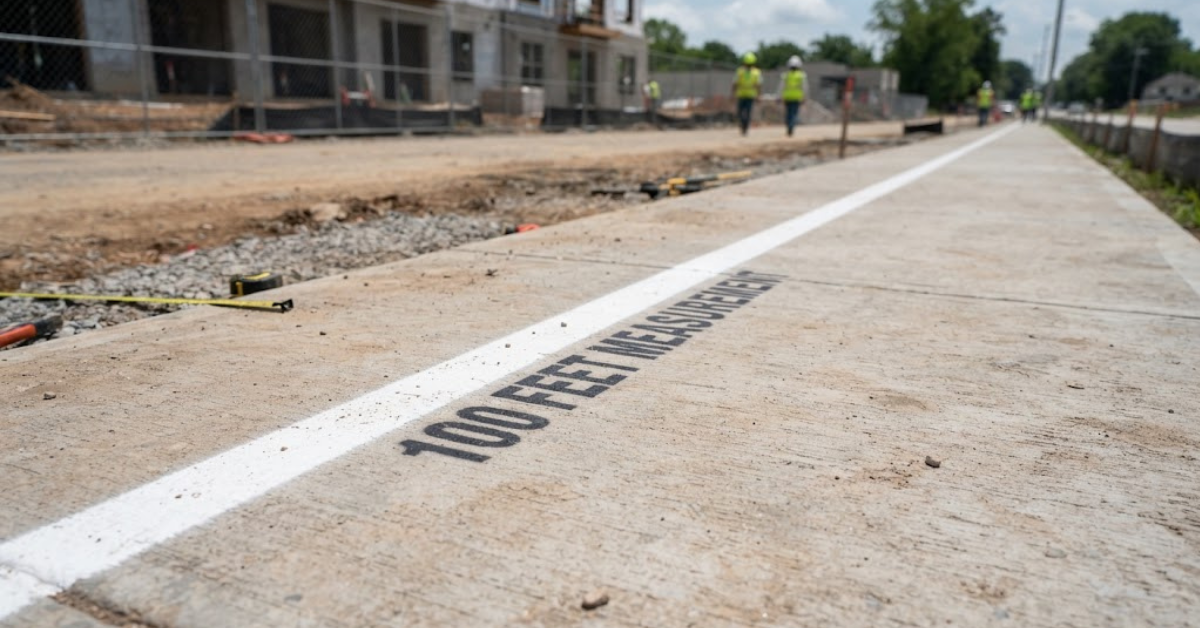
Have you ever looked at a property listing, sports field, road, or backyard and wondered what 100 feet actually looks like? A number on paper can be surprisingly difficult to visualize.
The 100 feet measurement equals exactly 30.48 meters, 33⅓ yards, or 1,200 inches. That’s a substantial distance—roughly the length of a baseball infield’s base paths when combined in certain layouts, or about one-third the length of a football field without the end zones.
But the easiest way to understand how long is 100 feet is to compare it with things you already know. In this guide, we’ll convert 100 feet into different units and use everyday objects, buildings, sports fields, walking distances, and property dimensions to make the measurement easier to picture.
How Long Is 100 Feet?
The simplest answer is:
100 feet = 30.48 meters.
That’s because one foot equals exactly 0.3048 meters.
In other common units:
- 100 feet = 1,200 inches
- 100 feet = 33.33 yards
- 100 feet = 30.48 meters
- 100 feet = 0.03048 kilometers
- 100 feet = 0.01894 miles
So if you walked in a straight line for 100 feet, you’d travel just over 30 meters.
100 Feet Measurement Conversion Table
| Unit | Equivalent to 100 Feet |
| Feet | 100 ft |
| Inches | 1,200 in |
| Yards | 33.33 yd |
| Meters | 30.48 m |
| Centimeters | 3,048 cm |
| Millimeters | 30,480 mm |
| Kilometers | 0.03048 km |
| Miles | 0.01894 mi |
These conversions are exact where the underlying unit definitions allow it, although some figures are rounded for convenience.
How Big Is 100 Feet in Real Life?
The best way to understand a measurement is to connect it to something familiar.
Imagine standing at one end of a straight 100-foot line. The other end would be 30.48 meters away.
That’s longer than most houses, longer than a typical city bus, and roughly comparable to the length of a large swimming pool.
It’s also far enough that the person standing at the other end would look noticeably smaller than someone standing just a few yards away.
100 Feet Compared to a Football Field
An American football field, including both 10-yard end zones, measures 120 yards from end line to end line, or 360 feet.
That makes 100 feet just under 28% of the total length of a football field.
The playing field between the goal lines is 100 yards, or 300 feet. So a 100-foot distance is exactly one-third of the 100-yard playing field.
| Comparison | Length |
| 100 feet | 100 ft |
| Football field, playing area | 300 ft |
| Complete football field | 360 ft |
| 100 ft as portion of playing area | ⅓ |
This is one of the easiest ways to picture the distance if you’re familiar with American football.
100 Feet Compared to a Soccer Field
Soccer fields don’t have one universal size. Their dimensions can vary depending on the level and governing regulations.
A full-size soccer field is considerably longer than 100 feet, so 100 feet represents only a portion of its length.
Instead of thinking of 100 feet as an entire field, picture yourself standing near one goal and walking approximately 30 meters toward the other end. That’s a substantial portion of the field, but not the full length.
100 Feet Compared to a Swimming Pool
A regulation Olympic swimming pool is 50 meters long, which is approximately 164 feet.
That means:
100 feet = about 61% of a 50-meter pool.
So if you picture an Olympic-size pool, 100 feet would take you a little more than halfway from one end to the other.
| Measurement | Approximate Length |
| 100 feet | 30.48 m |
| Olympic pool | 50 m |
| 100 feet as percentage of pool | ~61% |
This is a particularly useful comparison because swimming pools have standardized dimensions that are easy to visualize.
100 Feet Compared to a Basketball Court
A standard NBA basketball court is 94 feet long.
That means 100 feet is slightly longer than an NBA basketball court—by about 6 feet.
This is one of the most useful real-world comparisons for answering how long is 100 feet.
Imagine standing at one baseline of an NBA court and extending the distance past the opposite baseline by another six feet. That total would be approximately 100 feet.
Of course, basketball court dimensions vary between leagues and levels, so this comparison is specifically useful when referring to the NBA court.
How Many Steps Is 100 Feet?
Another practical way to visualize the 100 feet measurement is through walking steps.
The number of steps depends on your stride length.
For example, if someone’s average step covers about 2.5 feet:
100 ÷ 2.5 = 40 steps
So 100 feet might be roughly 40 normal walking steps for someone with a 2.5-foot stride.
But this is only an estimate.
A person’s height, walking speed, terrain, footwear, and natural stride all affect the result.
Approximate Steps for 100 Feet
| Average Step Length | Approximate Steps |
| 2.0 ft | 50 steps |
| 2.25 ft | 44 steps |
| 2.5 ft | 40 steps |
| 2.75 ft | 36 steps |
| 3.0 ft | 33 steps |
If you need an accurate distance, don’t rely on step counting. A measuring tape, survey equipment, or a properly calibrated measuring application will be much more reliable.
How Long Does It Take to Walk 100 Feet?
Walking 100 feet doesn’t take very long.
At a comfortable walking speed of around 3 miles per hour, 100 feet takes roughly 23 seconds.
The actual time will depend on how quickly you walk, whether you’re starting from a standstill, and whether you’re walking on level ground.
For everyday purposes, think of 100 feet as less than half a minute of normal walking.
100 Feet in Meters
For anyone who normally uses the metric system, the most important conversion is:
100 feet = 30.48 meters.
This conversion is exact.
The formula is:
Feet × 0.3048 = meters
Therefore:
100 × 0.3048 = 30.48 meters
For a quick mental estimate, you can think of 100 feet as about 30.5 meters.
That makes it relatively easy to understand in countries where meters are more commonly used than feet.
100 Feet in Yards
There are exactly three feet in one yard.
So:
100 ÷ 3 = 33.333 yards
Therefore, 100 feet is approximately:
33⅓ yards
This can be useful when comparing the measurement with sports fields, where yard measurements are common.
Quick Conversion
100 feet ≈ 33.3 yards
So if you see a distance described as 100 feet, imagine slightly more than 33 yards.
100 Feet in Inches
Since one foot contains 12 inches:
100 × 12 = 1,200 inches
Therefore:
100 feet = 1,200 inches
This conversion isn’t particularly useful for visualizing the distance, but it can be helpful for construction, woodworking, engineering, and other applications where smaller units are used.
100 Feet in Centimeters
One foot equals 30.48 centimeters.
Therefore:
100 × 30.48 = 3,048 centimeters
So:
100 feet = 3,048 cm
That’s also:
30,480 millimeters
For most everyday purposes, meters are much easier to work with, but centimeters and millimeters become useful when converting technical measurements.
How Far Is 100 Feet on a Property?
Property owners often encounter measurements in feet when dealing with:
- Lot dimensions
- Fence installation
- Driveways
- Property boundaries
- Landscaping
- Swimming pools
- Utility lines
- Building setbacks
- Outdoor structures
A 100-foot property dimension is not necessarily a 100-foot-long lot. It could describe the width, depth, boundary, setback, or another specific measurement.
For example, a rectangular property measuring 100 feet by 50 feet would have:
100 × 50 = 5,000 square feet
Notice the distinction between feet and square feet.
A 100-foot line measures distance. A 5,000-square-foot property measures area.
What Does a 100-Foot Lot Look Like?
Imagine a rectangular lot that’s 100 feet long and 50 feet wide.
The long side would be about 30.48 meters, while the short side would be about 15.24 meters.
That gives you a useful mental image of a relatively substantial residential or commercial property.
But property sizes vary dramatically by location, so a 100-foot dimension doesn’t tell you the total size of a property unless you also know its other dimensions.
100 Feet Compared to a House
A typical single-family house is usually much shorter than 100 feet from one end to the other.
A large house might have a footprint that’s several dozen feet wide or long, but a straight 100-foot distance could extend across the house and a significant portion of its surrounding yard.
For example, a hypothetical house measuring 50 feet long would need to be placed end-to-end twice to reach 100 feet.
That’s a useful mental shortcut:
Two 50-foot lengths = 100 feet.
How Many Cars Fit Into 100 Feet?
A typical passenger vehicle is around 14 to 16 feet long, although vehicle dimensions vary considerably.
If you use 15 feet as a rough reference:
100 ÷ 15 ≈ 6.7
So you could fit roughly six to seven average-sized cars end-to-end across 100 feet, ignoring gaps between vehicles.
That’s not a parking recommendation—it’s simply a visual comparison.
In a real parking arrangement, spaces need additional room for doors, maneuvering, and vehicle clearance.
How Many Rulers Make 100 Feet?
A standard ruler is usually 12 inches, or 1 foot, long.
Therefore, you would need:
100 one-foot rulers
placed end-to-end to create a 100-foot measurement.
This sounds obvious, but it’s actually a handy mental model.
If you’ve ever seen a standard 12-inch ruler, imagine placing 100 of them in a straight line. The resulting line would be 100 feet long.
How Many 10-Foot Lengths Make 100 Feet?
This is another easy comparison.
100 ÷ 10 = 10
So 100 feet is exactly ten 10-foot lengths.
If you’re familiar with a 10-foot measuring tape or construction material, imagine ten identical 10-foot sections placed end-to-end.
This can make the distance easier to visualize when planning construction or landscaping work.
100 Feet Compared With a 100-Meter Distance
Be careful with this comparison because 100 feet and 100 meters are very different distances.
- 100 feet = 30.48 meters
- 100 meters = 328.08 feet
Therefore, 100 meters is more than three times as long as 100 feet.
This is especially important when discussing athletics. A 100-meter sprint covers approximately 328 feet, not 100 feet.
If someone says “100” without specifying the unit, always check whether they mean feet or meters.
Common Uses of a 100-Foot Measurement
A distance of 100 feet appears in many everyday and professional situations.
Construction
Builders may use 100-foot measurements for:
- Property layouts
- Foundation planning
- Utility installation
- Site preparation
- Landscaping
Real Estate
Property listings and surveys may use feet to describe:
- Lot dimensions
- Building setbacks
- Road frontage
- Boundary distances
Sports
Sports facilities can provide useful visual references for understanding a 100-foot distance.
Outdoor Activities
People may encounter 100-foot distances when measuring:
- Hiking routes
- Backyards
- Garden layouts
- Fence lines
- Campsites
Safety and Planning
Certain safety instructions and site plans may specify distances in feet. In those situations, accurate measurement is more important than visual estimation.
How to Measure 100 Feet Accurately
If you actually need to mark out a 100-foot distance, guessing isn’t the best approach.
Using a measuring tape
A long tape measure is the simplest option.
- Start at the exact reference point.
- Extend the tape in a straight line.
- Mark the 100-foot point.
- Keep the tape level and reasonably taut.
- Check the measurement again if precision matters.
Using a measuring wheel
A measuring wheel is particularly convenient for longer outdoor distances.
Push the wheel along the intended route and read the distance on its counter.
Using surveying equipment
For construction, property boundaries, and professional applications, use appropriate surveying equipment or qualified professionals rather than relying on a rough estimate.
100 Feet Measurement: Quick Reference
Here’s the entire measurement at a glance.
| Question | Answer |
| How long is 100 feet? | 30.48 meters |
| 100 feet in yards | 33.33 yards |
| 100 feet in inches | 1,200 inches |
| 100 feet in centimeters | 3,048 cm |
| 100 feet in millimeters | 30,480 mm |
| 100 feet in miles | 0.01894 miles |
| 100 feet in kilometers | 0.03048 km |
| Approx. steps | 33–50, depending on stride |
| 100 ft compared with NBA court | Slightly longer |
| 100 ft compared with 50 m pool | About 61% of its length |
| 100 ft compared with football field | About ⅓ of the 100-yard playing area |
Frequently Asked Questions About 100 Feet
How long is 100 feet?
100 feet is exactly 30.48 meters, or approximately 33.33 yards. It’s also 1,200 inches.
How far is 100 feet when walking?
For an average walking stride, 100 feet might take roughly 33 to 50 steps, depending on the person’s stride length.
Is 100 feet a long distance?
It’s a moderate outdoor distance. It’s longer than an NBA basketball court but much shorter than a football field’s full length.
How many yards are in 100 feet?
There are 33⅓ yards in 100 feet because one yard equals three feet.
How many meters is 100 feet?
100 feet equals 30.48 meters.
How many inches are in 100 feet?
There are 1,200 inches in 100 feet.
How many steps is 100 feet?
There isn’t one exact answer. Depending on stride length, 100 feet could be approximately 33 to 50 steps.
How long does it take to walk 100 feet?
At a comfortable walking pace, it generally takes around 20–25 seconds, although individual walking speeds vary.
How does 100 feet compare with a basketball court?
A standard NBA basketball court is 94 feet long, so 100 feet is about 6 feet longer than an NBA court.
Is 100 feet the same as 100 meters?
No. 100 feet equals 30.48 meters, while 100 meters equals approximately 328 feet.
How can I visualize 100 feet?
Think of approximately one-third of a football field’s playing area, a little longer than an NBA basketball court, or about 30 meters of straight-line distance.
How do I measure 100 feet without a measuring tape?
You can estimate it using steps, known object lengths, or a measuring wheel. For accurate construction, property, or safety measurements, use a proper measuring tool.
Final Takeaway: 100 Feet Measurement
The 100 feet measurement is easier to understand once you connect it with familiar distances.
100 feet equals 30.48 meters, 33.33 yards, 1,200 inches, or 3,048 centimeters. It’s slightly longer than an NBA basketball court and represents about one-third of a 100-yard American football playing field.
If you’re still wondering how long is 100 feet, the simplest mental picture is a straight line about 30.5 meters long. Depending on your stride, that’s roughly 33 to 50 walking steps.
For casual estimates, these comparisons are usually enough. But when you’re measuring a property, planning construction, installing a fence, or working on another precision project, reach for a measuring tape or measuring wheel rather than relying on visual estimates.
Once you have 100 feet in perspective, other measurements become much easier to judge too.