Sometimes the most powerful way to make a point is to put two very different ideas next to each other. A writer can make love feel stronger by placing it beside hate, make freedom stand out against oppression, or highlight wealth by showing poverty.
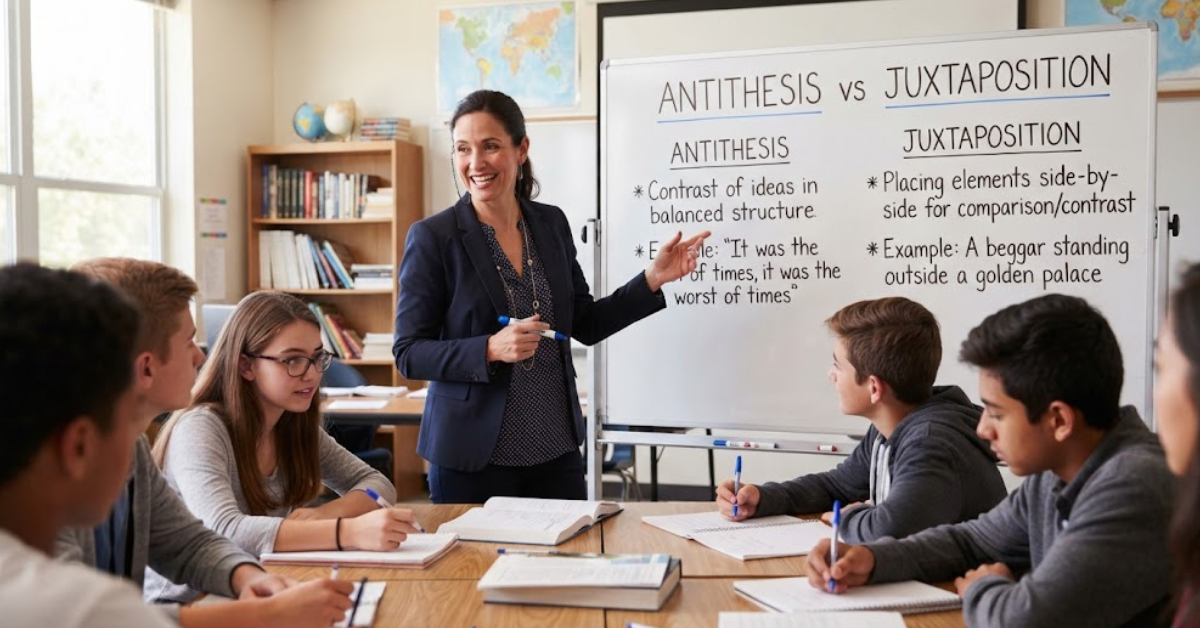
That’s where antithesis vs juxtaposition becomes useful. These literary devices are closely related because both can place contrasting ideas, images, or concepts near one another. However, they aren’t interchangeable: juxtaposition is the broader technique, while antithesis is a more specific form of contrast that often uses balanced or parallel wording.
Understanding the distinction becomes even easier when you bring parallelism vs juxtaposition into the picture.
What Is Juxtaposition?
The juxtaposition literary definition is essentially the placement of two or more things close together so their similarities, differences, or contrasts become noticeable.
Those things could be:
- Characters
- Images
- Objects
- Settings
- Ideas
- Events
- Emotions
- Social conditions
- Words or phrases
The important point is that juxtaposition doesn’t necessarily require the two things to be complete opposites.
For example:
“A wealthy businessman walked past a homeless man sleeping on the sidewalk.”
The two people are placed in the same scene. Their very different circumstances create a contrast, even though the sentence doesn’t explicitly say they’re opposites.
That’s juxtaposition.
Why Do Writers Use Juxtaposition?
Juxtaposition can make readers notice something they might otherwise overlook.
A writer might use it to:
- Highlight differences.
- Reveal similarities.
- Create irony.
- Develop a character.
- Strengthen a theme.
- Create emotional tension.
- Make an image more memorable.
- Encourage readers to compare two ideas.
Because juxtaposition is so broad, it appears in novels, poetry, journalism, film, photography, advertising, speeches, and everyday communication.
What Is Antithesis?
Antithesis is a more specific rhetorical and literary device in which contrasting ideas are expressed in a balanced or deliberately contrasting structure.
For example:
“Many are called, but few are chosen.”
The two clauses present contrasting ideas and use a balanced grammatical structure.
Another familiar example is:
“To err is human; to forgive, divine.”
The sentence contrasts “human” and “divine” while using a similar grammatical structure on both sides.
Antithesis is particularly effective in speeches and persuasive writing because the balanced structure makes an idea easier to remember.
Antithesis vs Juxtaposition: The Main Difference
The easiest way to understand antithesis vs juxtaposition is to think about scope.
Juxtaposition is the broader concept. Antithesis is a specific rhetorical form of contrast.
A juxtaposition simply places things together so readers can compare them.
Antithesis deliberately presents opposing or strongly contrasting ideas, often using parallel grammatical structures.
| Feature | Juxtaposition | Antithesis |
|---|---|---|
| Basic purpose | Places things together for comparison or contrast | Emphasizes opposing ideas |
| Scope | Broad literary technique | More specific rhetorical device |
| Must involve opposites? | No | Usually involves strong contrast |
| Parallel structure required? | No | Often used |
| Can involve images or characters? | Yes | Usually focuses on ideas, statements, or concepts |
| Common in speeches? | Yes | Especially common |
| Example | Rich character beside a poor character | “Easy come, easy go.” |
So while antithesis can involve juxtaposition, not every juxtaposition is an antithesis.
Antithesis Examples
Antithesis often becomes easier to recognize when you see several examples.
Example 1: Opposing Ideas
“Speech is silver; silence is golden.”
The statement contrasts speech with silence.
Example 2: Short and Balanced
“United we stand, divided we fall.”
The two halves present opposing conditions and use a similar grammatical pattern.
Example 3: Love and Hate
“She loved the attention but hated the responsibility.”
The sentence contrasts love and hate within a balanced structure.
Example 4: Action and Inaction
“Some people talk about change; others create it.”
The sentence sets two contrasting approaches against each other.
Example 5: Appearance and Reality
“He looked calm on the outside but was terrified within.”
The contrast between outward appearance and inner emotion creates an antithetical effect.
Juxtaposition Examples
Juxtaposition can be much broader than antithesis.
Example 1: Rich and Poor
“A luxury hotel stood across the street from a crowded shelter.”
The two locations create a striking social contrast.
Example 2: Old and New
“An ancient stone church stood beside a glass skyscraper.”
The old building and modern skyscraper are juxtaposed.
Example 3: Light and Darkness
“The child’s bedroom was brightly lit while the hallway outside was completely dark.”
The contrasting settings create an immediate visual effect.
Example 4: Youth and Age
A novel might place an energetic young character beside an elderly character who moves slowly and speaks cautiously.
The writer doesn’t have to announce the contrast. The side-by-side presentation allows readers to notice it.
Example 5: Beauty and Violence
A peaceful garden might be described immediately before a violent scene.
The contrast between the two settings can make the violence feel even more disturbing.
Antithesis vs Juxtaposition in Literature
Both techniques are powerful in literature, but they operate somewhat differently.
A novelist might use juxtaposition to place two characters with completely different personalities in the same chapter.
For example:
- One character is optimistic.
- Another is cynical.
- One trusts everyone.
- The other trusts nobody.
Their proximity allows readers to compare them.
An author could then use antithesis in dialogue to make that contrast more explicit:
“You see opportunity everywhere. I see danger everywhere.”
The characters’ opposing viewpoints are expressed through balanced language.
That’s an important distinction.
Juxtaposition can let the contrast emerge naturally. Antithesis often states the contrast more deliberately.
What Is Parallelism?
To understand parallelism vs juxtaposition, you first need to know what parallelism means.
Parallelism is the use of similar grammatical structures to express related ideas.
For example:
“She likes reading, writing, and painting.”
The three activities follow the same grammatical pattern.
Another example:
“He came to learn, to practice, and to improve.”
The repeated “to + verb” structure creates grammatical balance.
Parallelism isn’t necessarily about contrast.
That’s what makes it different from antithesis.
Parallelism vs Juxtaposition
The difference between parallelism vs juxtaposition is particularly important because the two devices can appear together.
Parallelism focuses on structure.
Juxtaposition focuses on placement and comparison.
For example:
“He was rich in money but poor in happiness.”
The two ideas are contrasted, and their similar structure strengthens the contrast.
This sentence contains elements of:
- Juxtaposition, because contrasting concepts are placed together.
- Antithesis, because the opposing ideas are deliberately balanced.
- Parallelism, because the grammatical structure helps reinforce the comparison.
Literary devices don’t always operate independently. A single sentence can use several techniques at once.
Antithesis vs Parallelism
Antithesis and parallelism are also closely connected.
Parallelism refers to the repeated or balanced grammatical structure.
Antithesis refers to the contrast between opposing ideas.
For example:
“Ask not what your country can do for you—ask what you can do for your country.”
The two parts use a similar structure while reversing the relationship between “country” and “you.”
That’s why antithesis frequently relies on parallelism.
You could think of it this way:
Parallelism = balanced structure.
Antithesis = contrasting ideas.
Antithetical parallelism = balanced structure used to emphasize contrast.
Juxtaposition Literary Definition in Simple Terms
If you need a short juxtaposition literary definition, remember this:
Juxtaposition is the deliberate placement of two or more things close together to highlight a comparison, contrast, or relationship.
It doesn’t require direct opposition.
A writer could juxtapose:
- Old and new
- Rich and poor
- Beauty and ugliness
- Silence and noise
- Youth and age
- Order and chaos
- Hope and despair
- Reality and fantasy
The contrast can be obvious or subtle.
Is Every Juxtaposition a Contrast?
Not necessarily.
Juxtaposition often creates contrast, but it can also highlight similarities or unusual relationships.
For instance, placing two characters who share the same goals but use completely different methods can be a form of juxtaposition.
The technique encourages readers to examine the two elements together.
That’s why juxtaposition is broader than simply saying “opposites side by side.”
Antithesis vs Juxtaposition in Speeches
Antithesis is especially effective in speeches because audiences can easily remember balanced phrases.
Consider a structure such as:
“We can choose fear, or we can choose courage.”
The contrast is immediate.
The speaker isn’t merely placing two concepts next to each other. The sentence frames them as competing choices.
This makes antithesis useful for:
- Political speeches
- Motivational speeches
- Advertising
- Editorial writing
- Debates
- Persuasive essays
Juxtaposition can also appear in speeches, but antithesis often produces the sharper rhetorical effect.
Why Does Antithesis Make Writing Powerful?
Antithesis works because humans naturally notice contrasts.
When two opposing ideas are presented in a balanced structure, the relationship between them becomes easier to process.
Compare:
“The situation had both advantages and disadvantages.”
with:
“It brought opportunity, but it also brought risk.”
The second version creates a clearer tension between the two ideas.
A strong antithesis can make an argument feel concise, memorable, and persuasive.
Why Is Juxtaposition Effective?
Juxtaposition gives readers something to compare.
Imagine a story that describes a beautiful wedding and then immediately introduces a character mourning the death of a loved one.
The emotional contrast can be powerful.
Neither event has to be described as the opposite of the other. Their placement creates the effect.
This is one reason filmmakers and photographers also rely heavily on juxtaposition.
Antithesis, Juxtaposition, and Oxymoron
Another term that sometimes gets confused with these devices is oxymoron.
An oxymoron places apparently contradictory words together.
Examples include:
- “Deafening silence”
- “Bittersweet”
- “Living dead”
- “Seriously funny”
The difference is mainly one of scale.
An oxymoron is usually a compact combination of contradictory terms.
Antithesis generally contrasts larger ideas or clauses.
Juxtaposition can involve entire characters, scenes, settings, events, or concepts.
Antithesis, Juxtaposition, and Paradox
A paradox is a statement that appears contradictory but may reveal a deeper truth.
For example:
“Less is more.”
The statement initially seems contradictory, but it can express the idea that simplicity can sometimes be more effective than excess.
A useful distinction is:
- Juxtaposition: places things together for comparison or contrast.
- Antithesis: presents opposing ideas in deliberate contrast.
- Oxymoron: combines contradictory terms.
- Paradox: presents an apparent contradiction that can contain a deeper meaning.
- Parallelism: uses matching grammatical structures.
These categories can overlap.
How to Identify Antithesis
When reading a sentence, ask yourself three questions:
- Are two contrasting ideas being presented?
- Are they deliberately balanced against each other?
- Does the wording emphasize the opposition?
If the answer is yes, you’re likely looking at antithesis.
For example:
“She wanted freedom; he wanted control.”
The ideas of freedom and control are opposites, and the sentence presents them in a balanced structure.
How to Identify Juxtaposition
For juxtaposition, ask a slightly different question:
Has the writer deliberately placed two things close enough that their relationship becomes noticeable?
If yes, you may have juxtaposition.
For example:
“The children’s laughter echoed through the hospital.”
The contrast between children’s happiness and a hospital’s serious atmosphere creates juxtaposition.
The sentence doesn’t need to explicitly say “happiness versus suffering.”
The placement does the work.
How to Identify Parallelism
Look at the grammatical structure.
Consider:
“She wanted to learn, to explore, and to create.”
The repeated to + verb structure is parallelism.
Another example:
“He enjoys swimming, running, and cycling.”
Each item follows the same grammatical pattern.
The key question is:
Are similar grammatical structures being repeated?
If so, you’re probably looking at parallelism.
A Simple Way to Remember All Three
Here’s an easy shortcut:
Juxtaposition = Placement
Put things beside each other.
Antithesis = Opposition
Put contrasting ideas against each other.
Parallelism = Structure
Use matching grammatical patterns.
This gives you three simple words to remember:
Juxtaposition → placement
Antithesis → contrast
Parallelism → structure
Once you see those three distinctions, the terminology becomes much less intimidating.
Common Mistakes to Avoid
Mistake 1: Treating Antithesis and Juxtaposition as Synonyms
They’re related, but they’re not identical.
Juxtaposition is broader. Antithesis is a more specific form of deliberate contrast.
Mistake 2: Assuming Juxtaposition Always Means Opposites
It doesn’t.
Two things can be juxtaposed because their differences, similarities, or unusual relationship are worth noticing.
Mistake 3: Assuming Parallelism Means Contrast
Parallelism is about grammatical or structural similarity.
Two parallel ideas can actually agree with each other.
Mistake 4: Looking Only for Specific Keywords
Unlike some grammatical patterns, these literary devices don’t always have a particular signal word.
You need to look at the relationship between the ideas.
Quick Comparison Chart
| Literary Device | Main Idea | What to Look For |
| Juxtaposition | Placement creates comparison | Two elements placed together |
| Antithesis | Contrast creates emphasis | Opposing ideas, often balanced |
| Parallelism | Structure creates rhythm or balance | Repeated grammatical patterns |
| Oxymoron | Contradictory words together | Two opposing terms |
| Paradox | Apparent contradiction | Contradictory statement with deeper meaning |
This chart is useful when studying for an exam because it separates the devices by their primary function.
Frequently Asked Questions
What is the difference between antithesis and juxtaposition?
The main difference between antithesis and juxtaposition is that juxtaposition is a broad technique of placing elements together for comparison or contrast, while antithesis specifically emphasizes opposing ideas, often through balanced or parallel wording.
Is antithesis a type of juxtaposition?
Antithesis can be understood as a specialized form of contrast that often uses juxtaposition. However, not every example of juxtaposition qualifies as antithesis.
What is the juxtaposition literary definition?
The juxtaposition literary definition is the deliberate placement of two or more elements close together to make their similarities, differences, or relationship more noticeable.
What is the difference between parallelism and juxtaposition?
Parallelism vs juxtaposition comes down to structure versus placement. Parallelism uses similar grammatical structures, while juxtaposition places elements together to encourage comparison or contrast.
Is antithesis the same as parallelism?
No. Antithesis focuses on contrasting ideas, while parallelism focuses on similar grammatical or structural patterns. However, antithesis often uses parallelism to make its contrast stronger.
Can a sentence contain juxtaposition and antithesis?
Yes. A sentence can use juxtaposition to place contrasting ideas together and antithesis to express those ideas in a balanced structure.
What is an easy example of antithesis?
“United we stand, divided we fall.”
The sentence contrasts being united with being divided and presents the ideas in a balanced structure.
What is an easy example of juxtaposition?
“A luxury apartment stood beside an abandoned building.”
The two settings are placed next to each other, creating a noticeable contrast.
What is an easy example of parallelism?
“She came to learn, to grow, and to succeed.”
The repeated grammatical structure creates parallelism.
Why do writers use juxtaposition?
Writers use juxtaposition to highlight contrasts or similarities, develop characters, strengthen themes, create irony, and make scenes or ideas more memorable.
Why is antithesis useful in persuasive writing?
Antithesis presents opposing ideas in a clear and memorable way. Its balanced structure can make arguments, speeches, and slogans more powerful and easier to remember.
Conclusion: Antithesis vs Juxtaposition Made Clear
The distinction between antithesis vs juxtaposition becomes much easier when you stop thinking of them as competing definitions.
Juxtaposition is the broader technique of placing elements together so their relationship becomes noticeable. Antithesis is a more specific form of contrast that presents opposing ideas, often using balanced or parallel language.
And when parallelism vs juxtaposition comes into the discussion, remember that parallelism is primarily about grammatical structure, while juxtaposition is about placement and comparison.
A quick memory trick is:
Juxtaposition = placement.
Antithesis = opposition.
Parallelism = structure.
Once you’ve mastered those three ideas, you’ll be able to recognize a much wider range of literary devices—and, more importantly, use them intentionally in your own writing.