Words can do more than simply tell us what something is. They can help us picture it, feel it, and understand it in a completely different way.
That’s where simile vs metaphor comes in. Both are figures of speech used to compare two things, but they make that comparison differently. A simile usually uses words such as “like” or “as,” while a metaphor directly says that one thing is another.
Once you understand that small distinction, identifying and writing similes and metaphors becomes much easier.
What Is a Simile?
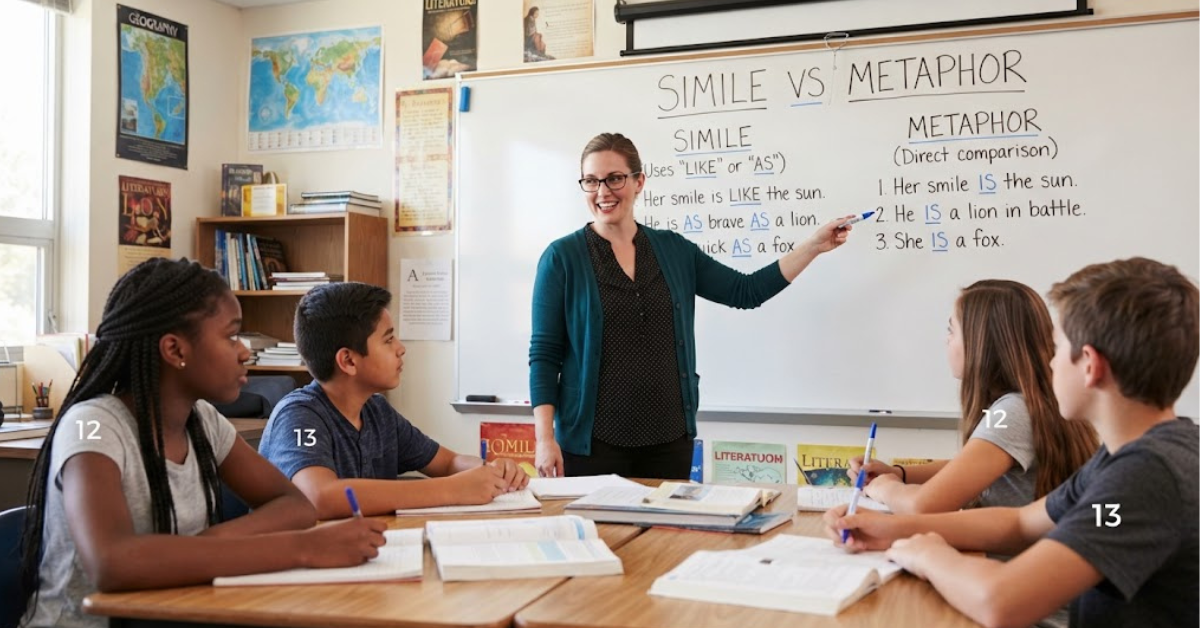
A simile is a figure of speech that compares two different things using an explicit comparison. The words “like” or “as” are commonly used to make the comparison clear.
For example:
“Her smile was like sunshine.”
The person’s smile isn’t literally sunshine. The sentence compares the brightness or warmth of her smile to sunshine.
Another example is:
“He ran like a deer.”
The person isn’t actually a deer. The comparison suggests that he ran quickly or gracefully.
Similes are useful because they allow readers to connect an unfamiliar idea with something they already know.
Common Simile Examples
Here are some everyday examples:
- The baby was as quiet as a mouse.
- The water was as cold as ice.
- She sings like an angel.
- He eats like a horse.
- The car moved like a rocket.
- Her hands were as cold as snow.
- The classroom was as busy as a beehive.
- He was as stubborn as a mule.
Notice the pattern. Each sentence makes a comparison using like or as.
What Is a Metaphor?
A metaphor also compares two different things, but it does so more directly.
Instead of saying that something is like something else, a metaphor describes it as if it actually were that thing.
For example:
“Her smile was sunshine.”
Obviously, her smile isn’t literally a ball of burning gas. The metaphor directly connects her smile with sunshine to suggest warmth, brightness, happiness, or beauty.
Another example:
“He is a rock.”
The person isn’t literally made of stone. The metaphor suggests that he is strong, dependable, or emotionally steady.
Metaphors can make writing more vivid because they don’t simply explain an idea—they give the reader an image to work with.
Simile vs Metaphor: What’s the Difference?
The simplest difference between simile and metaphor is how the comparison is expressed.
| Feature | Simile | Metaphor |
| Purpose | Makes a comparison | Makes a comparison |
| Comparison | Usually explicit | Usually direct |
| Common words | Like, as | Is, are, was, were, or implied comparison |
| Example | “Her voice is like music.” | “Her voice is music.” |
| Effect | Often makes an idea easier to picture | Often creates a stronger or more direct image |
The key distinction is this:
A simile says one thing is like another. A metaphor says one thing is another.
Of course, real-world writing can be more complicated than that simple rule, but it’s an excellent starting point.
Simile vs Metaphor Examples Side by Side
One of the easiest ways to understand simile vs metaphor is to compare them directly.
Example 1: The Sun
Simile:
“The sun was like a golden ball in the sky.”
Metaphor:
“The sun was a golden ball in the sky.”
Both create a similar mental image, but the simile openly signals the comparison with like.
Example 2: A Brave Person
Simile:
“She was as brave as a lion.”
Metaphor:
“She was a lion in the face of danger.”
The simile directly compares her bravery to a lion. The metaphor makes the comparison more forcefully.
Example 3: Someone Who Is Very Busy
Simile:
“He was like a bee, rushing from task to task.”
Metaphor:
“He was a bee, buzzing from one task to another.”
Again, both sentences communicate a similar idea, but the metaphor creates a more direct image.
Example 4: A Difficult Situation
Simile:
“Getting through the exam was like climbing a mountain.”
Metaphor:
“The exam was a mountain.”
The metaphor makes the challenge feel more immediate and substantial.
How to Identify a Simile
If you’re trying to identify a simile in a sentence, look for a direct comparison between two different things.
Then check for words such as:
- Like
- As
- As if
- Similar to
- Resembles
For example:
“The old house looked like a ghost ship.”
The sentence compares the house to a ghost ship.
However, be careful: not every sentence containing “like” is a simile.
For example:
“She likes chocolate.”
That’s not a simile. There’s no comparison happening.
Likewise:
“He works like his father.”
Depending on the intended meaning, this could be a comparison, but context matters. The presence of the word like alone doesn’t automatically make something a simile.
How to Identify a Metaphor
Metaphors can be slightly trickier because they don’t always use an obvious comparison word.
Look for language that describes one thing as another thing when the statement isn’t meant literally.
For example:
“The classroom was a zoo.”
The classroom isn’t literally a zoo. The metaphor suggests that it was noisy, chaotic, or difficult to control.
Another example:
“Time is money.”
Time isn’t literally currency. The metaphor suggests that time is valuable and shouldn’t be wasted.
A useful question to ask is:
“Could this statement literally be true, or is the writer creating an image?”
If it’s creating an image through an implied comparison, you’re probably looking at a metaphor.
What Is the Difference Between Simile and Metaphor in Writing?
Both devices help writers make abstract or complicated ideas easier to understand.
But they can create slightly different effects.
Similes Explain Through Comparison
A simile often gives readers a clear connection.
For example:
“The baby’s skin was as soft as silk.”
The reader immediately understands the intended quality: softness.
Similes can be particularly useful when you want to guide the reader toward a specific characteristic.
Metaphors Create Stronger Images
Metaphors can feel more powerful because they make the comparison directly.
For example:
“The baby’s skin was silk.”
This is obviously not literal, but it creates a striking image.
Metaphors are common in poetry, literature, speeches, advertising, journalism, and everyday conversation because they can communicate complex ideas in very few words.
Simile vs Metaphor in Literature
Writers have used both similes and metaphors for centuries.
They’re especially common in poetry and fiction because literature often needs to communicate emotions and experiences that are difficult to describe literally.
Imagine a writer wants to describe sadness.
A straightforward sentence might say:
“She felt very sad.”
A simile could say:
“Her sadness hung over her like a dark cloud.”
A metaphor could say:
“Her sadness was a dark cloud.”
The second versions give the emotion a physical image. Instead of simply telling readers that the character is sad, they give readers something they can visualize.
Simile vs Metaphor in Everyday Language
You don’t have to be a poet or novelist to use these figures of speech.
People use them constantly in everyday conversation.
You might hear:
- “I’m as busy as a bee.”
- “That test was a nightmare.”
- “She’s like a ray of sunshine.”
- “He’s a walking encyclopedia.”
- “My phone battery is dying.”
- “The kids were wild animals.”
Some metaphors have become so common that we barely notice them.
For example, when someone says:
“I’m drowning in work.”
They’re not literally underwater. The metaphor communicates that they’re overwhelmed by the amount of work they have.
These familiar expressions are sometimes called dead metaphors or conventional metaphors because they’ve become part of ordinary language.
Simile vs Metaphor vs Analogy
Similes and metaphors are sometimes confused with analogies, but they’re not exactly the same.
A simile usually makes a relatively concise comparison:
“Her eyes were like stars.”
A metaphor can be equally concise:
“Her eyes were stars.”
An analogy generally explains a relationship or idea by comparing it with another relationship.
For example:
“Learning a language is like building a house. You need a strong foundation before you can add more complicated structures.”
That’s more than a single comparison. The analogy develops the relationship between the two ideas.
The Simple Difference
- Simile: A comparison using “like” or “as.”
- Metaphor: A direct or implied comparison.
- Analogy: A comparison used to explain a relationship or concept.
Simile vs Metaphor: Common Types
Both devices can appear in different forms.
Direct Metaphor
A direct metaphor clearly identifies one thing with another.
“The city is a jungle.”
Implied Metaphor
An implied metaphor suggests the comparison without directly stating it.
“The lawyer attacked the witness’s argument.”
The lawyer isn’t physically attacking anyone. The word “attacked” creates an implied comparison between arguing and fighting.
Extended Metaphor
An extended metaphor continues a comparison over several sentences or even an entire work.
For example, a writer might describe a person’s career as a journey, using words such as roads, obstacles, destinations, and crossroads throughout the passage.
Extended metaphors can create a consistent theme and help readers understand complicated ideas.
Extended Simile
A simile can also be developed over several sentences.
A writer might compare a difficult relationship to a storm and continue describing the relationship using imagery associated with clouds, wind, thunder, and calm.
Why Do Writers Use Similes and Metaphors?
These figures of speech aren’t just decorative.
They can serve several practical purposes.
1. They Make Writing More Vivid
Compare:
“The forest was quiet.”
with:
“The forest was as quiet as a sleeping room.”
The second sentence gives the reader a stronger sensory impression.
2. They Explain Abstract Ideas
Concepts such as love, fear, time, success, and grief can be difficult to describe literally.
A metaphor can give those abstract concepts a concrete image.
3. They Create Emotion
Compare:
“He was nervous.”
with:
“His thoughts were a swarm of bees.”
The metaphor gives the emotion more energy and intensity.
4. They Make Ideas Memorable
A good metaphor can stick in a reader’s mind long after the sentence is finished.
That’s one reason figurative language appears so frequently in speeches, books, advertisements, and popular culture.
Common Mistakes With Similes and Metaphors
Mistake 1: Assuming Every “Like” Is a Simile
It isn’t.
“I like pizza.”
There is no comparison.
Mistake 2: Assuming Every Metaphor Uses “Is”
Some metaphors are implied.
“The wind whispered through the trees.”
The wind isn’t literally capable of whispering. The sentence uses personification, a related form of figurative language.
Mistake 3: Mixing the Comparison
A comparison should make sense within its context.
An awkward metaphor can confuse the reader instead of helping them.
Mistake 4: Using Too Many Figurative Expressions
A paragraph packed with unrelated metaphors and similes can become difficult to follow.
Good figurative language should strengthen the writing, not overwhelm it.
How to Remember the Difference
If you keep forgetting which is which, try this simple trick:
Simile = Similar
The word simile sounds a little like similar.
A simile says:
“A is like B.”
Metaphor = Direct Comparison
A metaphor says:
“A is B.”
For example:
Simile:
“Her voice is like music.”
Metaphor:
“Her voice is music.”
That’s the basic distinction in one pair of sentences.
How to Write Your Own Similes and Metaphors
Want to create better figurative language? Start with something ordinary.
Let’s say you’re describing someone who is extremely fast.
Step 1: Identify the quality
The quality is speed.
Step 2: Think of something associated with speed
You might think of:
- Lightning
- A rocket
- A cheetah
- A racing car
Step 3: Create a simile
“She ran like lightning.”
Step 4: Turn it into a metaphor
“She was lightning on the track.”
The metaphor is more dramatic, while the simile makes the comparison more explicit.
Frequently Asked Questions About Simile vs Metaphor
What is the main difference between simile and metaphor?
The main difference between simile and metaphor is how they make comparisons. A simile explicitly compares two things, often using “like” or “as,” while a metaphor directly or implicitly describes one thing as another.
Is a simile a type of metaphor?
In a broad sense, both are forms of figurative comparison, and some literary discussions treat similes as closely related to metaphors. However, in standard grammar and literature instruction, simile and metaphor are generally taught as separate figures of speech.
Does a metaphor use “like” or “as”?
A conventional metaphor generally doesn’t need “like” or “as.” It makes a direct or implied comparison instead.
For example:
“The classroom was a zoo.”
Can a sentence contain both a simile and a metaphor?
Yes. A piece of writing can contain multiple types of figurative language, including similes and metaphors.
For example:
“She was a storm, moving through the room like a hurricane.”
The first part uses a metaphor, while the second makes a simile-like comparison.
What is an easy example of a simile?
“He is as quiet as a mouse.”
The sentence compares his quietness to that of a mouse using “as.”
What is an easy example of a metaphor?
“He is a mouse.”
The sentence doesn’t mean he is literally a mouse. It uses the image of a mouse to suggest something about his behavior or personality.
Which is stronger, a simile or a metaphor?
Neither is automatically stronger. A metaphor can feel more direct and forceful, while a simile can make a comparison especially clear and accessible. The best choice depends on the effect the writer wants.
Why are similes and metaphors important?
They make language more vivid, help explain abstract ideas, create emotional impact, and give readers memorable mental images.
Conclusion: Simile vs Metaphor Made Simple
The simile vs metaphor debate becomes much easier once you focus on the way each comparison works.
A simile compares two things explicitly, usually with words such as “like” or “as.” A metaphor makes a more direct or implied comparison, describing one thing as another.
Remember the shortcut:
Simile: “Her eyes are like stars.”
Metaphor: “Her eyes are stars.”
Both can make writing more colorful and memorable, but they don’t create exactly the same effect. If you’re studying figurative language, writing creatively, or simply trying to make your communication more engaging, learning when to use each one is a useful skill.
From here, exploring related concepts such as personification, analogy, hyperbole, and symbolism can give you an even stronger understanding of how figurative language works.