
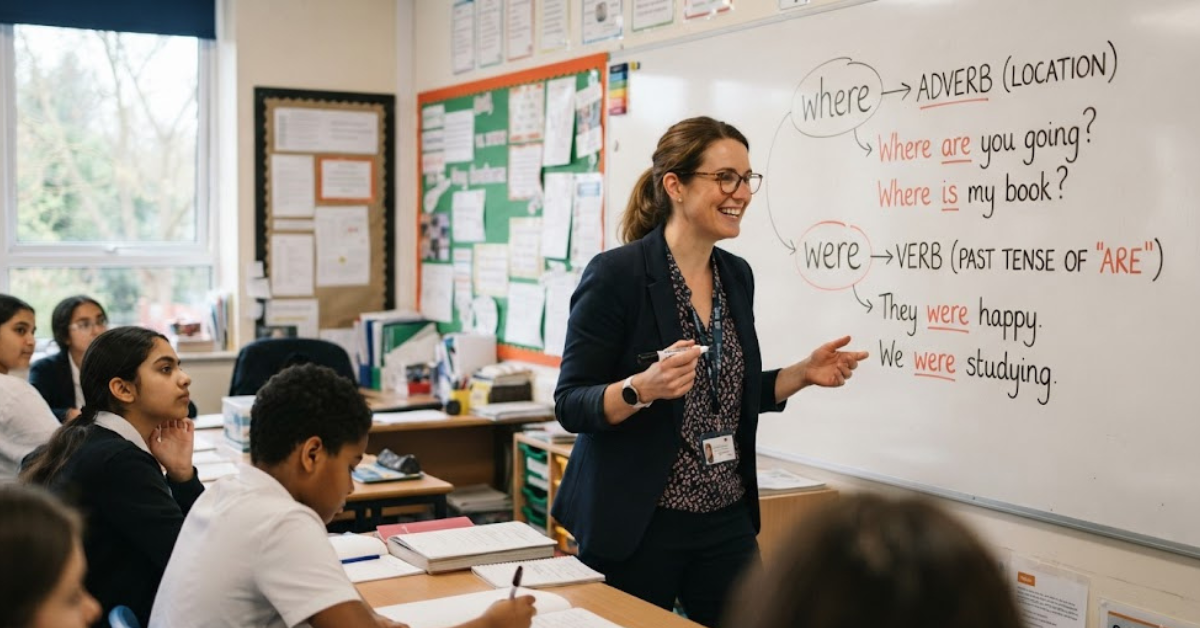
A single letter can completely change the meaning of a sentence. That’s exactly what happens with where or were. Although these two words sound somewhat similar in casual speech, they have completely different meanings and grammatical jobs.
Where is generally used when talking about a place or location, while were is a past-tense form of the verb be. Once you understand what each word does, choosing the correct one becomes much easier.
Where or Were: The Basic Difference
The easiest way to remember the difference is this:
- Where = relates to a place or location
- Were = a past-tense form of “be”
Compare these two sentences:
- Where are you going?
- You were at the store yesterday.
In the first sentence, where asks about a location. In the second, were describes something that happened in the past.
They may look and sound similar, but they cannot normally be used interchangeably.
What Does “Where” Mean?
Where is primarily used to ask about or describe a location. It can function as an adverb, conjunction, or pronoun depending on how it is used in a sentence.
Examples of “Where”
Here are some common examples:
- Where do you live?
- Do you know where my phone is?
- This is the restaurant where we had dinner.
- Where did you put the keys?
- I remember where we first met.
In each example, where has a connection to a place, position, or location.
“Where” in Questions
One of the most common uses of where is asking about a location.
For example:
Where is the nearest grocery store?
Where did you leave your bag?
Where are they going?
A simple trick is to ask yourself: “Am I talking about a place?” If the answer is yes, where is probably the word you need.
What Does “Were” Mean?
Were is a past-tense form of the verb to be. It is commonly used with you, we, they, and plural nouns.
For example:
- You were late.
- We were tired.
- They were excited.
- The children were playing outside.
It can also appear in certain hypothetical or conditional statements:
- If I were you, I would apologize.
- If she were here, she would help us.
The key point is that were is connected to the verb be, not to location.
Where vs. Were Examples
Seeing the words side by side makes the difference easier to understand.
| Word | Meaning | Example |
| Where | A place or location | Where are you going? |
| Were | Past form of “be” | They were at home. |
| Where | Asking about a place | Where is my book? |
| Were | Describing a past state | We were tired. |
Consider this pair:
Where were you yesterday?
This sentence actually uses both words correctly.
- Where asks about the location.
- Were describes the person’s past state or situation.
The answer could be:
I was at home.
Or:
We were at the mall.
How to Remember Where or Were
If you frequently confuse these words, try connecting each one with a simple idea.
Remember “Where” With “Here”
The word where contains a sound similar to here, which is also connected to location.
Think:
Where = location
Examples:
- Where are you?
- Where is the store?
- Where did you go?
Remember “Were” With “Was”
Both were and was are forms of the verb to be.
Think:
Were = past form of “be”
Examples:
- I was tired.
- You were tired.
- They were tired.
This distinction can make the two words much easier to separate.
Where or Were in a Sentence
A useful way to decide which word belongs in your sentence is to look at what you are trying to say.
Use “Where” for a Place
Use where when you are asking about or identifying a location.
Correct:
Where is your office?
Incorrect:
Were is your office?
The second sentence doesn’t work because were cannot be used to ask for a location.
Use “Were” for a Past Situation
Use were when you’re describing something that happened or existed in the past.
Correct:
They were happy yesterday.
Incorrect:
They where happy yesterday.
The second sentence is incorrect because the sentence needs the past form of be: were.
Common Mistakes With Where and Were
Because these words can sound similar, they’re frequently mixed up in writing.
Mistake 1: “Were” Instead of “Where”
Incorrect:
Were did you go?
Correct:
Where did you go?
The sentence asks about a destination, so where is required.
Mistake 2: “Where” Instead of “Were”
Incorrect:
We where very tired.
Correct:
We were very tired.
Here, the sentence describes a past condition, so were is correct.
Mistake 3: Confusing “Where,” “Were,” and “We’re”
There is a third word that often causes confusion: we’re.
These three words are different:
- Where = location
- Were = past form of be
- We’re = contraction of we are
For example:
Where are we going?
We were there yesterday.
We’re going home now.
Understanding all three together can prevent many common spelling and grammar mistakes.
Where, Were, and We’re Compared
| Word | Meaning | Example |
| Where | Location | Where is the station? |
| Were | Past form of “be” | They were busy. |
| We’re | We are | We’re ready to leave. |
A quick substitution test can help with we’re. If you can replace the word with “we are,” then we’re is correct.
For example:
We’re ready.
becomes:
We are ready.
That works, so we’re is correct.
Is “Where or Were” a Common Grammar Mistake?
Yes. Where and were are commonly confused because their pronunciation can be similar, particularly in some accents and conversational speech.
The confusion is especially common when writing quickly, texting, or proofreading informal content. However, their meanings are distinct enough that context usually reveals which word is appropriate.
When editing your writing, pay special attention to sentences containing where, were, and we’re.
Easy Examples to Practice
Try choosing the correct word in each sentence:
- ___ did you buy that shirt?
- They ___ excited about the trip.
- ___ are my keys?
- We ___ at the restaurant last night.
- ___ going to the beach tomorrow.
Answers
- Where did you buy that shirt?
- They were excited about the trip.
- Where are my keys?
- We were at the restaurant last night.
- We’re going to the beach tomorrow.
The pattern becomes much clearer once you focus on the meaning rather than the sound.
A Quick Trick for Choosing the Right Word
When you’re unsure whether to use where or were, follow these steps:
- Look for a location.
If the sentence asks or refers to a place, use where. - Look for a past form of “be.”
If you’re describing someone or something in the past, were may be correct. - Check whether “we are” fits.
If it does, use we’re.
For example:
___ did they go?
This asks about a place or destination, so the answer is where.
They ___ at home.
This describes a past situation, so the answer is were.
FAQ About Where or Were
Is “where” and “were” the same?
No. Where generally refers to a location, while were is a past-tense form of the verb to be.
What is the difference between where and were?
Where is associated with place or location. Were is used as a past form of be, especially with you, we, they, and plural subjects.
How do you use “where” in a sentence?
Use where when asking about or referring to a place.
Example:
Where is the library?
How do you use “were” in a sentence?
Use were to describe a past state or situation.
Example:
They were at school yesterday.
Is “where” a verb?
No. Where is not a verb. Depending on its use, it can function as an adverb, conjunction, or pronoun.
Is “were” past tense?
Yes. Were is a past-tense form of the verb to be.
What is the difference between “were” and “we’re”?
Were is a past-tense verb, while we’re is a contraction meaning “we are.”
For example:
We were tired yesterday.
We’re tired today.
Can “where” and “were” sound the same?
In some accents and contexts, they may sound similar enough to cause confusion. However, they have different meanings and spellings.
Conclusion: Where or Were?
The difference between where or were is simple once you connect each word to its function. Where is used for places and locations, while were is a past form of the verb to be. And don’t forget we’re, which means we are.
When you’re unsure, ask yourself what the sentence is doing. If it concerns a location, choose where. If it describes a past state or action involving be, were is usually the right choice.
A little attention to context can make this commonly confused pair much easier to get right—and help keep your writing clear and polished.