
A single letter can change the meaning of a word completely. That is exactly what happens with amendable vs amenable. The two words look and sound similar, but they describe very different ideas.
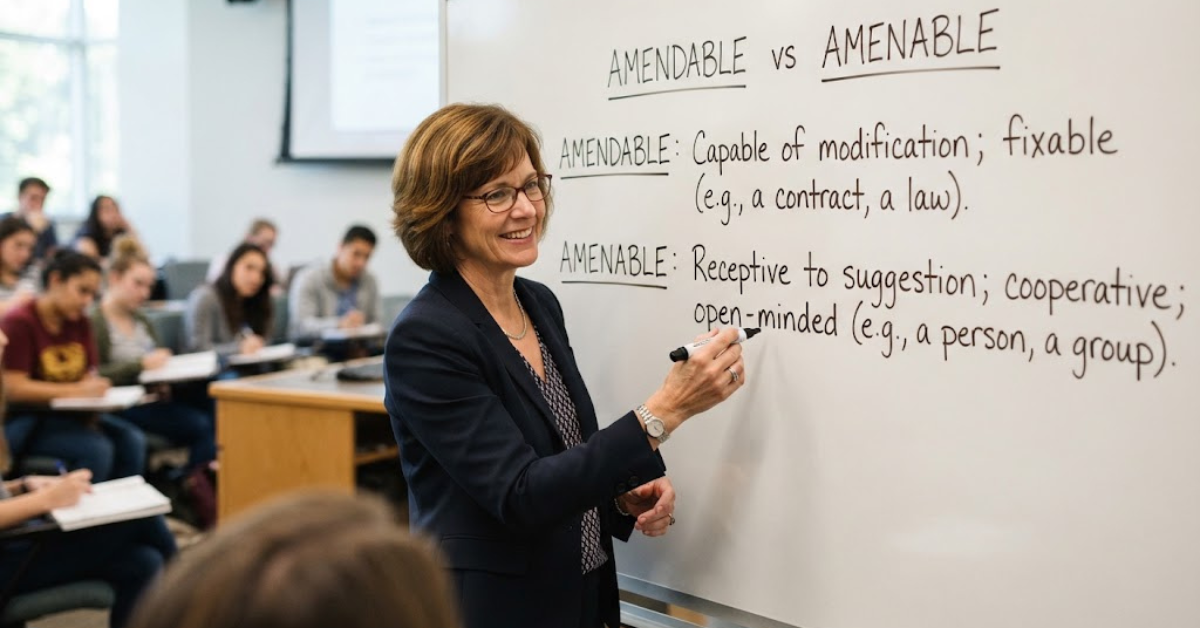
Amendable generally means something can be changed, modified, corrected, or improved. Amenable, on the other hand, usually describes someone who is willing to cooperate or accept a suggestion, although it can also mean something is responsive or capable of being influenced.
The confusion is understandable because both words are often used when talking about change or agreement. Once you understand what each word actually means, however, choosing between them becomes much easier.
Amendable vs Amenable: The Quick Difference
The easiest way to distinguish amendable vs amenable is to focus on what is being described.
| Word | Meaning | Example |
| Amendable | Capable of being changed or modified | The agreement is amendable. |
| Amenable | Willing to cooperate, agree, or be influenced | She is amenable to the proposal. |
In other words:
- Amendable → can be changed
- Amenable → willing to accept or cooperate
For example:
The contract is amendable.
This means the contract can be changed.
Compare that with:
The client is amenable to changing the contract.
Here, amenable describes the client’s willingness to consider the change.
That distinction is the key to understanding these words.
What Does Amendable Mean?
If you’re looking for the amendable meaning, the word generally means capable of being amended, altered, corrected, or modified.
The verb amend means to make changes, usually in order to improve something, correct an error, or adjust an existing document, rule, agreement, or proposal.
Adding the suffix -able gives us amendable, meaning that something can be amended.
For example:
The terms of the contract are amendable.
This tells us that the contract’s terms can be changed.
Other examples include:
- The policy is amendable if circumstances change.
- The document is amendable before publication.
- The proposed legislation is amendable.
- The agreement contains several amendable provisions.
- The plan is amendable as new information becomes available.
Amendable meaning in simple terms
You can remember amendable as:
Able to be changed.
If the thing you’re describing can be revised or altered, amendable may be the appropriate word.
What Does Amenable Mean?
Amenable has a different meaning.
When describing a person, amenable usually means willing to agree, cooperate, or accept a particular idea or suggestion.
For example:
The manager was amenable to the employee’s proposal.
This means the manager was willing to consider or accept the proposal.
You can also use amenable when talking about something that is responsive to a particular treatment, influence, or approach.
For example:
The condition may be amenable to treatment.
Here, the meaning is closer to responsive to or capable of being successfully treated.
Amenable meaning in simple terms
Think of amenable as:
Willing to cooperate or open to influence.
That makes it quite different from amendable.
Amendable vs Amenable: Why Are They Confused?
The confusion between amendable vs amenable is easy to understand.
The words:
- Begin with similar sounds
- Have similar spellings
- Both contain the letters a, m, e, and n
- Can appear in discussions involving change
- Are relatively formal words
But their origins and meanings are different.
Amendable is built from amend, meaning to change or correct something.
Amenable is associated with being responsive, willing, or cooperative.
The simplest solution is not to memorize every dictionary definition. Instead, connect each word with its central idea.
Amendable = changeable
Amenable = cooperative
Amendable vs Amenable in a Sentence
Looking at the words side by side makes the distinction clearer.
Amendable
The contract is amendable before both parties sign it.
The contract can be changed.
Amenable
The client is amenable to revising the contract.
The client is willing to consider a change.
Notice that both sentences involve a contract and a possible change, but the words describe different things.
Amendable describes the contract.
Amenable describes the client’s attitude.
When Should You Use Amendable?
Use amendable when you want to say that something can be changed, revised, corrected, or modified.
It commonly appears in contexts involving:
- Contracts
- Agreements
- Policies
- Laws
- Regulations
- Documents
- Proposals
- Plans
- Procedures
- Written provisions
For example:
The terms of the agreement are amendable by mutual consent.
The meaning is that the terms can be changed if the required conditions are met.
More examples of amendable
The draft is amendable before publication.
Certain sections of the policy are amendable.
The proposal is amendable based on the committee’s feedback.
The legislation contains several amendable provisions.
In each case, amendable refers to the possibility of making a change.
When Should You Use Amenable?
Use amenable when you are describing someone who is willing to cooperate, agree, listen, or consider an idea.
For example:
She is amenable to the suggestion.
This means she is receptive to it.
You can also use amenable to when discussing someone’s willingness to accept a particular course of action.
Common structures include:
amenable to + noun
He is amenable to the proposal.
Or:
amenable to + -ing form
They are amenable to changing the schedule.
The phrase “amenable to” is especially common in professional and formal writing.
More examples of amenable
- The board was amenable to the proposed changes.
- He is amenable to negotiation.
- The team proved amenable to a different approach.
- She was amenable to discussing the issue.
- The client is amenable to extending the deadline.
In each example, the word describes openness or willingness.
Amendable vs Amenable: A Useful Memory Trick
If you regularly mix up these words, try this simple association:
Amendable = Amend it
Amendable contains amend, which means to change or revise.
If you can amend it, it is amendable.
Amenable = Agreeable
Amenable can describe someone who is willing or cooperative.
If someone is amenable, they are generally open to an idea or suggestion.
So remember:
Amendable = can be changed.
Amenable = willing to cooperate.
That two-line distinction covers most everyday uses.
Can a Person Be Amendable?
Technically, amendable is primarily used for something that can be amended or changed.
You would normally say:
The document is amendable.
rather than:
The manager is amendable.
If you’re describing a person’s willingness to cooperate or accept a suggestion, amenable is usually the better choice:
The manager is amenable to the proposal.
This is one of the easiest ways to avoid confusing the words.
Can a Thing Be Amenable?
Yes.
Although amenable is frequently used for people, it can also describe something that is responsive to an action, treatment, approach, or influence.
For example:
The problem is amenable to a relatively simple solution.
Or:
The condition is amenable to treatment.
In these contexts, amenable doesn’t mean that the object has an attitude or willingness. Instead, it means that the thing is responsive or suitable to a particular approach.
This is an important secondary meaning of the word.
Amendable vs Amenable in Business Writing
Both words can appear in professional communication, but they serve different purposes.
Consider a contract negotiation.
You might write:
The agreement is amendable.
This means the agreement can be modified.
Then you might write:
The supplier is amenable to the proposed changes.
This means the supplier is willing to consider them.
A professional sentence could even use both:
The contract is amendable, and the client appears amenable to the proposed revisions.
That sentence is grammatically correct because each word has a separate role.
- Amendable describes whether the contract can be changed.
- Amenable describes the client’s willingness to consider the change.
Amendable vs Amenable in Legal and Formal Contexts
The distinction can be particularly important in legal or administrative writing.
Amendable may describe a document, agreement, statute, pleading, policy, or provision that can be modified.
For example:
The agreement is amendable under the conditions specified in the contract.
Amenable may describe a person, party, organization, or sometimes a legal matter that is receptive to a particular action or approach.
For example:
The parties were amenable to further negotiations.
Because legal writing depends heavily on precise language, substituting one word for the other can change the intended meaning.
When the distinction matters, choose the word based on whether you’re describing the possibility of change or willingness to accept change.
Common Mistakes With Amendable and Amenable
Mistake 1: Using amenable when you mean changeable
Incorrect:
The contract is amenable.
If you mean that the contract can be changed, amendable is more precise.
Better:
The contract is amendable.
Mistake 2: Using amendable for a cooperative person
Incorrect:
The manager is amendable to the proposal.
If you mean the manager is willing to consider the proposal, use amenable.
Correct:
The manager is amenable to the proposal.
Mistake 3: Assuming the words are interchangeable
They aren’t.
Although both words can occur in conversations about changes, they focus on different things.
Mistake 4: Forgetting “amenable to”
A common construction is:
She is amenable to the idea.
or:
She is amenable to making the change.
Using the correct preposition makes the sentence sound natural.
Amendable vs Amenable: More Examples
Here are additional examples to reinforce the difference.
Example 1
The policy is amendable.
Meaning: The policy can be changed.
Example 2
The employee is amenable to the new policy.
Meaning: The employee is willing to accept or consider it.
Example 3
The proposal is amendable after review.
Meaning: The proposal can be revised.
Example 4
The committee is amenable to revising the proposal.
Meaning: The committee is willing to consider revising it.
Example 5
The treatment plan is amendable as new evidence becomes available.
Meaning: The plan can be modified.
Example 6
The patient was amenable to trying a different approach.
Meaning: The person was receptive to the alternative.
The pattern becomes much easier to recognize once you focus on what the adjective describes.
Amendable, Amenable, and Similar Words
Several related words can make the distinction easier to understand.
Amendable vs changeable
Changeable is a broad everyday word meaning capable of being changed.
Amendable is more specific and often suggests changing something that already exists, especially a document, rule, agreement, or proposal.
Amenable vs agreeable
Agreeable can mean willing to agree or pleasant.
Amenable often emphasizes willingness to cooperate, accept a suggestion, or respond to a particular approach.
Amendable vs revisable
Revisable means capable of being reviewed and changed.
It overlaps considerably with amendable, although “amendable” is particularly natural when discussing formal documents, rules, agreements, and provisions.
Amenable vs receptive
Receptive means open to receiving or considering something.
That makes it a useful synonym for one common sense of amenable.
How to Choose the Right Word
When you’re stuck between amendable vs amenable, ask one question:
Am I describing something that can be changed, or someone who is willing to accept a change?
If you’re describing something that can be modified:
Use amendable.
If you’re describing someone’s willingness or openness:
Use amenable.
For example:
The proposal is amendable, but the committee is not amenable to changing it.
This sentence makes the difference particularly clear. The proposal can technically be changed, but the committee isn’t willing to make the change.
Frequently Asked Questions
What is the difference between amendable vs amenable?
Amendable means capable of being changed, modified, corrected, or revised. Amenable generally means willing to cooperate, agree, or consider something, and can also mean responsive to a particular treatment or approach.
What is the amendable meaning?
The amendable meaning is “capable of being amended or changed.” It is commonly used for documents, agreements, policies, proposals, laws, and other things that can be modified.
Is amendable a real word?
Yes. Amendable is a standard English adjective formed from the verb amend. It describes something that can be amended or changed.
What does amenable mean?
Amenable commonly means willing to cooperate, agree, or accept a suggestion. It can also mean responsive or susceptible to a particular action, treatment, or influence.
Is “amenable to” correct?
Yes. Amenable to is a common grammatical construction.
For example:
She is amenable to the idea.
You can also use a gerund after “to”:
She is amenable to changing the schedule.
Is amendable the same as changeable?
They overlap, but they aren’t always identical. Changeable is broader, while amendable often suggests that an existing document, rule, agreement, plan, or provision can be formally modified.
Can amenable describe a thing?
Yes. In addition to describing a person’s willingness, amenable can describe something that is responsive or suitable to a particular treatment, influence, or approach.
Can amendable describe a person?
It is possible in unusual contexts, but it is not the normal choice when describing someone’s willingness to cooperate. Amenable is usually the appropriate word for that meaning.
What is an easy way to remember amendable vs amenable?
Remember:
Amendable = can be changed.
Amenable = willing to cooperate.
If you can amend it, it is amendable. If someone is open to an idea, they may be amenable to it.
Conclusion: Amendable vs Amenable
The difference between amendable vs amenable becomes much clearer once you focus on what each word describes.
Amendable means something can be changed, corrected, modified, or revised. Amenable generally describes someone who is willing to cooperate or accept an idea, although it can also describe something that is responsive to a particular treatment or approach.
A simple rule can help you remember the distinction:
Amendable means “able to be amended.” Amenable means “open or willing to cooperate.”
So, when you’re writing about a contract, policy, proposal, or document that can be changed, choose amendable. When you’re describing a person who is receptive to an idea or willing to cooperate, choose amenable.
Once you connect each word to its core meaning, this commonly confused pair becomes much easier to use correctly.