A single misplaced letter can turn a familiar word into something that looks completely different. Masonry or masonary is a common example, especially because the pronunciation can make the spelling less obvious.
If you are wondering about masonary vs masonry, the answer is straightforward: masonry is the correct spelling. Masonary is a common misspelling and is not the standard spelling used in English.
In this guide, we’ll explain what masonry means, why people spell it “masonary,” how to remember the correct spelling, and how the word is used in construction and everyday writing.
Masonry or Masonary: Which One Is Correct?
The correct spelling is masonry.
| Spelling | Correct? | Example |
| Masonry | Yes | The house has a brick masonry wall. |
| Masonary | No | The house has a brick masonary wall. |
So, if you’re choosing between masonry or masonary, always use masonry in standard English.
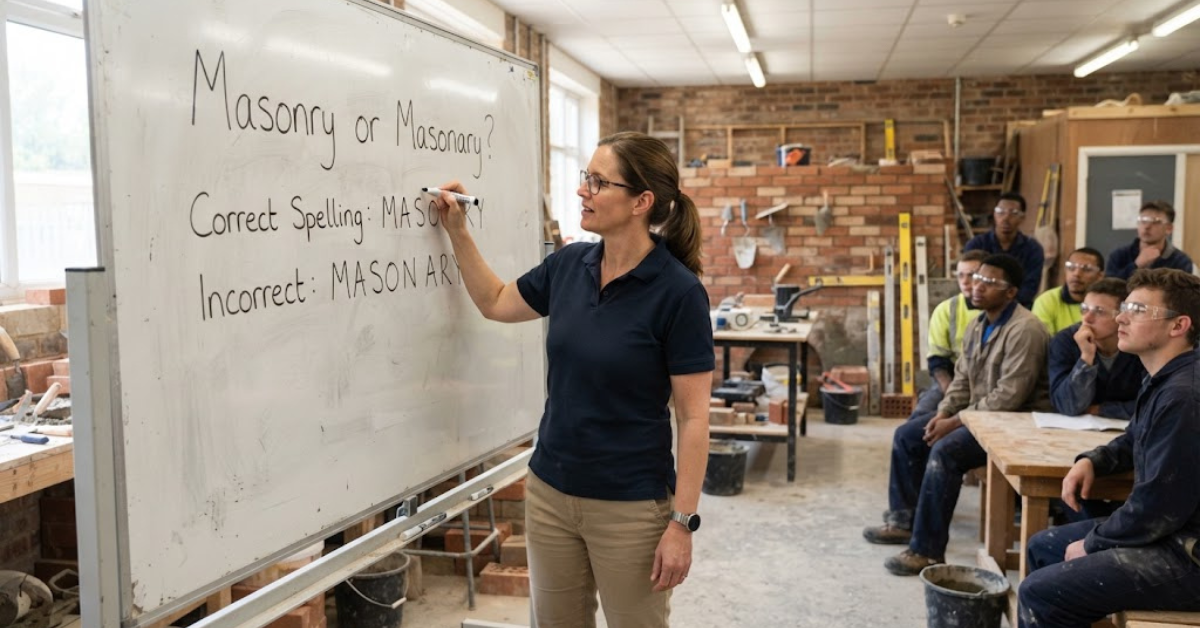
Correct spelling
Masonry
Incorrect spelling
Masonary
The mistake is particularly common in construction-related searches, technical documents, and online discussions, but “masonary” should be corrected to masonry.
What Does Masonry Mean?
Masonry refers to construction using individual units such as bricks, stones, concrete blocks, or similar materials that are assembled to form walls, structures, and other architectural elements.
These units may be joined with mortar, although some masonry systems use dry stacking or other methods.
Masonry construction can be used for:
- Exterior walls
- Interior walls
- Foundations
- Fireplaces
- Chimneys
- Retaining walls
- Paving
- Arches
- Decorative structures
For example:
The contractor specializes in brick masonry.
Here, “masonry” describes the construction technique involving masonry units.
Masonry vs Masonary: What Is the Difference?
When comparing masonary vs masonry, there is no difference in meaning because masonary is simply a misspelling of masonry.
The distinction is:
- Masonry = the correct English word
- Masonary = an incorrect spelling
For example:
Correct:
The building features traditional stone masonry.
Incorrect:
The building features traditional stone masonary.
If you’re writing a construction estimate, report, article, school assignment, or professional document, use masonry.
Why Do People Spell Masonry as Masonary?
The spelling mistake is understandable because masonry does not necessarily sound exactly as it looks.
People may hear the word and mentally connect it with mason, leading them to add an “a” before the final “ry”:
mason + ary → “masonary”
But the established spelling is:
masonry
The word is formed from mason with the suffix -ry, rather than being spelled “masonary.”
A simple way to remember it
Think:
Mason + ry = masonry
There is no extra a before the r.
How to Spell Masonry Correctly
Break the word into its letters:
M-A-S-O-N-R-Y
That gives you:
Masonry
A useful memory trick is to focus on the middle:
MASON + RY
Not:
MASON + ARY
If you remember “mason” followed directly by “ry,” you’re much less likely to write masonary by mistake.
What Is Masonry Construction?
Masonry construction is one of the oldest building techniques still widely used today.
Instead of creating a wall from one continuous material, workers assemble individual units into a larger structure. Depending on the design, those units may be bricks, concrete masonry units, natural stone, or other manufactured materials.
Mortar is commonly used to bond the units together and distribute loads between them.
Common types of masonry
Some major categories include:
- Brick masonry: Uses fired clay or similar bricks.
- Stone masonry: Uses natural or processed stone.
- Concrete block masonry: Uses manufactured concrete masonry units.
- Veneer masonry: Provides an exterior facing layer rather than carrying the primary structural load.
- Reinforced masonry: Incorporates reinforcement to improve structural performance.
The appropriate system depends on the building design, materials, structural requirements, climate, and local building regulations.
Masonry in Modern Construction
Although masonry has ancient roots, it remains important in modern construction.
Brick and concrete masonry can offer several practical advantages, including durability, fire resistance, thermal mass, and relatively low maintenance when properly designed and installed.
However, masonry isn’t automatically the best choice for every project. Factors such as weight, moisture management, seismic requirements, insulation, labor, and local construction practices all need to be considered.
Masonry Materials
The term masonry describes a construction method rather than one specific material.
Common masonry units include:
Brick
The Brick masonry is widely used for walls, façades, partitions, and architectural details.
Brick comes in many sizes, colors, textures, and grades, allowing builders to combine structural and aesthetic considerations.
Natural stone
Stone masonry can provide a distinctive appearance and excellent durability.
Depending on the type of stone and construction method, it may be used for structural walls, retaining walls, foundations, landscaping, and decorative features.
Concrete masonry units
Concrete blocks, often called CMUs, are widely used in commercial and residential construction.
They can be produced in different sizes and configurations and may be reinforced or filled with grout where required by the design.
Masonry and Mortar: Are They the Same Thing?
No. Masonry and mortar are related, but they are not the same thing.
Masonry refers broadly to the construction system or assembled units, while mortar is a material commonly used to bond those units together.
For example, a brick wall may consist of:
- Brick masonry units
- Mortar joints
- Reinforcement where required
- Flashing and moisture-control components
- Other structural or finishing elements
Understanding this distinction is useful when reading construction specifications.
Common Uses of Masonry
You can find masonry in many types of buildings and structures.
Examples include:
- Residential houses
- Commercial buildings
- Schools
- Churches and historic structures
- Retaining walls
- Fireplaces
- Chimneys
- Garden walls
- Walkways and patios
- Architectural façades
Historic masonry is particularly important because many older buildings depend on brick or stone construction for both their structure and appearance.
Common Spelling Mistakes With Masonry
The most common error is adding an unnecessary a:
masonary
Instead, remember:
masonry
Other mistakes can occur when people try to spell the word based entirely on pronunciation.
If you’re writing professionally, a spell checker will usually identify “masonary,” but it is still useful to know the correct form rather than relying entirely on software.
Masonry or Masonary in a Sentence
Here are some examples showing the correct usage.
Correct examples
The contractor repaired the damaged masonry.
The building has a beautiful brick masonry façade.
Water can cause serious problems if masonry is not properly protected.
The engineer inspected the stone masonry wall.
Masonry construction requires careful attention to joints and drainage.
Incorrect examples
The contractor repaired the damaged masonary.
The building has a brick masonary façade.
In each case, masonry is the correct spelling.
Is Masonry a Noun or an Adjective?
Masonry is primarily a noun.
It can refer to the construction technique, the assembled work, or masonry construction as a field.
For example:
The masonry needs repair.
It also appears in compound phrases where it modifies another noun:
masonry wall
masonry construction
masonry units
In these expressions, “masonry” functions as a noun used attributively.
Masonry vs Brickwork
These terms are related but aren’t always identical.
Brickwork specifically refers to construction or work involving bricks.
Masonry is broader and can include brick, stone, concrete blocks, and other masonry units.
So:
Brickwork is a type of masonry.
But not all masonry is brickwork.
For example, a stone wall can be masonry without being brickwork.
Masonry vs Concrete
Masonry and concrete are also different concepts.
Concrete is a composite construction material typically made using cement, water, and aggregates.
Masonry refers to a construction system involving individual masonry units, such as bricks or blocks, that are assembled into structures.
Concrete can be used to manufacture concrete masonry units, but poured concrete and masonry construction are not the same thing.
Frequently Asked Questions About Masonry or Masonary
Is it masonry or masonary?
Masonry is the correct spelling. Masonary is a common misspelling.
What is the difference between masonary and masonry?
There is no difference in meaning. Masonary is an incorrect spelling, while masonry is the standard English word.
How do you spell masonry?
The correct spelling is:
M-A-S-O-N-R-Y — masonry.
What does masonry mean?
Masonry refers to construction using individual units such as bricks, stones, or concrete blocks, usually assembled into walls or other structures.
Is masonry a construction term?
Yes. Masonry is a widely used construction term referring to building with masonry units and the resulting construction.
Is brick masonry the same as brickwork?
They can refer to similar work, but masonry is the broader term. Brickwork specifically refers to construction involving bricks.
Is “masonary” a word?
“Masonary” is not the standard spelling of the construction term. When referring to construction with brick, stone, or blocks, use masonry.
Why is masonry spelled without an “a”?
The standard spelling is masonry, derived from “mason” with the suffix -ry. The extra “a” in “masonary” is an unnecessary addition.
What is masonry used for?
Masonry is used for walls, foundations, façades, fireplaces, chimneys, retaining walls, paving, architectural details, and many other structures.
Conclusion: Masonry or Masonary?
When you’re deciding between masonry or masonary, the correct choice is clear: masonry is the standard English spelling, while masonary is a common spelling mistake.
Remember the word as:
MASON + RY = MASONRY
Masonry is also an important construction term that covers building with materials such as brick, stone, and concrete masonry units. Understanding the word correctly can help you communicate more clearly in construction documents, technical writing, and everyday conversations.
So, the next time you wonder about masonary vs masonry, skip the extra “a” and go with masonry.