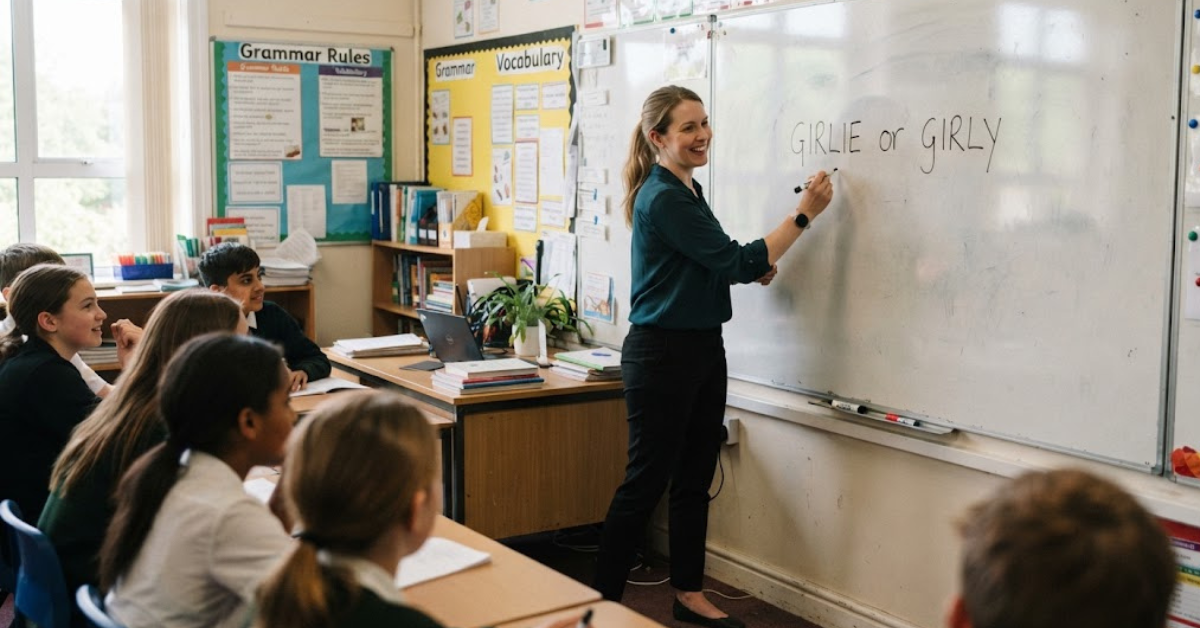
Words that look almost identical can still carry slightly different meanings, tones, and cultural associations. Girlie or girly is a good example. Both words are used in English, and both are connected with ideas traditionally associated with girls or femininity, but they are not always interchangeable.
So, when should you use girlie, and when is girly the better choice? The answer depends largely on context, tone, and the kind of English you are writing.
In this guide, we will explain girlie vs girly, look at their meanings, compare their usage, and show you how to use each word naturally.
Girlie or Girly: Which One Is Correct?
Both girlie and girly are recognized English words, but they are used somewhat differently.
| Word | Common use | Example |
|---|---|---|
| Girly | Describing something traditionally associated with girls or femininity | She has a very girly style. |
| Girlie | Often describing something feminine, cute, playful, or associated with girls; also used as a noun in some contexts | She loves girlie clothes and accessories. |
There is no simple rule saying that one spelling is correct and the other is wrong. Girly and girlie can both be correct, depending on the sentence and intended meaning.
However, girly is generally the more common spelling when you simply want an adjective meaning feminine or characteristic of a girl.
What Does Girly Mean?
Girly is an informal adjective meaning traditionally associated with girls or femininity.
For example:
She chose a pink, girly bedroom design.
Here, “girly” describes the style of the bedroom.
The word can refer to things such as:
- Clothing
- Colors
- Hairstyles
- Decorations
- Hobbies
- Mannerisms
- Fashion
- Interests
For example:
Her outfit has a very girly look.
The room has a bright and girly design.
She prefers girly accessories.
The word is usually informal and can be positive, neutral, teasing, or even critical depending on the speaker and context.
What Does Girlie Mean?
Girlie has a similar meaning but can have a slightly different feel.
It can describe something associated with girls or traditionally feminine interests. In many contexts, it has a more playful, cute, casual, or affectionate tone.
For example:
We had a fun girlie night out.
In British English especially, girlie is commonly used in informal expressions such as “girlie night” or “girlie chat.”
It can also appear in phrases describing feminine clothing, products, or activities:
She likes girlie fashion.
They planned a girlie weekend together.
The exact tone depends heavily on context.
Girly vs Girlie: What Is the Difference?
The main difference between girly vs girlie is often not the basic meaning but the tone and usage.
Girly
Girly is usually straightforward and descriptive.
It commonly means:
- Feminine
- Traditionally associated with girls
- Characteristic of a girl
- Cute or delicate in a traditionally feminine way
Example:
She has a girly sense of style.
Girlie
Girlie can have the same general meaning, but it often sounds more informal, playful, or affectionate.
Example:
We’re having a girlie evening with movies and snacks.
The distinction is not absolute. Native speakers may use the two forms differently depending on region, personal preference, and context.
Girlie or Girly in American English
In American English, girly is generally the more familiar spelling when the word is being used as an adjective.
For example:
That’s a very girly dress.
She likes girly colors.
The decorations are cute but a little girly.
Girlie is still understood, particularly in informal expressions, but it can sound more deliberately playful or stylistic.
If you are writing ordinary American English and simply need an adjective meaning traditionally feminine, girly is usually the safer choice.
Girlie or Girly in British English
British English commonly uses girlie in certain informal expressions.
For example:
We’re planning a girlie weekend.
Let’s have a girlie chat.
That does not mean British English never uses girly. Both forms occur, but girlie has a particularly familiar place in informal British expressions.
Regional preference can therefore influence which form sounds most natural.
Why Are There Two Spellings?
English frequently has multiple spellings that develop through different usage patterns.
In this case, girly and girlie have developed as related forms, and both have become established in informal English.
The ending -y is common when forming adjectives:
- Fun → funny
- Cloud → cloudy
- Girl → girly
The ending -ie also appears in informal and diminutive forms of words:
- Dog → doggie
- Bird → birdie
- Sweet → sweetie
That helps explain why both girly and girlie can feel natural to English speakers.
Girly vs Girlie in Everyday Sentences
Seeing the words in context makes the distinction easier to understand.
Examples with “girly”
She doesn’t like overly girly clothes.
The bedroom has a girly design.
Her handwriting looks surprisingly girly.
She bought a girly pink backpack.
Examples with “girlie”
We’re having a girlie night tonight.
They went on a girlie shopping trip.
She loves all things cute and girlie.
It was a relaxed girlie weekend.
The meanings overlap, but girlie often adds a more informal or playful feeling.
Is Girly a Negative Word?
Not necessarily.
The meaning of girly depends on how it is being used.
Someone might say:
I love this girly dress.
Here, the word is clearly positive.
But someone could also say:
He thinks that hobby is too girly.
In this case, the speaker may be using the word negatively or reinforcing a stereotype.
This is why context matters. “Girly” itself is not inherently positive or negative.
Modern conversations about gender also recognize that colors, hobbies, clothing, and interests are not inherently restricted to one gender. Something described as “girly” is usually being described according to a cultural association rather than an objective characteristic.
Is Girlie a Negative Word?
Girlie is also not inherently negative.
In phrases such as “girlie night” or “girlie weekend,” it can sound friendly and affectionate.
However, like “girly,” it can become dismissive if someone uses it to stereotype a person’s interests or behavior.
For example, calling someone’s hobby “girlie” specifically to suggest that it is less valuable can give the word a negative tone.
The surrounding sentence and the speaker’s intention make a significant difference.
Girlie vs Girly for Fashion
Both words are frequently used when discussing clothing and personal style.
Girly fashion generally refers to clothing with traditionally feminine features, such as:
- Floral patterns
- Pastel colors
- Skirts or dresses
- Bows
- Ruffles
- Delicate accessories
- Decorative details
For example:
She prefers a girly fashion style with floral dresses and soft colors.
Girlie fashion can communicate essentially the same idea, but it may sound more casual or playful:
She loves bright, girlie outfits.
If you are writing a fashion article, girly will usually sound more neutral, while girlie can work when you want a relaxed or conversational tone.
Girlie vs Girly for Social Media
On social media, both spellings can appear frequently.
People may use girly when describing an aesthetic:
My new room has such a girly vibe.
They may use girlie to create a more playful or personal feeling:
Just having a little girlie day with my best friends.
Online language is flexible, so spelling can also be influenced by branding, usernames, captions, and personal style.
Is “Girlie” a Noun?
Yes, girlie can have uses beyond being an adjective, although these uses vary by context.
Historically and informally, “girlie” has sometimes been used as a noun referring to a girl or young woman. However, that usage can sound dated, patronizing, or overly familiar depending on who is speaking and to whom.
There is also a completely different use in expressions such as “girlie magazine,” an older term historically associated with magazines featuring photographs of women.
Because of these associations, it is usually better to use girlie as an adjective in modern everyday writing unless the context clearly calls for another meaning.
Is “Girly” More Common Than “Girlie”?
In many modern contexts, particularly American English, girly is the more straightforward adjective.
For example:
girly clothes
girly hairstyle
girly room
girly aesthetic
However, girlie remains common in informal phrases, especially in British English and casual social settings.
Rather than thinking of one as correct and the other as incorrect, it is more useful to think of them as overlapping words with different stylistic tendencies.
Common Mistakes With Girlie and Girly
Here are a few mistakes worth avoiding.
Mistake 1: Assuming “girlie” is always incorrect
It isn’t. Girlie is a legitimate English word and is appropriate in many informal contexts.
Mistake 2: Assuming the two words always have identical tones
They can have different connotations. “Girlie” often sounds more playful or informal, while “girly” can sound more directly descriptive.
Mistake 3: Ignoring regional English
British and American speakers may have different preferences for certain expressions.
Mistake 4: Using the words without considering context
A word describing someone’s personality, clothing, or interests can carry a different tone depending on how it is used.
How to Choose Between Girly and Girlie
If you’re unsure which word to use, consider these simple guidelines:
- Use “girly” for a general adjective.
Example: “She has a girly style.” - Use “girlie” for a playful or informal expression.
Example: “We’re having a girlie night.” - Consider your audience.
American readers may find “girly” more natural in many contexts, while “girlie” is especially familiar in some British expressions. - Think about tone.
If you want a neutral description, “girly” may be preferable. If you want something cute or playful, “girlie” may fit better. - Read the entire sentence aloud.
Sometimes the more natural option becomes obvious when you hear it.
Frequently Asked Questions About Girlie or Girly
Is “girlie” or “girly” correct?
Both girlie and girly are correct English words. They overlap in meaning, but “girly” is often the more straightforward adjective, while “girlie” can have a more informal, playful, or affectionate tone.
What is the difference between girlie and girly?
The difference between girlie and girly is mainly related to usage and tone. “Girly” commonly describes something traditionally associated with girls or femininity, while “girlie” can express the same idea in a more casual or playful way.
Is “girly” a proper word?
Yes. Girly is a standard informal English adjective. It is commonly used to describe something considered traditionally feminine or associated with girls.
Is “girlie” a proper word?
Yes. Girlie is also an established English word. Its use is particularly common in informal expressions and can vary by region.
Which is more common: girlie or girly?
Girly is generally the more straightforward choice when used as an adjective, particularly in American English. Girlie is also common, especially in informal phrases and some varieties of British English.
Can I say “girly clothes”?
Yes. Girly clothes is a natural expression for clothing that has traditionally feminine styling or features.
Can I say “girlie clothes”?
Yes. Girlie clothes is also understandable and can sound more casual or playful.
Is “girlie” informal?
Often, yes. “Girlie” frequently appears in casual conversations and expressions such as “girlie night” or “girlie weekend.”
Is “girly” informal?
Yes. “Girly” is generally considered an informal adjective. It is common in everyday conversation, fashion discussions, social media, and casual writing.
Should I use girly or girlie in formal writing?
For formal writing, it is usually better to choose a more precise word such as feminine, traditionally feminine, or another description that clearly communicates what you mean. Both “girly” and “girlie” are relatively informal.
Conclusion: Girlie or Girly?
When deciding between girlie or girly, remember that both spellings are valid, but they do not always create exactly the same impression.
Girly is generally the more straightforward adjective for describing something traditionally associated with girls or femininity. Girlie often sounds more informal, playful, cute, or affectionate and appears naturally in expressions such as “girlie night” or “girlie weekend.”
So, in the girlie vs girly debate, there is no single spelling that wins every time. Choose girly when you want a simple descriptive adjective, and consider girlie when the context calls for a more casual or playful tone.
Most importantly, let the sentence, audience, and intended meaning guide your choice.