
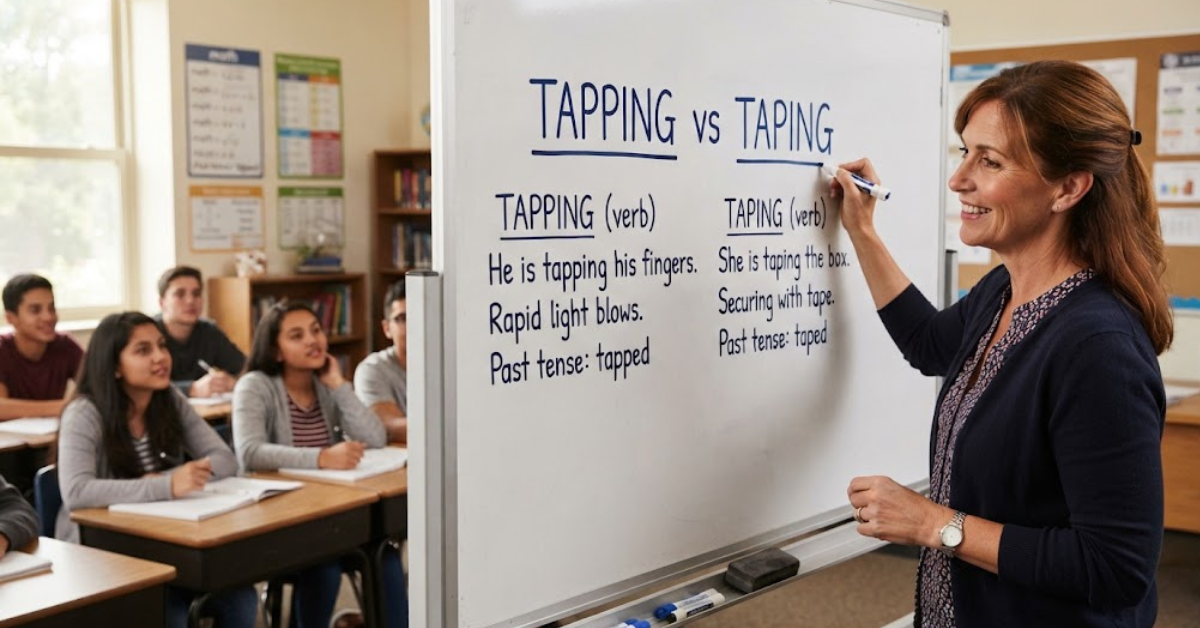
A single letter can completely change the meaning of a word. That is exactly what happens with tapping vs taping. Although both words come from the verb “tap,” “tapping” and “taping” are not interchangeable—and using the wrong one can make an otherwise clear sentence confusing.
The good news is that the difference is easy to understand once you know what each word means. Tapping usually refers to touching, striking, or making light repeated contact, while taping means attaching, covering, or recording something with tape.
Let’s break down the difference between tapping or taping, including when to use tapped or taped.
Tapping vs Taping: The Basic Difference
The simplest way to remember the distinction is:
- Tapping = touching or striking something lightly, usually with a finger or another object.
- Taping = using tape to attach, secure, cover, or record something.
Consider these examples:
She was tapping on her phone.
Here, she is touching the screen repeatedly.
She was taping a package.
Here, she is using adhesive tape to seal the package.
The two words may look almost identical, but they describe completely different actions.
What Does Tapping Mean?
Tapping is the present participle or gerund form of tap. The verb “tap” can mean to touch or strike something lightly, often more than once.
For example:
- He was tapping his foot to the music.
- She kept tapping on the window.
- I am tapping the screen to open the app.
- Someone was tapping me on the shoulder.
- The rain was tapping against the glass.
In each case, the idea involves light contact or a light repeated strike.
Tapping in everyday technology
You will often see tapping used when talking about smartphones, tablets, and touchscreens.
For example:
- Tap the button to continue.
- She is tapping the screen.
- Try tapping the icon twice.
- He accidentally tapped the wrong option.
In these situations, tapping has nothing to do with tape.
What Does Taping Mean?
Taping comes from the verb tape, which means to attach, secure, cover, or record something using tape.
Examples include:
- She is taping the box shut.
- He was taping a poster to the wall.
- They are taping the injured finger.
- We spent the afternoon taping the wires together.
- The crew is taping the television show.
The context makes the meaning clear: something is being attached, secured, covered, or recorded.
Taping can also mean recording
“Taping” has another common meaning: recording audio or video.
For example:
The production team is taping the interview today.
This means the team is recording the interview.
Similarly:
The show was taped in front of a live audience.
Here, taped means recorded.
Taping vs Tapping: Examples Side by Side
One of the easiest ways to remember the difference is to compare the words directly.
| Tapping | Taping |
| Tapping the screen | Taping a box |
| Tapping your foot | Taping a poster |
| Tapping on a door | Taping a cable |
| Tapping someone’s shoulder | Taping an injured ankle |
| Tapping a glass | Taping a television show |
The first column describes light contact or striking. The second describes using tape or making a recording.
Tapping or Taping: Which One Should You Use?
When you’re unsure between tapping or taping, ask yourself one simple question:
Am I touching something, or am I using tape?
If you’re touching or lightly striking something, use tapping.
I was tapping my fingers on the desk.
You’re using tape, use taping.
I was taping the package.
If you’re recording something, taping can also be correct.
They were taping the podcast.
This quick distinction works in most everyday situations.
Why Is Tapping Spelled With Double P?
This is where spelling can become confusing.
The base verb is tap. When adding -ing, the final consonant is doubled:
tap + ing = tapping
The same pattern appears in words such as:
- run → running
- sit → sitting
- stop → stopping
- plan → planning
So tapping has two p’s.
The spelling taping has only one p because it comes from tape, which already ends in a silent “e.”
tape + ing = taping
This difference is important because the spelling also signals a difference in meaning.
Tapped or Taped: What’s the Difference?
The same distinction applies in the past tense.
- Tapped comes from tap.
- Taped comes from tape.
For example:
She tapped me on the shoulder.
She touched or struck my shoulder lightly.
She taped the note to the wall.
She attached the note using tape.
Tapped vs taped examples
Here are a few more examples:
Tapped:
- He tapped on the door.
- She tapped the screen.
- I tapped him on the shoulder.
- The bird tapped against the window.
Taped:
- He taped the box.
- She taped the photograph to the wall.
- We taped the wires together.
- They taped the interview yesterday.
The difference is consistent: tapped involves tapping, while taped involves tape or recording.
Taped vs Tapped in Sentences
If you’re comparing taped vs tapped, look at these pairs:
Example 1
He tapped the table.
He lightly struck the table.
He taped the table.
He attached or covered something on the table with tape.
Example 2
She tapped the button.
She touched the button.
She taped the button.
She attached or covered the button with tape.
Example 3
They tapped on the window.
They lightly knocked on the window.
They taped the window.
They used tape on the window.
The surrounding noun and context can therefore change the meaning dramatically.
Tapping vs Taping in Technology
Technology is one area where these words are frequently confused.
When using a smartphone, you tap the screen.
Correct:
Tap the settings icon.
Incorrect for this meaning:
Tape the settings icon.
However, if someone is physically attaching something to the phone with adhesive tape, taping could be correct.
For example:
He was taping a cracked protective cover to the phone.
So the technology context doesn’t automatically mean “tapping.” You still need to consider the action being described.
Tapping vs Taping in Sports and Fitness
Both words can appear in sports and fitness, but they describe different actions.
Tapping might refer to:
- Tapping your feet
- Tapping a ball
- Tapping a teammate
- Tapping a surface
- Tapping a body part
Taping might refer to:
- Taping an ankle
- Taping a wrist
- Taping a knee
- Taping equipment
- Taping a damaged area
For example:
The player was tapping his foot impatiently.
But:
The trainer was taping his ankle before the game.
These are completely different actions.
Tapping vs Taping in Recording
The word taping can also be confusing because tape was historically used to record audio and video.
Today, people still say:
We’re taping the interview.
Even when the recording is actually digital.
Likewise:
The program was taped yesterday.
This doesn’t necessarily mean physical magnetic tape was used. “Tape” has developed a broader meaning related to recording.
By contrast, tapping has no recording meaning in ordinary usage.
Common Mistakes With Tapping and Taping
Here are some errors worth watching for.
Mistake 1: Writing “taping” when you mean touching
Incorrect:
She was taping the phone screen.
If she is touching the screen, the correct word is:
She was tapping the phone screen.
Mistake 2: Writing “tapping” when you mean using tape
Incorrect:
He was tapping the box shut.
If he is using adhesive tape, write:
He was taping the box shut.
Mistake 3: Confusing “taped” and “tapped”
Remember:
- Tapped = touched or struck lightly.
- Taped = attached with tape or recorded.
A Simple Memory Trick
If you frequently forget the difference between tapping vs taping, try this:
TAP = TOUCH
TAPE = ATTACH or RECORD
Think:
Tap → touch
Tape → tape
The extra p in “tapping” comes from the short word tap, while “taping” comes from tape.
Once you connect each spelling to its meaning, the difference becomes much easier to remember.
Frequently Asked Questions
Is it tapping or taping?
Both are correct words, but they have different meanings. Tapping means touching or striking something lightly, while taping means attaching something with tape or recording something.
What is the difference between tapping vs taping?
The difference is mainly the action involved. Tapping comes from “tap” and refers to light touching or striking. Taping comes from “tape” and refers to using tape or recording something.
Is it tapped or taped?
Both words are correct. Use tapped when something is lightly touched or struck, and taped when something is attached with tape or recorded.
Is “taping” a real word?
Yes. Taping is the standard -ing form of “tape.” It can mean attaching something with tape or recording audio or video.
Is “tapping” spelled with two Ps?
Yes. The correct spelling is tapping, with two p’s. It comes from “tap” + “-ing,” with the final consonant doubled.
What is the difference between taped vs tapped?
Taped means attached with tape or recorded, while tapped means lightly touched or struck.
Is it “tapping the screen” or “taping the screen”?
If you mean touching a touchscreen, the correct phrase is “tapping the screen.” “Taping the screen” would suggest putting tape on the screen.
How do you remember tapping vs taping?
A useful shortcut is tap = touch and tape = attach or record. This makes it easier to choose the correct spelling when writing.
Conclusion: Tapping vs Taping
The difference between tapping vs taping is simple once you connect each word to its root.
Tapping comes from tap and describes light touching or striking. Taping comes from tape and describes attaching something with tape or, in some contexts, recording something.
The same rule applies to the past-tense forms: tapped means lightly touched or struck, while taped means attached with tape or recorded.
So when you’re deciding between tapping or taping, ask yourself: Am I touching something, or am I using tape? That one question will usually give you the right answer.