Sometimes two English words can be so similar that even experienced writers pause before choosing one. Spatter or splatter is a good example. Both words describe small drops or particles being scattered, and in everyday English, they are often used interchangeably.
However, there are subtle differences in meaning, emphasis, and usage. Understanding spatter vs splatter can help you choose the word that fits your sentence more naturally, especially in formal, technical, artistic, or descriptive writing.
Spatter or Splatter: Which Word Is Correct?
Both spatter and splatter are legitimate English words.
The main difference is usually one of degree and manner:
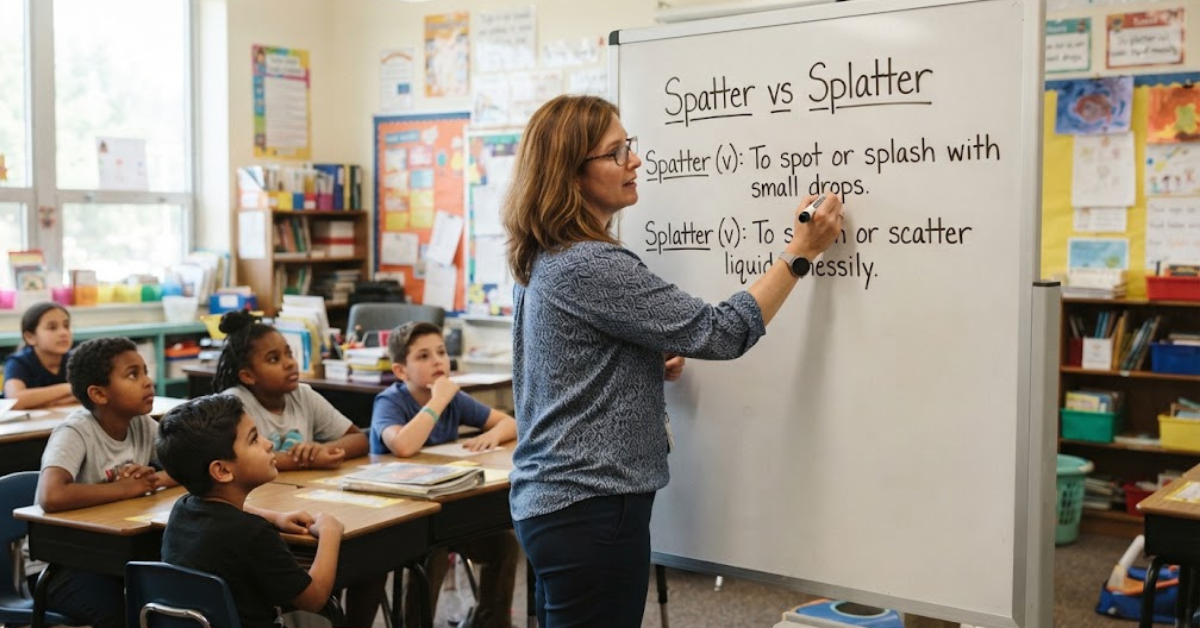
- Spatter generally refers to small drops or particles scattered over a surface.
- Splatter often suggests a larger, messier, or more forceful scattering of liquid or material.
Consider these examples:
Mud spattered across the car.
Mud splattered across the car.
Both sentences are understandable. However, splattered can make the scene sound more dramatic, messy, or forceful.
So, when comparing spatter vs splatter, neither word is inherently incorrect. The best choice depends on the context and the effect you want to create.
What Does Spatter Mean?
Spatter means to scatter small drops or particles over something.
It can be used as both a verb and a noun.
Spatter as a verb
As a verb, spatter means to cause small drops or particles to scatter.
For example:
Rain spattered against the window.
The puddle spattered mud onto his shoes.
Paint spattered the wall during the renovation.
The emphasis is generally on small droplets or particles being scattered.
Spatter as a noun
As a noun, spatter can refer to the drops or marks produced by scattering.
For example:
There was paint spatter on the floor.
The technician cleaned the oil spatter from the machine.
The word is often useful in technical or descriptive contexts because it does not necessarily imply an extremely messy event.
What Does Splatter Mean?
Splatter also means to scatter liquid or small pieces of material, but it often suggests a more noticeable, messy, or energetic action.
Like spatter, it can function as both a verb and a noun.
Splatter as a verb
For example:
The sauce splattered across the stove.
Water splattered onto the floor.
The tires splattered mud onto the sidewalk.
The word splatter often creates a stronger visual impression. It can suggest that liquid or material has been thrown, struck, or scattered with some force.
Splatter as a noun
As a noun, splatter can refer to the scattered material or the resulting marks.
For example:
The kitchen was covered in tomato splatter.
The artist used colorful paint splatter in the background.
In everyday conversation, splatter often sounds more dramatic or messy than spatter.
Spatter vs Splatter: The Main Difference
The simplest way to understand the distinction is to think about the amount of force and messiness involved.
| Word | Typical sense | Example |
| Spatter | Small drops or particles scattered | Rain spattered the window. |
| Splatter | More forceful, widespread, or messy scattering | Mud splattered the car. |
This is a tendency rather than an absolute grammatical rule. There are many situations where either word can work.
Spatter tends to sound more precise
Spatter is often preferred when describing small droplets or scattered marks in a relatively neutral way.
For example:
The surface was covered with paint spatter.
The sentence simply describes small paint marks.
Splatter tends to sound more vivid
Splatter often creates a stronger image.
For example:
Paint splattered across the artist’s clothes.
The sentence suggests a more energetic or messy event.
Difference Between Spatter and Splatter in Everyday English
In casual conversation, native speakers may use spatter and splatter interchangeably.
For instance, you might hear:
Water spattered on the floor.
or:
Water splattered on the floor.
Both can be perfectly understandable.
The difference becomes more noticeable when the writer wants to emphasize a particular quality.
Use spatter when you want to focus on:
- Small drops
- Fine particles
- Scattered marks
- A relatively neutral description
- Technical or specialized contexts
Use splatter when you want to emphasize:
- Messiness
- Force
- Larger or more noticeable drops
- A dramatic visual effect
- Something being scattered widely
Spatter vs Splatter in Art
The distinction can also appear in discussions of painting and visual art.
Paint spatter refers to small drops or marks of paint scattered across a surface.
The artist added paint spatter to the canvas.
Paint splatter can suggest a more energetic or deliberately messy technique.
The artist created a bold splatter effect.
Both expressions are common, and artistic writing often chooses between them based on style rather than a strict technical rule.
The term splatter painting, for example, is strongly associated with energetic paint application and scattered droplets.
Spatter vs Splatter in Cooking
Cooking provides another easy way to see the difference.
When hot oil produces small droplets, you might describe the oil as spattering:
The hot oil began to spatter.
If a sauce or liquid is thrown around more dramatically, splatter may sound more natural:
The tomato sauce splattered all over the stove.
Again, these are tendencies rather than rigid rules.
Spatter vs Splatter in Technical Writing
Spatter is particularly useful in scientific, engineering, medical, and other technical contexts.
For example:
- liquid spatter
- paint spatter
- ink spatter
- blood spatter
- welding spatter
- chemical spatter
Technical writing often favors spatter when describing droplets or particles deposited on a surface.
Splatter is also used in technical contexts, but it can carry a more informal or visually dramatic tone.
Therefore, when writing professionally, consider whether you are describing a measurable phenomenon or simply trying to create a vivid image.
Spatter and Splatter in Forensic Language
The word spatter is especially familiar in forensic terminology.
Terms such as blood spatter have traditionally been used to describe blood droplets distributed across surfaces or objects.
For example:
Investigators examined the blood spatter pattern.
The word refers to the distribution of droplets rather than simply emphasizing that something was messy.
This is one reason spatter can sound more technical and precise than splatter.
Can Spatter and Splatter Be Used as Verbs?
Yes. Both words can function as verbs.
Examples with spatter
The rain spattered the pavement.
Mud spattered his trousers.
Paint spattered across the wall.
Examples with splatter
The rain splattered against the glass.
Mud splattered onto the vehicle.
Sauce splattered across the counter.
The grammatical structure is similar, but splatter often produces a stronger sense of movement and mess.
Can Spatter and Splatter Be Used as Nouns?
Yes. Both can also be nouns.
Spatter as a noun
There was oil spatter on the equipment.
The wall showed signs of paint spatter.
Splatter as a noun
The floor was covered with paint splatter.
The splatter reached the surrounding walls.
In both cases, the noun refers to scattered drops, marks, or material.
Spatter vs Splatter: Which One Should You Use?
If you’re unsure, consider what you want the reader to picture.
Choose “spatter” when:
- You are describing small droplets.
- You want a neutral or technical tone.
- You are discussing a pattern of scattered marks.
- Precision is more important than dramatic effect.
Example:
The machine produced a fine spatter of liquid.
Choose “splatter” when:
- The material is scattered with noticeable force.
- The result is messy or widespread.
- You want more vivid imagery.
- The situation is informal or descriptive.
Example:
The car splattered mud across the clean sidewalk.
Common Mistakes With Spatter and Splatter
One common mistake is assuming that one word is correct and the other is always wrong. That is not the case.
Another mistake is treating the difference as a strict grammatical rule. English usage is more flexible than that.
For example:
Paint spattered the floor.
and
Paint splattered the floor.
can both be correct.
The second version simply tends to sound more energetic or messy.
Is “Spatter” More Formal Than “Splatter”?
Often, spatter can sound more formal or technical, particularly in scientific, industrial, medical, and forensic contexts.
Splatter tends to have a more vivid and informal feel because it naturally evokes a messy or forceful action.
However, formality depends heavily on context. Neither word is inherently informal or incorrect.
Spatter or Splatter: Quick Memory Trick
Here’s an easy way to remember the general distinction:
Spatter = small scattered drops.
Splatter = scattered drops with more force or mess.
Think of splatter as the more dramatic cousin of spatter.
If you are writing a technical description of tiny droplets, spatter may be the better choice. If you’re describing sauce exploding across a kitchen wall, splatter probably fits better.
FAQs About Spatter or Splatter
Is it spatter or splatter?
Both spatter and splatter are correct English words. Spatter generally refers to small drops or particles scattered over a surface, while splatter often suggests a more forceful, widespread, or messy scattering.
What is the difference between spatter and splatter?
The main difference is emphasis. Spatter tends to emphasize small scattered drops or marks, while splatter often suggests greater force, messiness, or visual impact.
Is blood spatter or blood splatter correct?
Blood spatter is the traditional and widely used technical expression, especially in forensic contexts. Blood splatter is also understandable and occurs in general usage, but blood spatter is the more established technical term.
Is paint spatter or paint splatter correct?
Both are correct. Paint spatter emphasizes scattered droplets or marks, while paint splatter often suggests a more energetic or messy painting technique.
Can spatter and splatter be used interchangeably?
Sometimes, yes. In everyday English, the two words frequently overlap. However, spatter often has a more neutral or technical sense, while splatter tends to suggest greater force or messiness.
Is “splatter” a real word?
Yes. Splatter is a standard English word and can be used as both a noun and a verb.
Is “spatter” a real word?
Yes. Spatter is also a standard English word and can function as both a noun and a verb.
Which word is better for formal writing?
It depends on the context. Spatter is often a good choice for technical or scientific descriptions, while splatter may be preferable when you want to emphasize a dramatic or messy effect.
What does spatter mean?
Spatter means to scatter small drops or particles over or onto something. It can also refer to the resulting scattered drops or marks.
What does splatter mean?
Splatter means to scatter liquid or small pieces of material, usually in a more forceful, messy, or widespread manner. It can also refer to the material or marks produced by that action.
Conclusion: Spatter or Splatter?
When comparing spatter or splatter, remember that both are correct words. The difference is mainly one of emphasis and context rather than simple correctness.
Spatter usually describes small drops or particles scattered across a surface and is especially common in technical or forensic language. Splatter often suggests a more forceful, messy, or visually dramatic scattering.
So, when deciding between spatter vs splatter, ask yourself what you want to emphasize. If you’re describing fine droplets or a technical pattern, spatter may be the better fit. If you’re describing a messy or energetic burst of liquid, splatter may sound more natural.
Once you understand that subtle difference, choosing between splatter vs spatter becomes much easier.